AQA · GCSE · Religious Studies
Course version: 8062 · Version from Sept 2018
The concept of avatara, including Krishna, Rama.
Full specification wording
Hinduism - 3.1.4.1 Beliefs and teachings: the concept of avatara, including Krishna, Rama.
The concept of an avatara refers to the physical incarnation or descent of a deity on Earth, most commonly associated with Lord Vishnu, the preserver.
- Point 11 of 19
- 4 key terms
Study notes
From the teaching notes for this specification point.
The idea
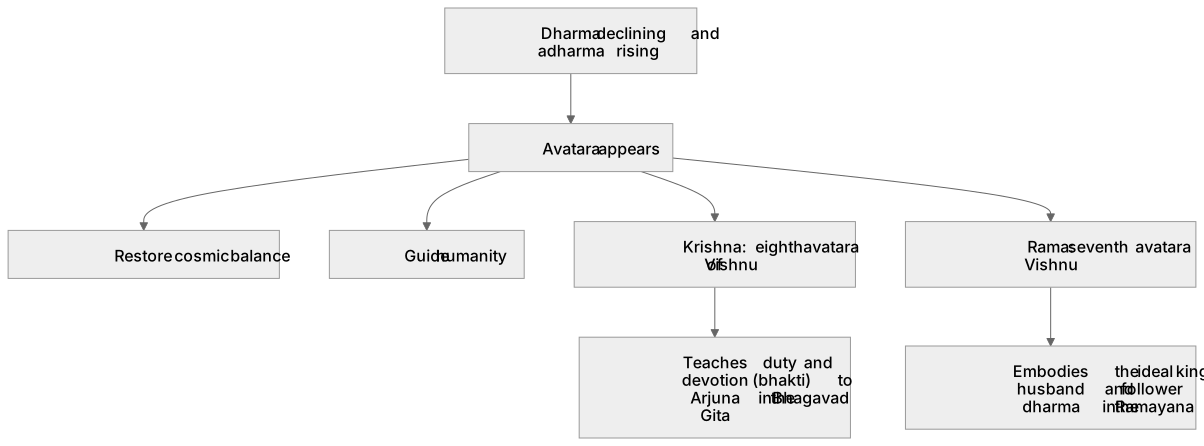
The concept of an avatara refers to the physical incarnation or descent of a deity on Earth, most commonly associated with Lord Vishnu, the preserver. Avataras appear when dharma (righteousness) is declining and adharma (evil) is rising, to restore cosmic balance and guide humanity. Krishna, the eighth avatara of Vishnu, is a central figure in the Bhagavad Gita, teaching the paths of duty and devotion (bhakti) to the warrior Arjuna. Rama, the seventh avatara, is the hero of the Ramayana epic, embodying the ideal king, husband, and follower of dharma through his unwavering commitment to duty and virtue. By studying and worshipping these avataras, Hindus learn moral lessons and develop a personal, loving relationship with the divine.
What earns the marks
- Define 'avatara' as the descent or incarnation of a deity, usually Vishnu, into the physical world.
- Explain the purpose of an avatara: to protect the good, destroy evil, and restore dharma (righteousness).
- Identify Krishna as an avatara who teaches about duty, devotion, and the nature of the soul in the Bhagavad Gita.
- Identify Rama as an avatara who demonstrates the perfect adherence to dharma, duty, and virtue in the Ramayana.
- Discuss how avataras provide a personal form of God (saguna Brahman) for Hindus to worship and relate to.
Common mistakes and how to put them right
Stating that avataras are prophets or messengers.
Put it right: Clarify that avataras are actual physical incarnations of the divine (God in human or animal form), not just human messengers.
Confusing the stories of Rama and Krishna.
Put it right: Ensure Rama is linked to the Ramayana and the rescue of Sita, while Krishna is linked to the Mahabharata, the Bhagavad Gita, and his teachings to Arjuna.
Believing only Vishnu has avataras.
Put it right: While Vishnu's ten avatars (Dashavatara) are the most prominent, acknowledge that other deities can also manifest in physical forms, though Vishnu's are the primary focus of the specification.
Exam tips
- Memorise a quote from the Bhagavad Gita regarding avataras, such as Krishna stating he appears 'whenever there is a decline in righteousness'.
- Use Rama as an example when discussing Hindu ethics, duty, and the concept of dharma in exam answers.
- Link the concept of avatara to the Trimurti, specifically highlighting Vishnu's role as the preserver of the universe.
Try the lesson
The start of the Hinduism - 3.1.4.1 Beliefs and teachings: the concept of avatara, including Krishna, Rama. lesson, made from teaching notes for this specification point.
Have a go first
What is an avatara in Hinduism?
Listen
The concept of an avatara refers to the physical incarnation or descent of a deity on Earth, most commonly associated with Lord Vishnu, the preserver. Avataras appear when dharma (righteousness) is declining and adharma (evil) is rising, to restore cosmic balance and guide humanity. Krishna, the eighth avatara of Vishnu, is a central figure in the Bhagavad Gita, teaching the paths of duty and devotion (bhakti) to the warrior Arjuna. Rama, the seventh avatara, is the hero of the Ramayana epic, embodying the ideal king, husband, and follower of dharma through his unwavering commitment to duty and virtue. By studying and worshipping these avataras, Hindus learn moral lessons and develop a personal, loving relationship with the divine. A strong answer earns marks for these points. Define 'avatara' as the descent or incarnation of a deity, usually Vishnu, into the physical world. Explain the purpose of an avatara: to protect the good, destroy evil, and restore dharma (righteousness). Identify Krishna as an avatara who teaches about duty, devotion, and the nature of the soul in the Bhagavad Gita. Identify Rama as an avatara who demonstrates the perfect adherence to dharma, duty, and virtue in the Ramayana. A common slip: Stating that avataras are prophets or messengers. Instead, Clarify that avataras are actual physical incarnations of the divine (God in human or animal form), not just human messengers. Exam tip: Memorise a quote from the Bhagavad Gita regarding avataras, such as Krishna stating he appears 'whenever there is a decline in righteousness'.
See it
Key words
Say what each word means before you turn the card.
Avatara
Try answering aloud or in your head before turning the card.
Dharma and Adharma
Try answering aloud or in your head before turning the card.
Preservation of the universe
Try answering aloud or in your head before turning the card.
Personal devotion (Bhakti)
Try answering aloud or in your head before turning the card.
See every definition
- Avatara
- The physical incarnation or descent of a deity on Earth, most commonly associated with Lord Vishnu, the preserver.
- Dharma and Adharma
- Righteousness, which is declining when avataras appear, and evil, which is rising at that time, so that cosmic balance is restored.
- Preservation of the universe
- The role of Lord Vishnu, with whom avataras are most commonly associated, appearing to restore cosmic balance and guide humanity.
- Personal devotion (Bhakti)
- A path taught by Krishna in the Bhagavad Gita, through which Hindus develop a personal, loving relationship with the divine.
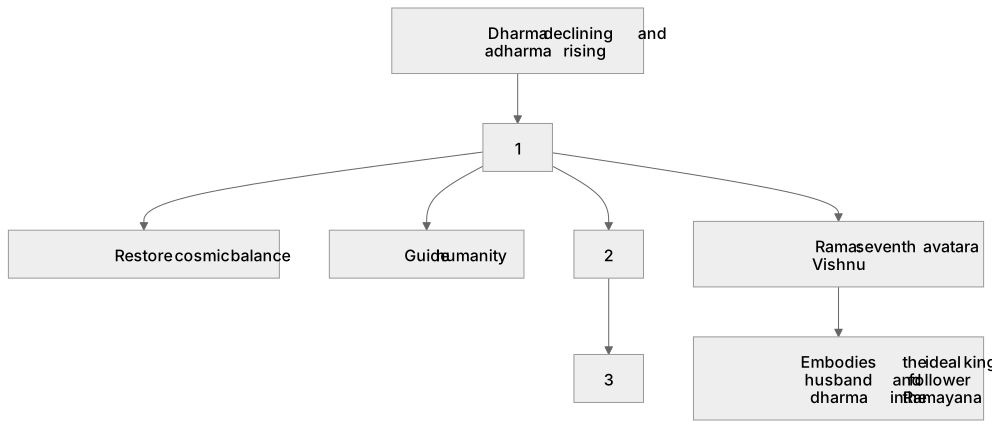
Label the diagram
Some boxes have lost their names. Pick the right name for each number.
1Box 1
2Box 2
3Box 3
There is more to this lesson
The full lesson goes on to check your understanding and help you earn the marks. Create a free account to carry on, with your progress saved.
A week of Premium from your first lesson · Then the free plan continues · No card, no charge
Test your understanding of Hinduism - 3.1.4.1 Beliefs and teachings: the concept of avatara, including Krishna, Rama.
Active recall beats re-reading. Take an instant quiz now to test what you’ve learned and lock it into long-term memory.
A week of Premium from your first lesson · Then the free plan continues · No card, no charge