AQA · GCSE · Religious Studies
Course version: 8062 · Version from Sept 2018
Male and female deities, including Ganesha, Lakshmi, Hanuman, Saraswati
Full specification wording
Hinduism - 3.1.4.1 Beliefs and teachings: male and female deities, including Ganesha, Lakshmi, Hanuman, Saraswati
In Hinduism, the ultimate reality, Brahman, is often understood and worshipped through various male and female deities, each representing different aspects of the divine.
- Point 10 of 19
- 3 key terms
Study notes
From the teaching notes for this specification point.
The idea
In Hinduism, the ultimate reality, Brahman, is often understood and worshipped through various male and female deities, each representing different aspects of the divine. Ganesha, the elephant-headed male deity, is revered as the remover of obstacles and is typically worshipped at the start of new ventures. Lakshmi, a female deity and consort of Vishnu, embodies wealth, prosperity, and purity, often depicted sitting on a lotus. Hanuman, the monkey god, is a male deity symbolising ultimate devotion, strength, and selfless service, particularly to Lord Rama. Saraswati, the female deity of knowledge, music, and the arts, is the consort of Brahma and is often shown playing the veena. Worshipping these diverse deities allows Hindus to connect with specific divine qualities relevant to their personal lives and spiritual needs.
What earns the marks
- Identify Ganesha as the remover of obstacles and the deity of new beginnings.
- Explain Lakshmi's role as the goddess of wealth, prosperity, and purity.
- Describe Hanuman as the embodiment of devotion (bhakti), strength, and loyalty to Rama.
- Recognise Saraswati as the goddess of knowledge, wisdom, music, and the arts.
- Explain that both male and female deities are manifestations of the one supreme Brahman.
Common mistakes and how to put them right
Believing Hindus are polytheistic because they worship many gods.
Put it right: Explain that Hinduism is generally henotheistic or pantheistic; the many male and female deities are different manifestations of the one supreme reality, Brahman.
Confusing the roles of Lakshmi and Saraswati.
Put it right: Lakshmi is associated with wealth and prosperity, whereas Saraswati is associated with knowledge, education, and the arts.
Viewing Hanuman merely as an animal.
Put it right: Understand Hanuman as a powerful deity representing perfect devotion, loyalty, and strength, not just a mythological monkey.
Exam tips
- Use specific examples of when a Hindu might worship a particular deity, such as praying to Ganesha before an exam or starting a business.
- Link the worship of female deities (goddesses) to the concept of Shakti, the divine feminine creative power.
- When evaluating beliefs about God, contrast the personal nature of these deities (saguna Brahman) with the formless ultimate reality (nirguna Brahman).
Try the lesson
The start of the Hinduism - 3.1.4.1 Beliefs and teachings: male and female deities, including Ganesha, Lakshmi, Hanuman, Saraswati lesson, made from teaching notes for this specification point.
Have a go first
Which Hindu deity is widely worshipped as the remover of obstacles and the god of new beginnings?
Listen
In Hinduism, the ultimate reality, Brahman, is often understood and worshipped through various male and female deities, each representing different aspects of the divine. Ganesha, the elephant-headed male deity, is revered as the remover of obstacles and is typically worshipped at the start of new ventures. Lakshmi, a female deity and consort of Vishnu, embodies wealth, prosperity, and purity, often depicted sitting on a lotus. Hanuman, the monkey god, is a male deity symbolising ultimate devotion, strength, and selfless service, particularly to Lord Rama. Saraswati, the female deity of knowledge, music, and the arts, is the consort of Brahma and is often shown playing the veena. Worshipping these diverse deities allows Hindus to connect with specific divine qualities relevant to their personal lives and spiritual needs. A strong answer earns marks for these points. Identify Ganesha as the remover of obstacles and the deity of new beginnings. Explain Lakshmi's role as the goddess of wealth, prosperity, and purity. Describe Hanuman as the embodiment of devotion (bhakti), strength, and loyalty to Rama. Recognise Saraswati as the goddess of knowledge, wisdom, music, and the arts. A common slip: Believing Hindus are polytheistic because they worship many gods. Instead, Explain that Hinduism is generally henotheistic or pantheistic; the many male and female deities are different manifestations of the one supreme reality, Brahman. Exam tip: Use specific examples of when a Hindu might worship a particular deity, such as praying to Ganesha before an exam or starting a business.
See it
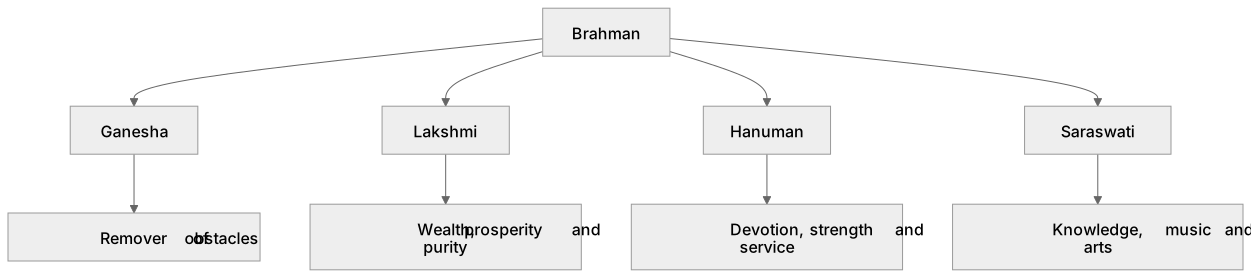
Key words
Say what each word means before you turn the card.
Nature of the divine
Try answering aloud or in your head before turning the card.
Manifestations of Brahman
Try answering aloud or in your head before turning the card.
Divine feminine (Shakti)
Try answering aloud or in your head before turning the card.
See every definition
- Nature of the divine
- Brahman, the ultimate reality, is often understood and worshipped through various male and female deities, each representing different aspects of the divine.
- Manifestations of Brahman
- The many male and female deities are different manifestations of the one supreme reality, Brahman.
- Divine feminine (Shakti)
- The worship of female deities (goddesses) is linked to the concept of Shakti, the divine feminine creative power.
Label the diagram
Some boxes have lost their names. Pick the right name for each number.
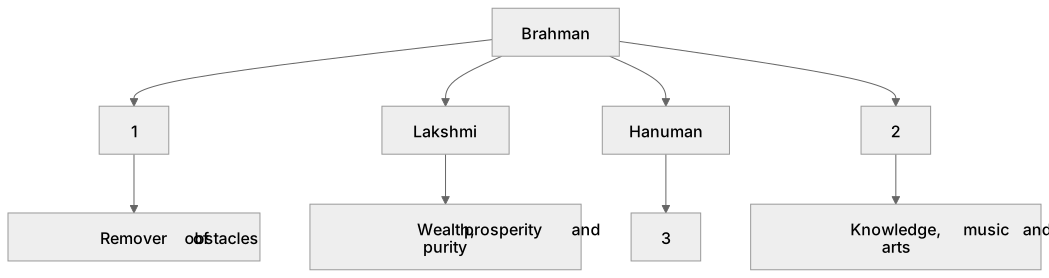
1Box 1
2Box 2
3Box 3
There is more to this lesson
The full lesson goes on to check your understanding and help you earn the marks. Create a free account to carry on, with your progress saved.
A week of Premium from your first lesson · Then the free plan continues · No card, no charge
Test your understanding of Hinduism - 3.1.4.1 Beliefs and teachings: male and female deities, including Ganesha, Lakshmi, Hanuman, Saraswati
Active recall beats re-reading. Take an instant quiz now to test what you’ve learned and lock it into long-term memory.
A week of Premium from your first lesson · Then the free plan continues · No card, no charge