AQA · GCSE · Religious Studies
Course version: 8062 · Version from Sept 2018
Hinduism - 3.1.4.2 Practices: Holi.
Holi, known as the Festival of Colours, is a vibrant Hindu spring festival celebrating the triumph of good over evil and the arrival of spring.
- Point 12 of 26
- 4 key terms
Study notes
From the teaching notes for this specification point.
The idea
Holi, known as the Festival of Colours, is a vibrant Hindu spring festival celebrating the triumph of good over evil and the arrival of spring. It originates from the story of Prahlad and Holika, where the devoted Prahlad was saved from fire by Lord Vishnu, while the demoness Holika burned. The night before Holi, Hindus light bonfires to symbolise the burning of Holika and the destruction of evil. The next day involves joyous celebrations where people throw coloured powders (gulal) and water at each other. This practice breaks down social barriers, uniting people regardless of caste, gender, or age, and encourages forgiveness, renewal, and devotion to God.
What earns the marks
- Identify Holi as the spring Festival of Colours celebrating the victory of good over evil.
- Explain the story of Prahlad and Holika, highlighting the theme of divine protection for true devotees.
- Describe the main customs, including lighting the Holika bonfire and throwing coloured powders (gulal).
- Analyse the social significance of Holi in temporarily dissolving caste and social boundaries to promote equality and unity.
Common mistakes and how to put them right
Confusing the story of Holi with Diwali.
Put it right: Ensure Holi is linked to Prahlad, Holika, and Vishnu, not Rama and Sita.
Describing Holi merely as a fun colour run.
Put it right by explaining the deep religious significance of devotion and the destruction of evil.
Forgetting the bonfire ritual.
Put it right by including the Holika Dahan (bonfire) on the eve of Holi as a crucial part of the festival.
Exam tips
- Reference the story of Prahlad to illustrate the concept of unwavering faith and Vishnu's role as the preserver.
- Discuss how throwing coloured powder symbolises equality, as everyone looks the same covered in colour, temporarily erasing social divisions.
- Use Holi as a strong example in questions about how Hindu practices promote community cohesion and forgiveness.
Try the lesson
The start of the Hinduism - 3.1.4.2 Practices: Holi. lesson, made from teaching notes for this specification point.
Have a go first
Which of the following best describes the primary focus of the Hindu festival of Holi?
Listen
Holi, known as the Festival of Colours, is a vibrant Hindu spring festival celebrating the triumph of good over evil and the arrival of spring. It originates from the story of Prahlad and Holika, where the devoted Prahlad was saved from fire by Lord Vishnu, while the demoness Holika burned. The night before Holi, Hindus light bonfires to symbolise the burning of Holika and the destruction of evil. The next day involves joyous celebrations where people throw coloured powders (gulal) and water at each other. This practice breaks down social barriers, uniting people regardless of caste, gender, or age, and encourages forgiveness, renewal, and devotion to God. A strong answer earns marks for these points. Identify Holi as the spring Festival of Colours celebrating the victory of good over evil. Explain the story of Prahlad and Holika, highlighting the theme of divine protection for true devotees. Describe the main customs, including lighting the Holika bonfire and throwing coloured powders (gulal). Analyse the social significance of Holi in temporarily dissolving caste and social boundaries to promote equality and unity. A common slip: Describing Holi merely as a fun colour run. Instead, explaining the deep religious significance of devotion and the destruction of evil. Exam tip: Reference the story of Prahlad to illustrate the concept of unwavering faith and Vishnu's role as the preserver.
See it
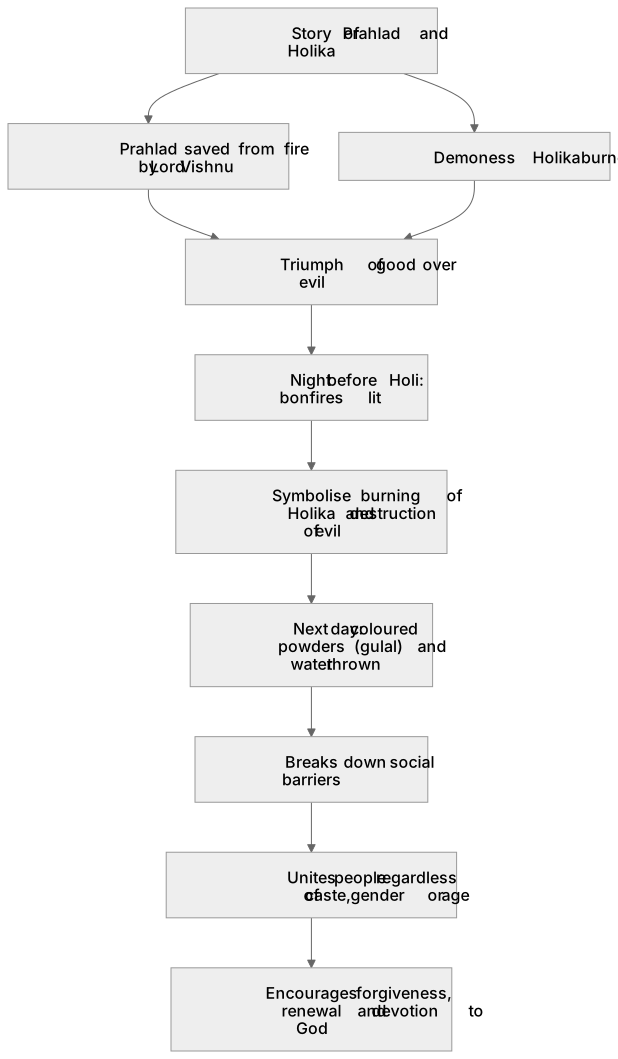
Key words
Say what each word means before you turn the card.
Good over evil
Try answering aloud or in your head before turning the card.
Equality and unity
Try answering aloud or in your head before turning the card.
Devotion (Bhakti)
Try answering aloud or in your head before turning the card.
Renewal and spring
Try answering aloud or in your head before turning the card.
See every definition
- Good over evil
- Holi celebrates the triumph of good over evil, shown by the devoted Prahlad being saved from fire while the demoness Holika burned.
- Equality and unity
- Throwing coloured powders breaks down social barriers, uniting people regardless of caste, gender, or age, and encourages forgiveness and renewal.
- Devotion (Bhakti)
- Holi encourages devotion to God, and the story shows divine protection for true devotees such as the devoted Prahlad.
- Renewal and spring
- Holi is a vibrant Hindu spring festival celebrating the arrival of spring and encouraging renewal.
Label the diagram
Some boxes have lost their names. Pick the right name for each number.
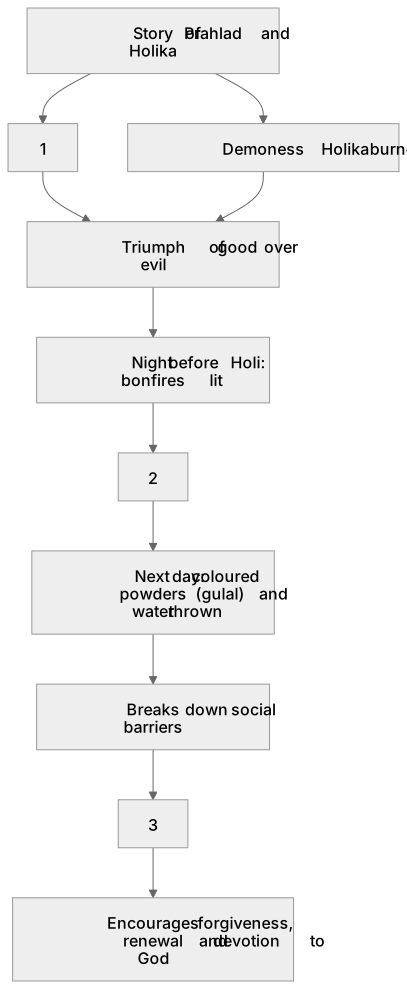
1Box 1
2Box 2
3Box 3
There is more to this lesson
The full lesson goes on to check your understanding and help you earn the marks. Create a free account to carry on, with your progress saved.
A week of Premium from your first lesson · Then the free plan continues · No card, no charge
Test your understanding of Hinduism - 3.1.4.2 Practices: Holi.
Active recall beats re-reading. Take an instant quiz now to test what you’ve learned and lock it into long-term memory.
A week of Premium from your first lesson · Then the free plan continues · No card, no charge