AQA · GCSE · Religious Studies
Course version: 8062 · Version from Sept 2018
Hinduism - 3.1.4.2 Practices: knowledge (jnana yoga)
Jnana yoga is the path of knowledge and wisdom, focusing on intellectual and spiritual realisation to achieve moksha.
- Point 16 of 26
- 3 key terms
Study notes
From the teaching notes for this specification point.
The idea
Jnana yoga is the path of knowledge and wisdom, focusing on intellectual and spiritual realisation to achieve moksha. It involves intense study of sacred scriptures, such as the Upanishads, often under the guidance of a guru. Practitioners use deep meditation and philosophical reflection to distinguish between what is real (Brahman, the eternal spirit) and what is an illusion (maya, the temporary material world). By realising the true identity of the self (Atman) as one with Brahman, a Hindu can break free from the cycle of samsara. Because it requires significant time, discipline, and intellectual effort, jnana yoga is traditionally considered the most difficult path, often pursued by ascetics or priests.
What earns the marks
- Jnana yoga is the spiritual path of knowledge, wisdom, and intellectual reflection.
- The goal is to achieve self-realisation, understanding that the individual soul (Atman) is identical to the supreme spirit (Brahman).
- Practitioners seek to overcome ignorance (avidya) and see past the illusion (maya) of the material world to attain moksha.
Common mistakes and how to put them right
Equating jnana yoga with general academic learning.
Put it right: It is specifically spiritual knowledge and self-realisation, not just acquiring facts.
Stating that anyone can easily practice jnana yoga.
Put it right: It is widely considered the most difficult and rigorous path, requiring immense discipline and time.
Confusing the focus of jnana yoga with devotion to a personal deity.
Put it right: Jnana yoga focuses on the impersonal, philosophical realisation of Brahman, whereas bhakti yoga focuses on devotion.
Exam tips
- Mention the role of a guru and the study of scriptures (like the Upanishads) when explaining how jnana yoga is practised.
- Use key Sanskrit terms such as Atman, Brahman, and maya to demonstrate accurate subject knowledge.
- When evaluating, argue why jnana yoga might be less practical for a householder with a family compared to karma or bhakti yoga.
Try the lesson
The start of the Hinduism - 3.1.4.2 Practices: knowledge (jnana yoga) lesson, made from teaching notes for this specification point.
Have a go first
Which of the following best describes the Hindu practice of jnana yoga?
Listen
Jnana yoga is the path of knowledge and wisdom, focusing on intellectual and spiritual realisation to achieve moksha. It involves intense study of sacred scriptures, such as the Upanishads, often under the guidance of a guru. Practitioners use deep meditation and philosophical reflection to distinguish between what is real (Brahman, the eternal spirit) and what is an illusion (maya, the temporary material world). By realising the true identity of the self (Atman) as one with Brahman, a Hindu can break free from the cycle of samsara. Because it requires significant time, discipline, and intellectual effort, jnana yoga is traditionally considered the most difficult path, often pursued by ascetics or priests. A strong answer earns marks for these points. Jnana yoga is the spiritual path of knowledge, wisdom, and intellectual reflection. The goal is to achieve self-realisation, understanding that the individual soul (Atman) is identical to the supreme spirit (Brahman). Practitioners seek to overcome ignorance (avidya) and see past the illusion (maya) of the material world to attain moksha. A common slip: Equating jnana yoga with general academic learning. Instead, it is specifically spiritual knowledge and self-realisation, not just acquiring facts. Exam tip: Mention the role of a guru and the study of scriptures (like the Upanishads) when explaining how jnana yoga is practised.
See it
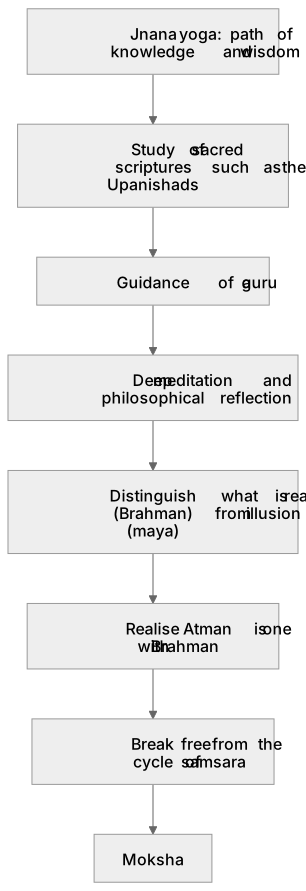
Put it in order
Put these steps in the order they happen.
- 1. Distinguish what is real (Brahman) from illusion (maya)
- 2. Moksha
- 3. Realise Atman is one with Brahman
- 4. Jnana yoga: path of knowledge and wisdom
- 5. Study of sacred scriptures such as the Upanishads
- 6. Break free from the cycle of samsara
- 7. Guidance of a guru
- 8. Deep meditation and philosophical reflection
Key words
Say what each word means before you turn the card.
Illusion (maya)
Try answering aloud or in your head before turning the card.
Atman and Brahman
Try answering aloud or in your head before turning the card.
Liberation (moksha)
Try answering aloud or in your head before turning the card.
See every definition
- Illusion (maya)
- The temporary material world, which practitioners of jnana yoga use deep meditation and philosophical reflection to see past.
- Atman and Brahman
- The self and the eternal spirit, whose true identity as one is realised by a Hindu to break free from the cycle of samsara.
- Liberation (moksha)
- The goal achieved through the path of knowledge and wisdom, focusing on intellectual and spiritual realisation.
Label the diagram
Some boxes have lost their names. Pick the right name for each number.
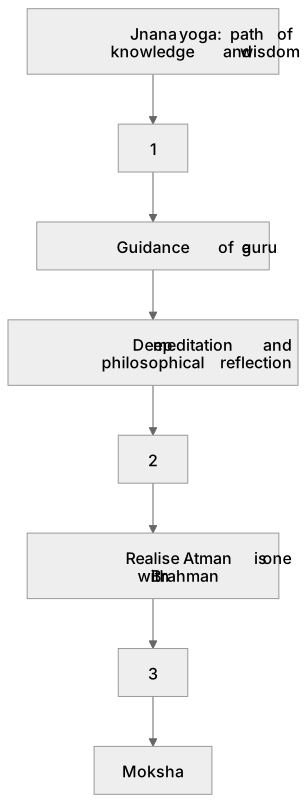
1Box 1
2Box 2
3Box 3
There is more to this lesson
The full lesson goes on to check your understanding and help you earn the marks. Create a free account to carry on, with your progress saved.
A week of Premium from your first lesson · Then the free plan continues · No card, no charge
Test your understanding of Hinduism - 3.1.4.2 Practices: knowledge (jnana yoga)
Active recall beats re-reading. Take an instant quiz now to test what you’ve learned and lock it into long-term memory.
A week of Premium from your first lesson · Then the free plan continues · No card, no charge