AQA · GCSE · Religious Studies
Course version: 8062 · Version from Sept 2018
Hinduism - 3.1.4.2 Practices: action (karma yoga)
Karma yoga is the path of unselfish action, where Hindus perform their duties (dharma) without attachment to the results or personal reward.
- Point 15 of 26
- 3 key terms
Study notes
From the teaching notes for this specification point.
The idea
Karma yoga is the path of unselfish action, where Hindus perform their duties (dharma) without attachment to the results or personal reward. It teaches that every action should be offered to the divine, transforming ordinary daily tasks into acts of worship. For example, a person might volunteer at a charity, care for their family, or perform their job diligently, not for praise or money, but because it is the right thing to do. By acting selflessly, Hindus aim to purify their mind, reduce the ego, and accumulate positive karma, which ultimately helps them progress towards moksha (liberation from the cycle of rebirth). It is considered highly accessible because it can be practised by anyone in their everyday life.
What earns the marks
- Karma yoga is the path of selfless action and fulfilling one's dharma without seeking personal reward.
- Actions are offered to God, making everyday duties a form of spiritual worship.
- Practising karma yoga generates positive karma, aiding the soul's journey towards moksha.
Common mistakes and how to put them right
Confusing karma yoga with just 'good karma'.
Put it right: Karma yoga is a specific spiritual path of selfless action, not just the universal law of cause and effect.
Thinking karma yoga requires leaving normal life.
Put it right: It is specifically designed to be practised within everyday life and duties (dharma).
Assuming the goal is to gain wealth or praise.
Put it right: The core principle is acting without attachment to the fruits or results of the action.
Exam tips
- Link karma yoga to the concept of dharma (duty) to show a deeper understanding of Hindu practices.
- Use the Bhagavad Gita as a source of wisdom, as Krishna advises Arjuna to act selflessly without attachment to the results.
- Contrast karma yoga with other paths (like jnana or bhakti) to evaluate which might be the most accessible for modern Hindus.
Try the lesson
The start of the Hinduism - 3.1.4.2 Practices: action (karma yoga) lesson, made from teaching notes for this specification point.
Have a go first
Which of the following best defines the practice of karma yoga in Hinduism?
Listen
Karma yoga is the path of unselfish action, where Hindus perform their duties (dharma) without attachment to the results or personal reward. It teaches that every action should be offered to the divine, transforming ordinary daily tasks into acts of worship. For example, a person might volunteer at a charity, care for their family, or perform their job diligently, not for praise or money, but because it is the right thing to do. By acting selflessly, Hindus aim to purify their mind, reduce the ego, and accumulate positive karma, which ultimately helps them progress towards moksha (liberation from the cycle of rebirth). It is considered highly accessible because it can be practised by anyone in their everyday life. A strong answer earns marks for these points. Karma yoga is the path of selfless action and fulfilling one's dharma without seeking personal reward. Actions are offered to God, making everyday duties a form of spiritual worship. Practising karma yoga generates positive karma, aiding the soul's journey towards moksha. A common slip: Confusing karma yoga with just 'good karma'. Instead, karma yoga is a specific spiritual path of selfless action, not just the universal law of cause and effect. Exam tip: Link karma yoga to the concept of dharma (duty) to show a deeper understanding of Hindu practices.
See it
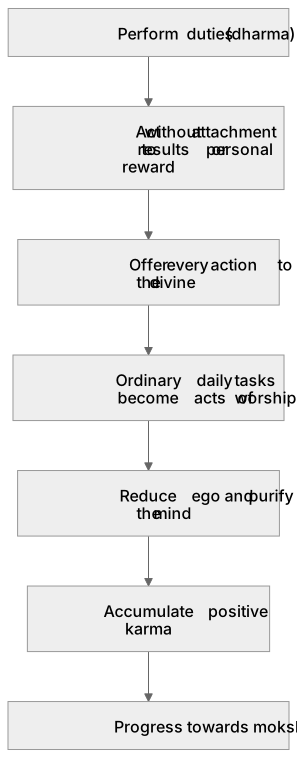
Put it in order
Put these steps in the order they happen.
- 1. Progress towards moksha
- 2. Accumulate positive karma
- 3. Offer every action to the divine
- 4. Reduce ego and purify the mind
- 5. Perform duties (dharma)
- 6. Act without attachment to results or personal reward
- 7. Ordinary daily tasks become acts of worship
Key words
Say what each word means before you turn the card.
Moksha (liberation)
Try answering aloud or in your head before turning the card.
Selflessness
Try answering aloud or in your head before turning the card.
Spiritual paths (margas)
Try answering aloud or in your head before turning the card.
See every definition
- Moksha (liberation)
- Liberation from the cycle of rebirth, which positive karma ultimately helps a Hindu progress towards.
- Selflessness
- Acting without attachment to the results or personal reward, which reduces the ego and purifies the mind.
- Spiritual paths (margas)
- Ways of progressing towards moksha, of which karma yoga is considered highly accessible because anyone can practise it in everyday life.
Label the diagram
Some boxes have lost their names. Pick the right name for each number.
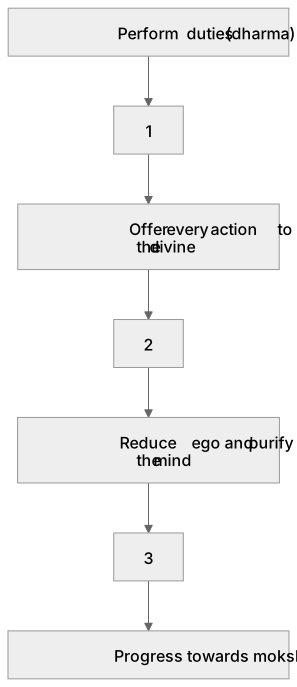
1Box 1
2Box 2
3Box 3
There is more to this lesson
The full lesson goes on to check your understanding and help you earn the marks. Create a free account to carry on, with your progress saved.
A week of Premium from your first lesson · Then the free plan continues · No card, no charge
Test your understanding of Hinduism - 3.1.4.2 Practices: action (karma yoga)
Active recall beats re-reading. Take an instant quiz now to test what you’ve learned and lock it into long-term memory.
A week of Premium from your first lesson · Then the free plan continues · No card, no charge