AQA · GCSE · Religious Studies
Course version: 8062 · Version from Sept 2018
Sacred festivals and their importance for Hindus in Great Britain today,…
Full specification wording
Hinduism - 3.1.4.2 Practices: Sacred festivals and their importance for Hindus in Great Britain today, including the origins and meaning of:
Sacred festivals are vital for Hindus in Great Britain today, providing a profound connection to their faith and community.
- Point 10 of 26
- 4 key terms
Study notes
From the teaching notes for this specification point.
The idea
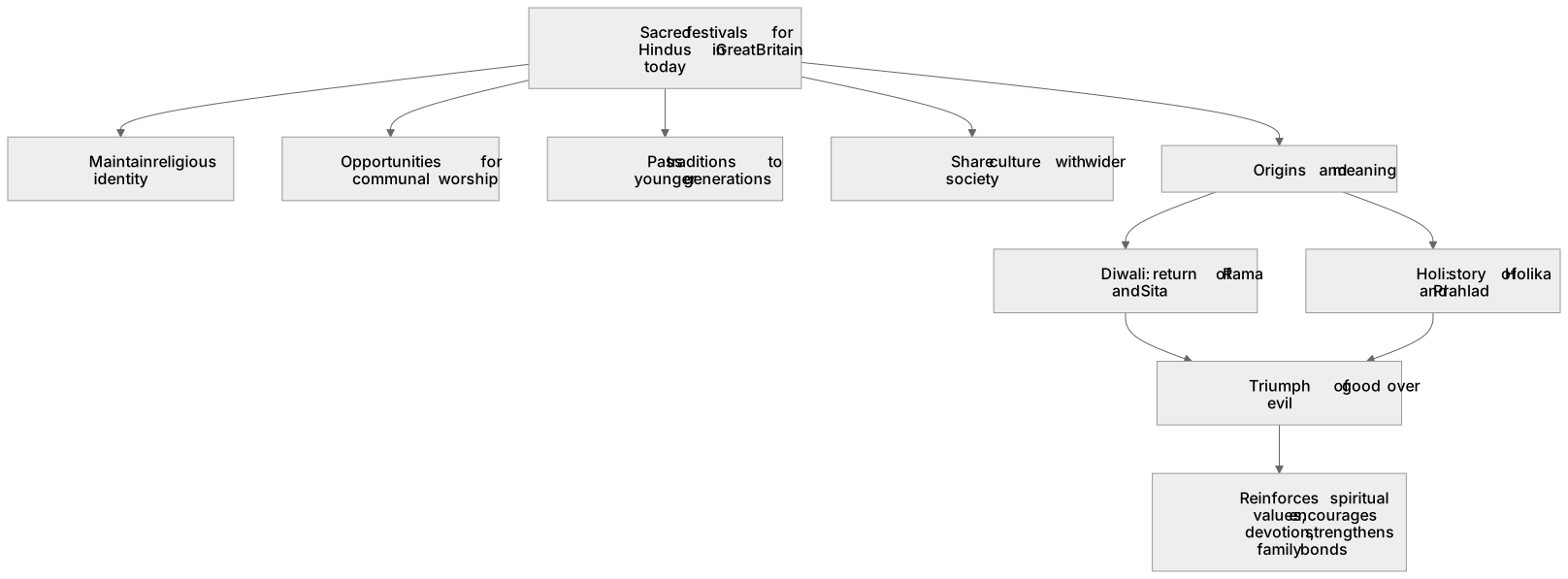
Sacred festivals are vital for Hindus in Great Britain today, providing a profound connection to their faith and community. These celebrations help British Hindus maintain their religious identity, offering opportunities for communal worship, passing traditions to younger generations, and sharing their culture with wider society. Understanding the origins and meaning of these festivals is essential. Exploring mythological roots—such as the return of Rama and Sita for Diwali, or the story of Holika and Prahlad for Holi—reveals core Hindu teachings like the triumph of good over evil. The meaning behind these events reinforces spiritual values, encourages devotion, and strengthens family bonds through shared rituals, feasting, and prayer.
What earns the marks
- Explain the role of festivals in maintaining Hindu identity and community cohesion in Great Britain.
- Identify how festivals serve as a means to pass religious teachings and cultural traditions to younger generations.
- Describe the origins of key festivals by referencing specific Hindu narratives (e.g., the Ramayana for Diwali).
- Analyse the spiritual meaning of festivals, such as celebrating the victory of light over darkness or good over evil.
Common mistakes and how to put them right
Discussing festivals only in an Indian context.
Put it right: Specifically address the importance of these festivals for Hindus living in Great Britain today, as required by the specification.
Confusing the origins of different festivals.
Put it right: Ensure the correct mythological story is linked to the correct festival (e.g., Rama and Sita to Diwali, not Holi).
Describing the celebrations without explaining their meaning.
Put it right: Link the physical practices (like lighting diyas) to their spiritual significance (light overcoming spiritual darkness).
Exam tips
- Always explicitly mention 'Great Britain' in your answers to ensure you are addressing the specific context of the question.
- Use specific examples of how British Hindus celebrate, such as community events in Leicester or London, to add depth to your answer.
- Structure your response to clearly separate the 'origins' (the historical or mythological story) from the 'meaning' (the spiritual lesson).
Try the lesson
The start of the Hinduism - 3.1.4.2 Practices: Sacred festivals and their importance for Hindus in Great Britain today, including the origins and meaning of: lesson, made from teaching notes for this specification point.
Have a go first
What is a primary reason why celebrating sacred festivals is important for Hindus living in Great Britain today?
Listen
Sacred festivals are vital for Hindus in Great Britain today, providing a profound connection to their faith and community. These celebrations help British Hindus maintain their religious identity, offering opportunities for communal worship, passing traditions to younger generations, and sharing their culture with wider society. Understanding the origins and meaning of these festivals is essential. Exploring mythological roots—such as the return of Rama and Sita for Diwali, or the story of Holika and Prahlad for Holi—reveals core Hindu teachings like the triumph of good over evil. The meaning behind these events reinforces spiritual values, encourages devotion, and strengthens family bonds through shared rituals, feasting, and prayer. A strong answer earns marks for these points. Explain the role of festivals in maintaining Hindu identity and community cohesion in Great Britain. Identify how festivals serve as a means to pass religious teachings and cultural traditions to younger generations. Describe the origins of key festivals by referencing specific Hindu narratives (e.g., the Ramayana for Diwali). Analyse the spiritual meaning of festivals, such as celebrating the victory of light over darkness or good over evil. A common slip: Discussing festivals only in an Indian context. Instead, Specifically address the importance of these festivals for Hindus living in Great Britain today, as required by the specification. Exam tip: Always explicitly mention 'Great Britain' in your answers to ensure you are addressing the specific context of the question.
See it
Key words
Say what each word means before you turn the card.
Community
Try answering aloud or in your head before turning the card.
Identity
Try answering aloud or in your head before turning the card.
Mythology
Try answering aloud or in your head before turning the card.
Celebration
Try answering aloud or in your head before turning the card.
See every definition
- Community
- Festivals provide opportunities for communal worship and strengthen family bonds through shared rituals, feasting, and prayer.
- Identity
- Celebrations help British Hindus maintain their religious identity and share their culture with wider society.
- Mythology
- Exploring mythological roots, such as the return of Rama and Sita for Diwali, reveals core Hindu teachings like the triumph of good over evil.
- Celebration
- Describing the celebrations without explaining their meaning is an error; physical practices should be linked to their spiritual significance.
Label the diagram
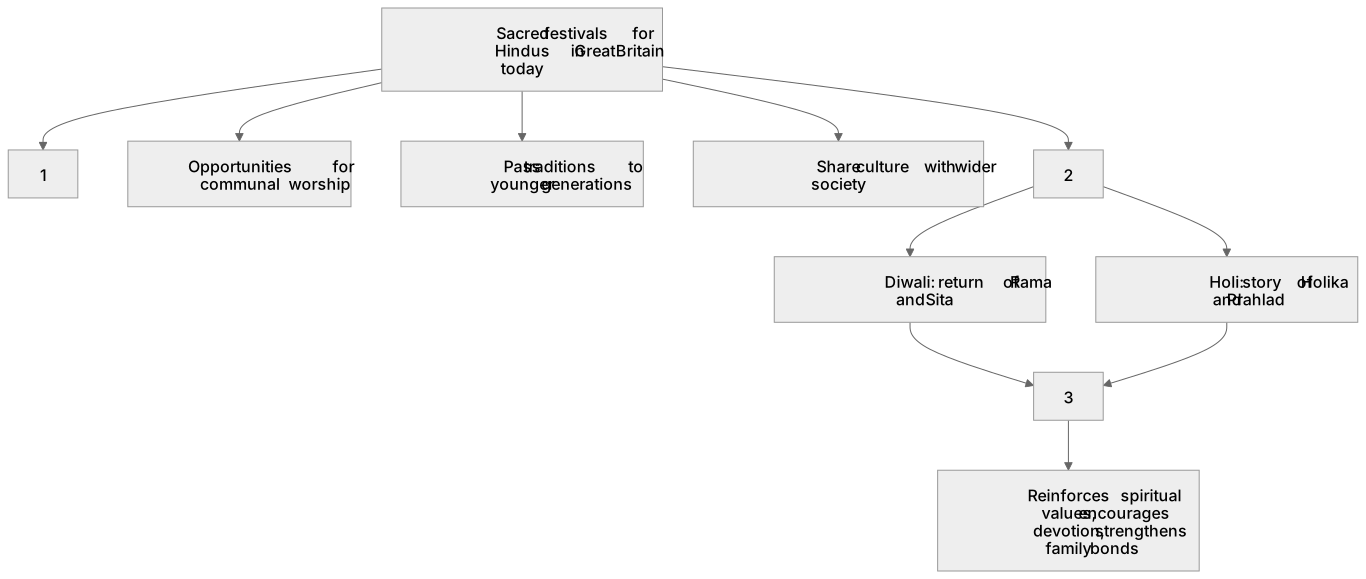
Some boxes have lost their names. Pick the right name for each number.
1Box 1
2Box 2
3Box 3
There is more to this lesson
The full lesson goes on to check your understanding and help you earn the marks. Create a free account to carry on, with your progress saved.
A week of Premium from your first lesson · Then the free plan continues · No card, no charge
Test your understanding of Hinduism - 3.1.4.2 Practices: Sacred festivals and their importance for Hindus in Great Britain today, including the origins and meaning of:
Active recall beats re-reading. Take an instant quiz now to test what you’ve learned and lock it into long-term memory.
A week of Premium from your first lesson · Then the free plan continues · No card, no charge