AQA · GCSE · Religious Studies
Course version: 8062 · Version from Sept 2018
Hinduism - 3.1.4.2 Practices: the murti as a representation of God.
A murti is a sacred image, statue, or idol of a Hindu deity used as a focal point during worship (puja).
- Point 9 of 26
- 3 key terms
Study notes
From the teaching notes for this specification point.
The idea
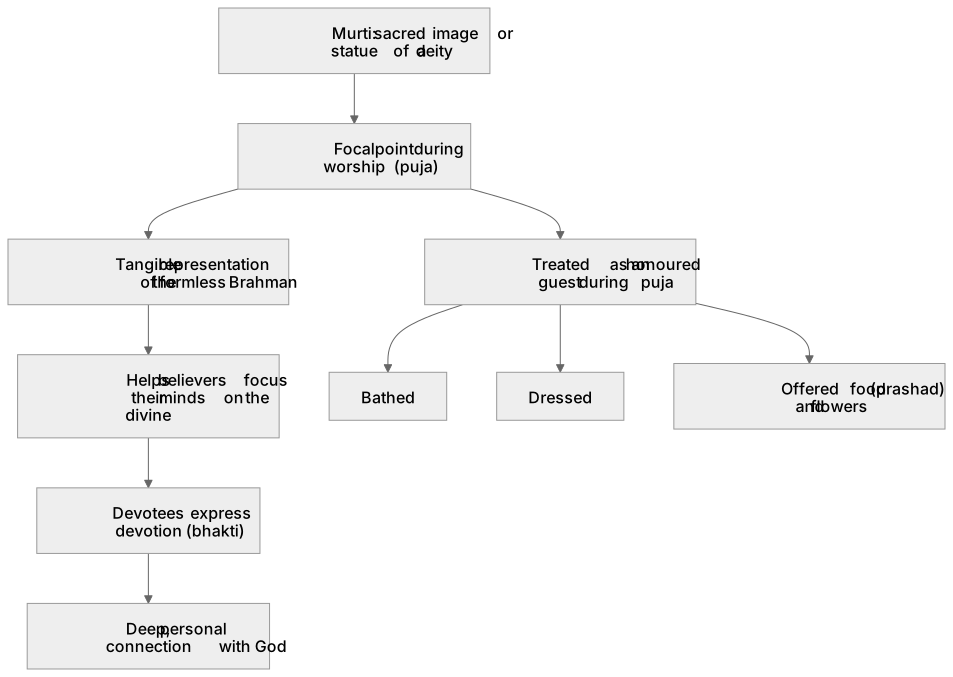
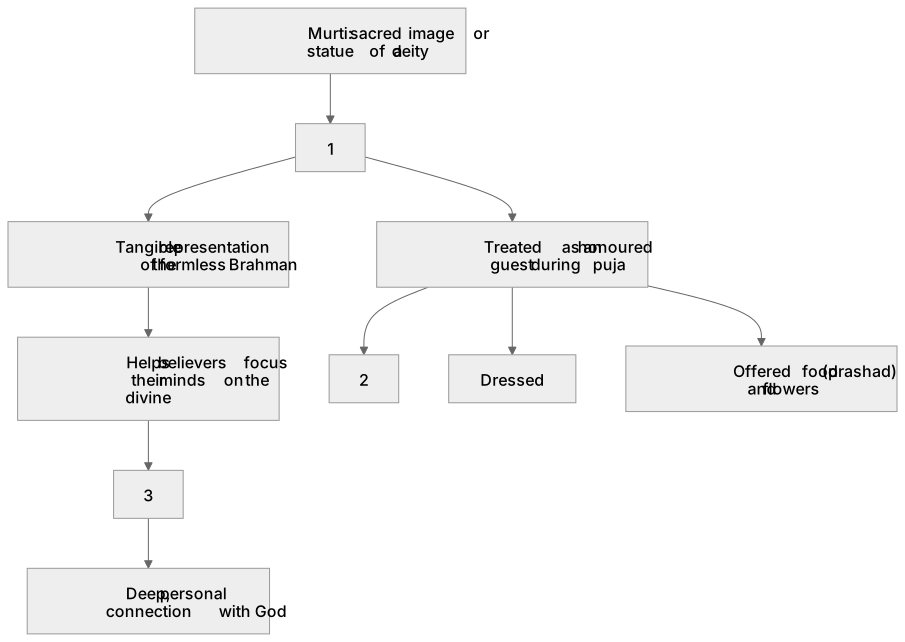
A murti is a sacred image, statue, or idol of a Hindu deity used as a focal point during worship (puja). It is crucial to understand that Hindus do not worship the physical object itself; rather, the murti serves as a tangible representation of the divine, helping believers focus their minds on the infinite, formless Brahman. For example, a murti of Ganesha, with his elephant head, represents wisdom and the removal of obstacles. During puja, the murti is treated as an honoured guest—it is bathed, dressed, and offered food (prashad) and flowers. This physical interaction allows devotees to express their devotion (bhakti) and experience a deep, personal connection with God, making the abstract concept of the divine accessible in everyday life.
What earns the marks
- Define murti as a sacred image or statue representing a deity.
- Explain that the murti is a focal point for worship (puja) and meditation, not the actual physical embodiment of God.
- Describe how murtis help Hindus connect with the formless Brahman by providing a tangible form.
- Detail the treatment of the murti during puja, such as bathing, dressing, and offering food (prashad).
Common mistakes and how to put them right
Stating that Hindus worship idols.
Put it right: Explain that Hindus worship God through the murti, which acts as a representation or focal point, not the physical object itself.
Believing a murti is only found in mandirs (temples).
Put it right: Note that murtis are also central to home shrines and everyday domestic worship.
Assuming all murtis represent different, separate gods.
Put it right: Clarify that different murtis represent various aspects or manifestations of the one supreme God, Brahman.
Exam tips
- Use the term 'representation' or 'focal point' rather than 'idol' to demonstrate a deeper understanding of Hindu theology.
- Provide a specific example of a deity's murti, such as Shiva or Lakshmi, to illustrate how physical features symbolise divine qualities.
- Link the use of a murti directly to the practice of puja and the expression of bhakti (loving devotion).
Try the lesson
The start of the Hinduism - 3.1.4.2 Practices: the murti as a representation of God. lesson, made from teaching notes for this specification point.
Have a go first
In Hindu worship, what is the primary purpose of a murti?
Listen
A murti is a sacred image, statue, or idol of a Hindu deity used as a focal point during worship (puja). It is crucial to understand that Hindus do not worship the physical object itself; rather, the murti serves as a tangible representation of the divine, helping believers focus their minds on the infinite, formless Brahman. For example, a murti of Ganesha, with his elephant head, represents wisdom and the removal of obstacles. During puja, the murti is treated as an honoured guest—it is bathed, dressed, and offered food (prashad) and flowers. This physical interaction allows devotees to express their devotion (bhakti) and experience a deep, personal connection with God, making the abstract concept of the divine accessible in everyday life. A strong answer earns marks for these points. Define murti as a sacred image or statue representing a deity. Explain that the murti is a focal point for worship (puja) and meditation, not the actual physical embodiment of God. Describe how murtis help Hindus connect with the formless Brahman by providing a tangible form. Detail the treatment of the murti during puja, such as bathing, dressing, and offering food (prashad). A common slip: Stating that Hindus worship idols. Instead, Explain that Hindus worship God through the murti, which acts as a representation or focal point, not the physical object itself. Exam tip: Use the term 'representation' or 'focal point' rather than 'idol' to demonstrate a deeper understanding of Hindu theology.
See it
Key words
Say what each word means before you turn the card.
Nature of God (Brahman)
Try answering aloud or in your head before turning the card.
Devotion (Bhakti)
Try answering aloud or in your head before turning the card.
Symbolism
Try answering aloud or in your head before turning the card.
See every definition
- Nature of God (Brahman)
- The infinite, formless divine, which the murti helps believers focus their minds on as a tangible representation.
- Devotion (Bhakti)
- Expressed through physical interaction with the murti, allowing devotees to experience a deep, personal connection with God.
- Symbolism
- Physical features of a murti, such as Ganesha's elephant head, represent divine qualities like wisdom and the removal of obstacles.
Label the diagram
Some boxes have lost their names. Pick the right name for each number.
1Box 1
2Box 2
3Box 3
There is more to this lesson
The full lesson goes on to check your understanding and help you earn the marks. Create a free account to carry on, with your progress saved.
A week of Premium from your first lesson · Then the free plan continues · No card, no charge
Test your understanding of Hinduism - 3.1.4.2 Practices: the murti as a representation of God.
Active recall beats re-reading. Take an instant quiz now to test what you’ve learned and lock it into long-term memory.
A week of Premium from your first lesson · Then the free plan continues · No card, no charge