AQA · GCSE · Religious Studies
Course version: 8062 · Version from Sept 2018
Hinduism - 3.1.4.2 Practices: sacred sites, including Varanasi
Hindus venerate numerous sacred sites across India, often located near rivers or places associated with deities.
- Point 22 of 26
- 4 key terms
Study notes
From the teaching notes for this specification point.
The idea
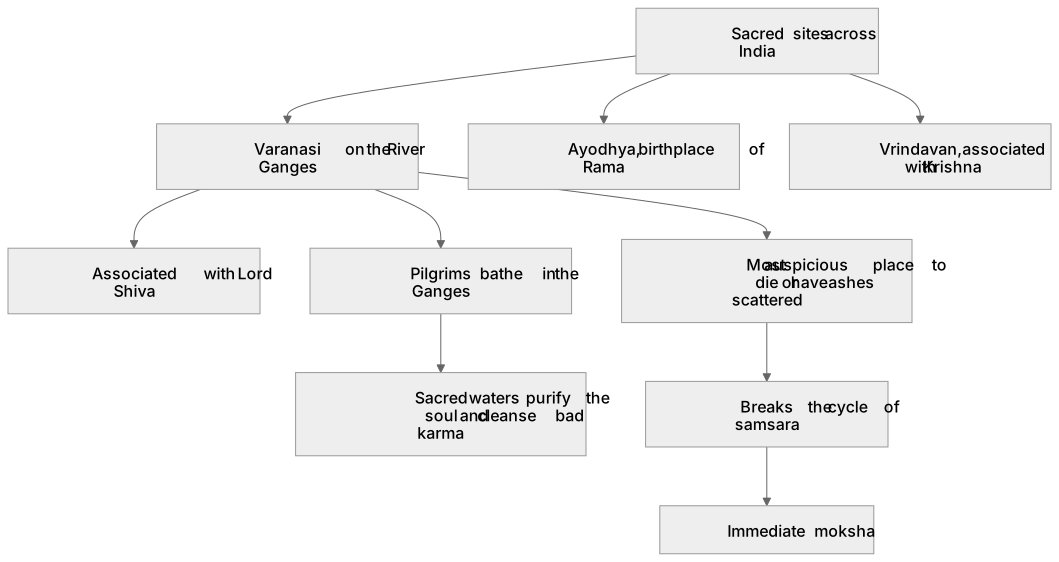
Hindus venerate numerous sacred sites across India, often located near rivers or places associated with deities. Varanasi, situated on the banks of the River Ganges, is considered the holiest of these sites and is deeply associated with Lord Shiva. Pilgrims travel to Varanasi to bathe in the Ganges, believing its sacred waters purify the soul and cleanse bad karma. Furthermore, Varanasi is the most auspicious place for a Hindu to die or have their ashes scattered. It is believed that dying here breaks the cycle of samsara, granting immediate moksha (liberation). Other sacred sites include Ayodhya, the birthplace of Rama, and Vrindavan, associated with Krishna, each offering unique spiritual benefits and drawing millions of devotees.
What earns the marks
- Identify Varanasi as a premier sacred site in Hinduism, located on the River Ganges and dedicated to Lord Shiva.
- Explain the significance of the River Ganges in purifying bad karma through ritual bathing.
- Describe the belief that dying or having ashes scattered in Varanasi grants immediate moksha.
- Recognise that other sacred sites exist, such as those linked to the avatars of Vishnu, which serve different devotional purposes.
Common mistakes and how to put them right
Claiming Varanasi is the only sacred site in Hinduism.
Put it right by naming others like Ayodhya or Vrindavan while noting Varanasi's supreme status.
Stating that the River Ganges is just a symbol.
Put it right by explaining that many Hindus view the river as a living goddess (Ganga) with real purifying power.
Confusing the scattering of ashes with a funeral service.
Put it right by clarifying that cremation usually happens first, and the ashes are subsequently immersed in the sacred river.
Exam tips
- Use Varanasi as your primary case study when answering questions about the importance of pilgrimage.
- Connect the geographical features of Varanasi (the River Ganges) directly to the theological concept of moksha.
- When discussing sacred sites, mention the associated deity (e.g., Shiva for Varanasi) to add depth to your answer.
Try the lesson
The start of the Hinduism - 3.1.4.2 Practices: sacred sites, including Varanasi lesson, made from teaching notes for this specification point.
Have a go first
Which river flows through the sacred city of Varanasi, making it a major site of Hindu pilgrimage?
Listen
Hindus venerate numerous sacred sites across India, often located near rivers or places associated with deities. Varanasi, situated on the banks of the River Ganges, is considered the holiest of these sites and is deeply associated with Lord Shiva. Pilgrims travel to Varanasi to bathe in the Ganges, believing its sacred waters purify the soul and cleanse bad karma. Furthermore, Varanasi is the most auspicious place for a Hindu to die or have their ashes scattered. It is believed that dying here breaks the cycle of samsara, granting immediate moksha (liberation). Other sacred sites include Ayodhya, the birthplace of Rama, and Vrindavan, associated with Krishna, each offering unique spiritual benefits and drawing millions of devotees. A strong answer earns marks for these points. Identify Varanasi as a premier sacred site in Hinduism, located on the River Ganges and dedicated to Lord Shiva. Explain the significance of the River Ganges in purifying bad karma through ritual bathing. Describe the belief that dying or having ashes scattered in Varanasi grants immediate moksha. Recognise that other sacred sites exist, such as those linked to the avatars of Vishnu, which serve different devotional purposes. A common slip: Claiming Varanasi is the only sacred site in Hinduism. Instead, naming others like Ayodhya or Vrindavan while noting Varanasi's supreme status. Exam tip: Use Varanasi as your primary case study when answering questions about the importance of pilgrimage.
See it
Key words
Say what each word means before you turn the card.
Varanasi
Try answering aloud or in your head before turning the card.
Moksha
Try answering aloud or in your head before turning the card.
Samsara
Try answering aloud or in your head before turning the card.
Karma
Try answering aloud or in your head before turning the card.
See every definition
- Varanasi
- Situated on the banks of the River Ganges, it is considered the holiest of sacred sites and is deeply associated with Lord Shiva.
- Moksha
- Liberation granted immediately to those who die in Varanasi, breaking the cycle of samsara.
- Samsara
- The cycle that is broken by dying in Varanasi, granting immediate moksha.
- Karma
- Bad karma is cleansed by bathing in the sacred waters of the Ganges, which purify the soul.
Label the diagram
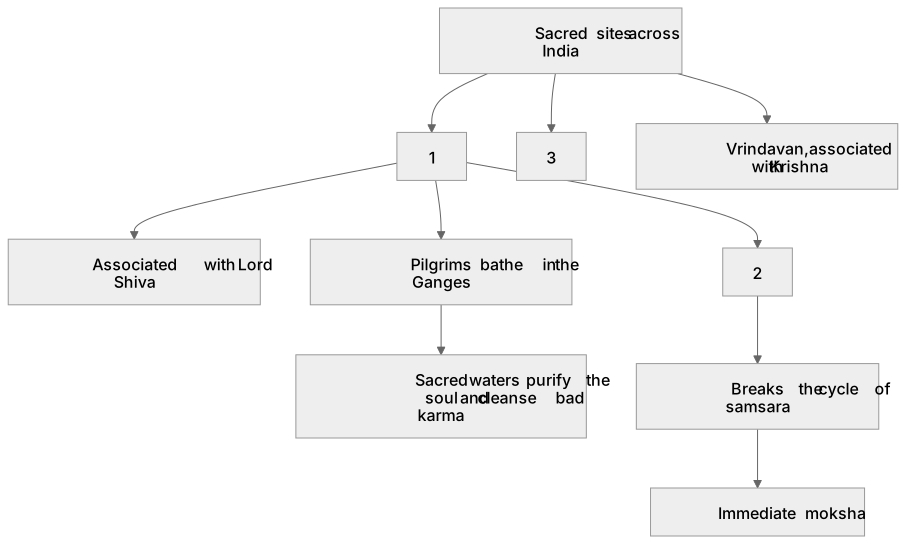
Some boxes have lost their names. Pick the right name for each number.
1Box 1
2Box 2
3Box 3
There is more to this lesson
The full lesson goes on to check your understanding and help you earn the marks. Create a free account to carry on, with your progress saved.
A week of Premium from your first lesson · Then the free plan continues · No card, no charge
Test your understanding of Hinduism - 3.1.4.2 Practices: sacred sites, including Varanasi
Active recall beats re-reading. Take an instant quiz now to test what you’ve learned and lock it into long-term memory.
A week of Premium from your first lesson · Then the free plan continues · No card, no charge