AQA · GCSE · Religious Studies
Course version: 8062 · Version from Sept 2018
Hinduism - 3.1.4.2 Practices: the many deities, guru and other elders
Hindu practices involve showing deep reverence to many deities, gurus, and elders.
- Point 6 of 26
- 3 key terms
Study notes
From the teaching notes for this specification point.
The idea
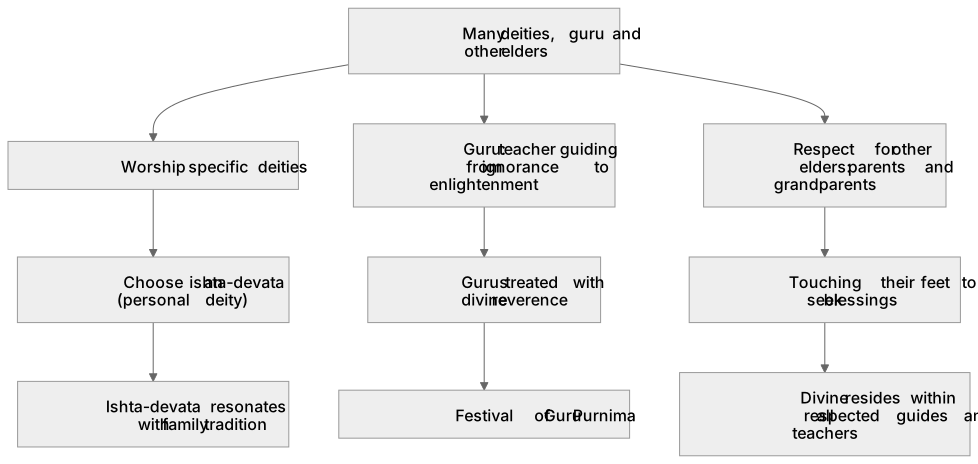
Hindu practices involve showing deep reverence to many deities, gurus, and elders. Devotees often worship specific deities, such as Ganesha for removing obstacles, choosing an ishta-devata (personal deity) that resonates with their family tradition. Beyond deities, immense spiritual respect is given to the guru, a teacher who guides students from ignorance to enlightenment. Gurus are often treated with divine reverence during festivals like Guru Purnima. Furthermore, everyday Hindu practice requires showing profound respect to other elders, including parents and grandparents. This is demonstrated through actions like touching their feet to seek blessings, reflecting the core belief that the divine resides within all respected guides and teachers.
What earns the marks
- Explain the role of an ishta-devata (personal deity) in focusing a Hindu's daily worship and devotion.
- Describe the function of a guru as a spiritual guide who helps devotees achieve moksha (liberation).
- Identify specific practices showing respect to gurus, such as celebrating Guru Purnima or seeking their spiritual counsel.
- Explain how respect for elders (parents, grandparents) is a daily religious duty, often shown by touching their feet for blessings.
Common mistakes and how to put them right
Assuming Hindus worship gurus as literal gods.
Put it right: Clarify that gurus are highly respected as spiritual guides who point the way to God, though they may be revered with god-like respect.
Ignoring the role of family elders in religious practice.
Put it right: Ensure you mention that respecting parents and grandparents is a fundamental spiritual duty in Hinduism, not just a cultural norm.
Stating Hindus are polytheists without qualification.
Put it right: Explain that while Hindus worship many deities, these are understood as different expressions of the one supreme reality, Brahman.
Exam tips
- Provide specific examples of deities (e.g., Ganesha, Saraswati) and explain why a Hindu might choose to worship them for specific needs.
- Use the term 'ishta-devata' when discussing the worship of many deities to show strong subject vocabulary.
- Connect the practice of respecting elders to the broader Hindu concept of dharma (duty) and seeing the divine in others.
Try the lesson
The start of the Hinduism - 3.1.4.2 Practices: the many deities, guru and other elders lesson, made from teaching notes for this specification point.
Have a go first
In Hindu practice, alongside the many deities, which group of people is traditionally shown deep spiritual respect and reverence?
Listen
Hindu practices involve showing deep reverence to many deities, gurus, and elders. Devotees often worship specific deities, such as Ganesha for removing obstacles, choosing an ishta-devata (personal deity) that resonates with their family tradition. Beyond deities, immense spiritual respect is given to the guru, a teacher who guides students from ignorance to enlightenment. Gurus are often treated with divine reverence during festivals like Guru Purnima. Furthermore, everyday Hindu practice requires showing profound respect to other elders, including parents and grandparents. This is demonstrated through actions like touching their feet to seek blessings, reflecting the core belief that the divine resides within all respected guides and teachers. A strong answer earns marks for these points. Explain the role of an ishta-devata (personal deity) in focusing a Hindu's daily worship and devotion. Describe the function of a guru as a spiritual guide who helps devotees achieve moksha (liberation). Identify specific practices showing respect to gurus, such as celebrating Guru Purnima or seeking their spiritual counsel. Explain how respect for elders (parents, grandparents) is a daily religious duty, often shown by touching their feet for blessings. A common slip: Assuming Hindus worship gurus as literal gods. Instead, Clarify that gurus are highly respected as spiritual guides who point the way to God, though they may be revered with god-like respect. Exam tip: Provide specific examples of deities (e.g., Ganesha, Saraswati) and explain why a Hindu might choose to worship them for specific needs.
See it
Key words
Say what each word means before you turn the card.
Ishta-devata
Try answering aloud or in your head before turning the card.
Guru
Try answering aloud or in your head before turning the card.
Respect and Reverence
Try answering aloud or in your head before turning the card.
See every definition
- Ishta-devata
- A personal deity chosen because it resonates with a family tradition, worshipped by devotees alongside many other deities.
- Guru
- A teacher who guides students from ignorance to enlightenment and is given immense spiritual respect.
- Respect and Reverence
- Deep reverence shown to many deities, gurus and elders, demonstrated through actions like touching their feet to seek blessings.
Label the diagram
Some boxes have lost their names. Pick the right name for each number.
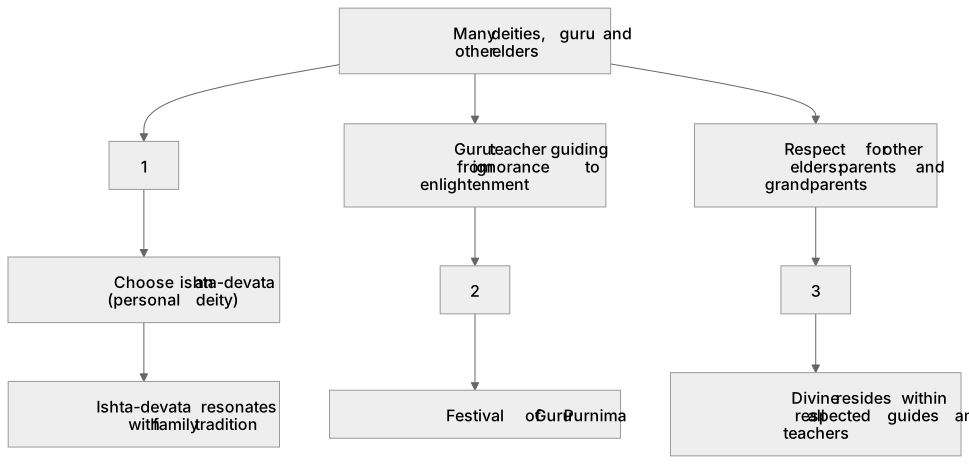
1Box 1
2Box 2
3Box 3
There is more to this lesson
The full lesson goes on to check your understanding and help you earn the marks. Create a free account to carry on, with your progress saved.
A week of Premium from your first lesson · Then the free plan continues · No card, no charge
Test your understanding of Hinduism - 3.1.4.2 Practices: the many deities, guru and other elders
Active recall beats re-reading. Take an instant quiz now to test what you’ve learned and lock it into long-term memory.
A week of Premium from your first lesson · Then the free plan continues · No card, no charge