AQA · GCSE · Religious Studies
Course version: 8062 · Version from Sept 2018
Hinduism - 3.1.4.2 Practices: holy land, hills and rivers
Hinduism views the entire Indian subcontinent as a sacred geography (holy land), often referred to as Bharat Mata (Mother India).
- Point 7 of 26
- 3 key terms
Study notes
From the teaching notes for this specification point.
The idea
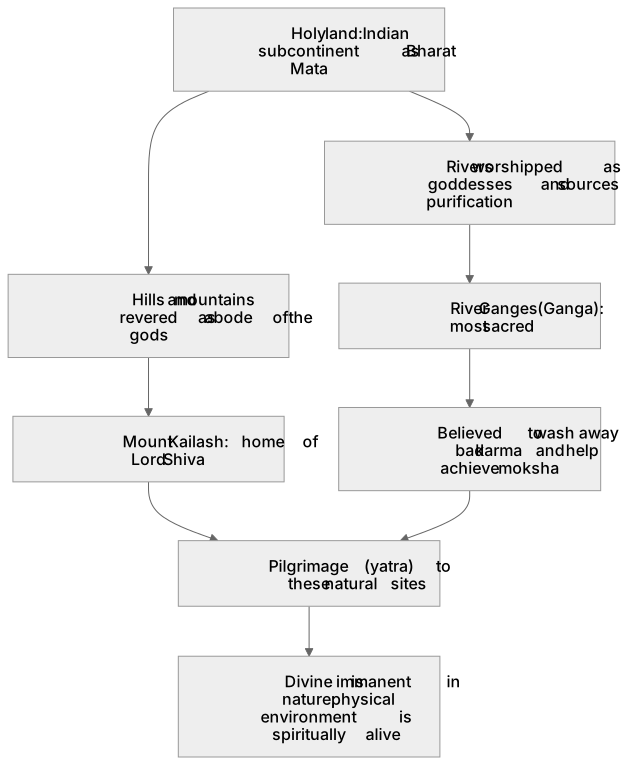
Hinduism views the entire Indian subcontinent as a sacred geography (holy land), often referred to as Bharat Mata (Mother India). Hills and mountains, particularly the Himalayas, are revered as the abode of the gods; for example, Mount Kailash is considered Lord Shiva's home. Rivers are worshipped as goddesses and sources of purification. The River Ganges (Ganga) is the most sacred, believed to wash away bad karma and help achieve moksha. Pilgrimage (yatra) to these natural sites is a key practice, demonstrating the belief that the divine is immanent in nature and that the physical environment is spiritually alive.
What earns the marks
- Explain the concept of Bharat Mata (Mother India) as a holy land.
- Describe the significance of hills and mountains, such as Mount Kailash being the abode of Lord Shiva.
- Explain the role of sacred rivers, especially the Ganges, in purification rituals and washing away bad karma.
- Connect the reverence for these geographical features to the Hindu belief in Brahman's presence in all of nature.
Common mistakes and how to put them right
Confusing the Ganges with just a physical river.
Put it right: Explain that Hindus view the Ganges as a living goddess (Ganga) capable of spiritual purification.
Stating that pilgrimage to these sites is mandatory.
Put it right: Clarify that while highly beneficial for karma and moksha, pilgrimage (yatra) is not a compulsory duty for all Hindus.
Ignoring the specific mention of hills.
Put it right: Ensure you explicitly mention hills or mountains, such as the Himalayas or Mount Kailash, as sacred abodes of deities.
Exam tips
- Use the term 'yatra' when discussing pilgrimage to these sacred geographical sites.
- Link the worship of rivers and hills to the broader Hindu environmental ethic of ahimsa and respect for nature.
- Provide specific examples, such as the River Ganges for rivers and Mount Kailash for hills, to support your explanations.
Try the lesson
The start of the Hinduism - 3.1.4.2 Practices: holy land, hills and rivers lesson, made from teaching notes for this specification point.
Have a go first
Which river is considered the most sacred in Hindu practice, where millions of pilgrims bathe to wash away their bad karma?
Listen
Hinduism views the entire Indian subcontinent as a sacred geography (holy land), often referred to as Bharat Mata (Mother India). Hills and mountains, particularly the Himalayas, are revered as the abode of the gods; for example, Mount Kailash is considered Lord Shiva's home. Rivers are worshipped as goddesses and sources of purification. The River Ganges (Ganga) is the most sacred, believed to wash away bad karma and help achieve moksha. Pilgrimage (yatra) to these natural sites is a key practice, demonstrating the belief that the divine is immanent in nature and that the physical environment is spiritually alive. A strong answer earns marks for these points. Explain the concept of Bharat Mata (Mother India) as a holy land. Describe the significance of hills and mountains, such as Mount Kailash being the abode of Lord Shiva. Explain the role of sacred rivers, especially the Ganges, in purification rituals and washing away bad karma. Connect the reverence for these geographical features to the Hindu belief in Brahman's presence in all of nature. A common slip: Confusing the Ganges with just a physical river. Instead, Explain that Hindus view the Ganges as a living goddess (Ganga) capable of spiritual purification. Exam tip: Use the term 'yatra' when discussing pilgrimage to these sacred geographical sites.
See it
Key words
Say what each word means before you turn the card.
Pilgrimage (Yatra)
Try answering aloud or in your head before turning the card.
Immanence of the divine
Try answering aloud or in your head before turning the card.
Purification and Karma
Try answering aloud or in your head before turning the card.
See every definition
- Pilgrimage (Yatra)
- A key practice of travelling to natural sacred sites, demonstrating the belief that the divine is immanent in nature.
- Immanence of the divine
- The belief that the divine is present in nature and that the physical environment is spiritually alive.
- Purification and Karma
- Rivers are worshipped as goddesses and sources of purification, and the Ganges is believed to wash away bad karma and help achieve moksha.
Label the diagram
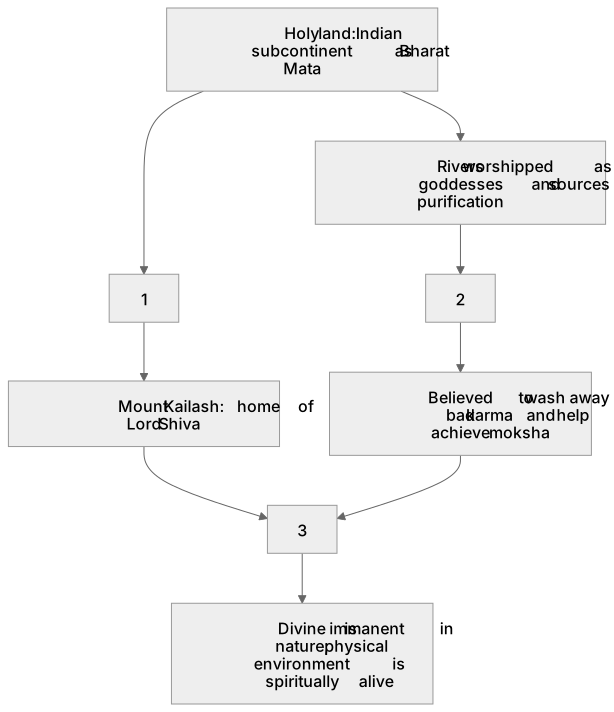
Some boxes have lost their names. Pick the right name for each number.
1Box 1
2Box 2
3Box 3
There is more to this lesson
The full lesson goes on to check your understanding and help you earn the marks. Create a free account to carry on, with your progress saved.
A week of Premium from your first lesson · Then the free plan continues · No card, no charge
Test your understanding of Hinduism - 3.1.4.2 Practices: holy land, hills and rivers
Active recall beats re-reading. Take an instant quiz now to test what you’ve learned and lock it into long-term memory.
A week of Premium from your first lesson · Then the free plan continues · No card, no charge