AQA · GCSE · Religious Studies
Course version: 8062 · Version from Sept 2018
Hinduism - 3.1.4.2 Practices: the role of pilgrimage
The role of pilgrimage in Hinduism is multifaceted, serving as a powerful tool for spiritual transformation.
- Point 20 of 26
- 4 key terms
Study notes
From the teaching notes for this specification point.
The idea
The role of pilgrimage in Hinduism is multifaceted, serving as a powerful tool for spiritual transformation. Primarily, it functions to purify the devotee, washing away accumulated bad karma and generating positive merit (punya). It plays a crucial role in expressing devotion (bhakti) to specific deities, often involving arduous travel that demonstrates commitment. Furthermore, pilgrimage acts as a unifying practice, bringing together Hindus from diverse backgrounds to share in communal worship and reinforce their shared faith.
For example: Participating in the Kumbh Mela allows millions to bathe collectively in sacred rivers, fulfilling the role of seeking moksha (liberation) while experiencing a profound sense of global Hindu community and spiritual renewal.
What earns the marks
- Explain that pilgrimage serves to purify the soul and remove negative karma.
- Describe how pilgrimage acts as a physical demonstration of devotion (bhakti) and commitment to the divine.
- Discuss the role of pilgrimage in building a sense of community and shared identity among Hindus globally.
- Evaluate the role of pilgrimage in the ultimate goal of achieving moksha (liberation from the cycle of rebirth).
Common mistakes and how to put them right
Claiming the only role of pilgrimage is to ask for material wealth.
Put it right: Clarify that while some may seek blessings for worldly issues, the primary roles are spiritual purification and seeking moksha.
Stating that bathing in the Ganges physically washes away sins.
Put it right: Explain that the purification is spiritual, removing negative karma rather than physical dirt or literal 'sins' in a Western sense.
Ignoring the communal aspect of pilgrimage.
Put it right: Ensure you mention how pilgrimage unites Hindus from different castes and regions, fostering a sense of universal brotherhood.
Exam tips
- When evaluating the role of pilgrimage, weigh its importance against other practices like meditation or daily puja.
- Use the Kumbh Mela as a primary example to illustrate the massive communal and spiritual role of pilgrimage.
- Connect the role of pilgrimage directly to core Hindu beliefs such as karma, samsara, and moksha.
Try the lesson
The start of the Hinduism - 3.1.4.2 Practices: the role of pilgrimage lesson, made from teaching notes for this specification point.
Have a go first
What is a primary role of pilgrimage (yatra) in Hinduism?
Listen
The role of pilgrimage in Hinduism is multifaceted, serving as a powerful tool for spiritual transformation. Primarily, it functions to purify the devotee, washing away accumulated bad karma and generating positive merit (punya). It plays a crucial role in expressing devotion (bhakti) to specific deities, often involving arduous travel that demonstrates commitment. Furthermore, pilgrimage acts as a unifying practice, bringing together Hindus from diverse backgrounds to share in communal worship and reinforce their shared faith. For example, participating in the Kumbh Mela allows millions to bathe collectively in sacred rivers, fulfilling the role of seeking moksha (liberation) while experiencing a profound sense of global Hindu community and spiritual renewal. A strong answer earns marks for these points. Explain that pilgrimage serves to purify the soul and remove negative karma. Describe how pilgrimage acts as a physical demonstration of devotion (bhakti) and commitment to the divine. Discuss the role of pilgrimage in building a sense of community and shared identity among Hindus globally. Evaluate the role of pilgrimage in the ultimate goal of achieving moksha (liberation from the cycle of rebirth). A common slip: Claiming the only role of pilgrimage is to ask for material wealth. Instead, Clarify that while some may seek blessings for worldly issues, the primary roles are spiritual purification and seeking moksha. Exam tip: When evaluating the role of pilgrimage, weigh its importance against other practices like meditation or daily puja.
See it
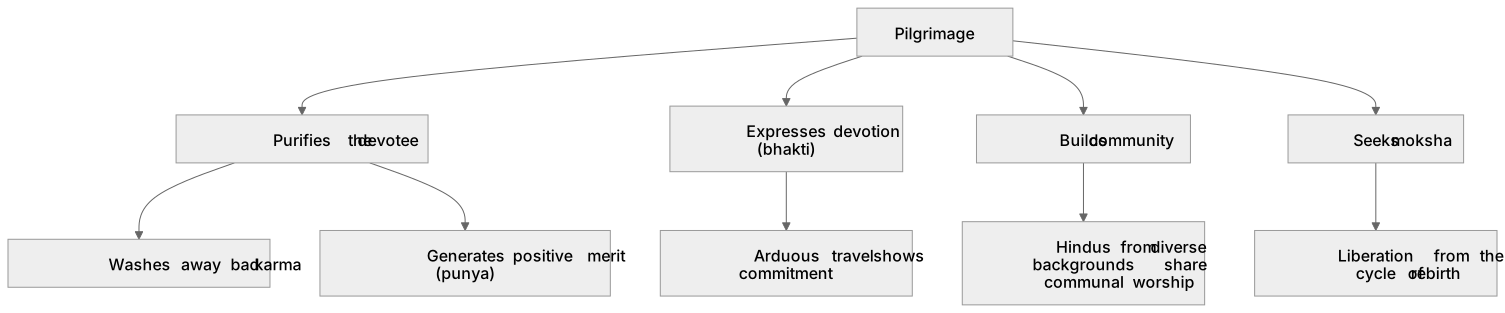
Key words
Say what each word means before you turn the card.
Moksha
Try answering aloud or in your head before turning the card.
Karma and purification
Try answering aloud or in your head before turning the card.
Community and unity
Try answering aloud or in your head before turning the card.
Bhakti (devotion)
Try answering aloud or in your head before turning the card.
See every definition
- Moksha
- Liberation from the cycle of rebirth, which pilgrimage helps the devotee to seek.
- Karma and purification
- Pilgrimage purifies the devotee, washing away accumulated bad karma and generating positive merit (punya).
- Community and unity
- Pilgrimage brings together Hindus from diverse backgrounds to share in communal worship and reinforce their shared faith.
- Bhakti (devotion)
- Pilgrimage expresses devotion to specific deities, often involving arduous travel that demonstrates commitment.
Label the diagram
Some boxes have lost their names. Pick the right name for each number.
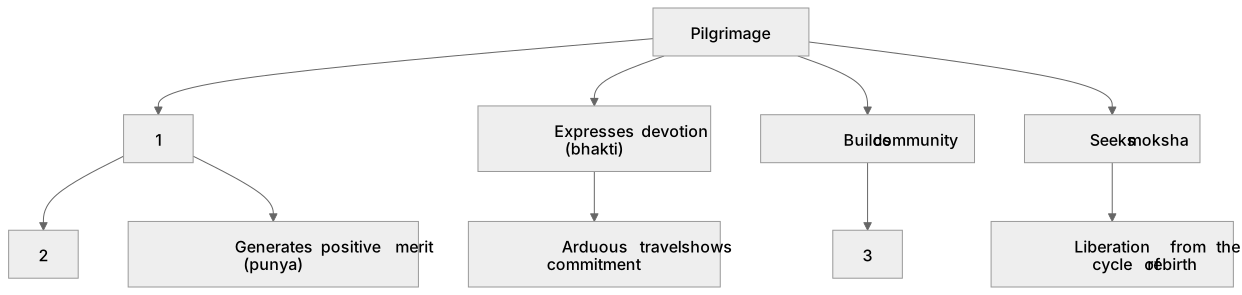
1Box 1
2Box 2
3Box 3
There is more to this lesson
The full lesson goes on to check your understanding and help you earn the marks. Create a free account to carry on, with your progress saved.
A week of Premium from your first lesson · Then the free plan continues · No card, no charge
Test your understanding of Hinduism - 3.1.4.2 Practices: the role of pilgrimage
Active recall beats re-reading. Take an instant quiz now to test what you’ve learned and lock it into long-term memory.
A week of Premium from your first lesson · Then the free plan continues · No card, no charge