AQA · GCSE · Religious Studies
Course version: 8062 · Version from Sept 2018
Hinduism - 3.1.4.2 Practices: The work and significance of:
When studying Hindu practices, evaluating 'the work and significance of' specific organisations requires understanding both their practical actions and their underlying spiritual motivations.
- Point 24 of 26
- 3 key terms
Study notes
From the teaching notes for this specification point.
The idea
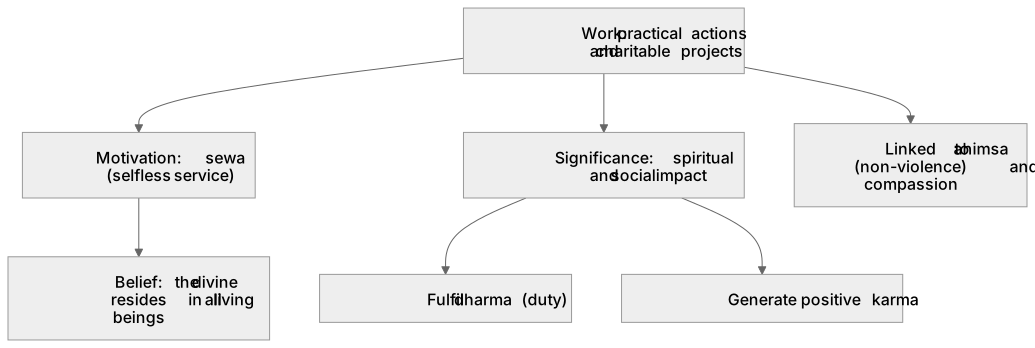
When studying Hindu practices, evaluating 'the work and significance of' specific organisations requires understanding both their practical actions and their underlying spiritual motivations. 'Work' refers to the tangible activities undertaken, such as providing food relief, environmental conservation, or education. This is often driven by the principle of sewa (selfless service) and the belief that the divine resides in all living beings. 'Significance' explores the impact of these actions on the community and how they help Hindus fulfil their dharma (duty) and generate positive karma.
What earns the marks
- Define 'work' as the practical actions and charitable projects undertaken by Hindu organisations.
- Define 'significance' as the spiritual and social impact of these actions on individuals and the wider world.
- Link charitable work to the Hindu concept of sewa (selfless service) performed without expectation of reward.
- Explain how performing such work helps a Hindu fulfil their dharma and accumulate positive karma.
Common mistakes and how to put them right
Describing what an organisation does without explaining why it matters.
Put it right: Pair the 'work' (the action) with its 'significance' (the spiritual or social impact).
Treating Hindu charities as purely secular NGOs.
Put it right: Explicitly connect the charity's work to Hindu beliefs such as sewa, dharma, or ahimsa.
Using vague descriptions of charity work.
Put it right: Provide specific examples of the work done, such as distributing plant-based meals or protecting sacred cows, to illustrate the religious connection.
Exam tips
- Whenever asked about an organisation's work, explicitly use the word 'sewa' to describe their selfless service.
- Structure your answers to first state the practical action (work) and then explain its religious importance (significance).
- Memorise at least two specific projects from a named Hindu charity to use as concrete evidence in longer answers.
Try the lesson
The start of the Hinduism - 3.1.4.2 Practices: The work and significance of: lesson, made from teaching notes for this specification point.
Have a go first
What is the primary significance of the work carried out by Hindu charitable organisations?
Listen
When studying Hindu practices, evaluating 'the work and significance of' specific organisations requires understanding both their practical actions and their underlying spiritual motivations. Work' refers to the tangible activities undertaken, such as providing food relief, environmental conservation, or education. This is often driven by the principle of sewa (selfless service) and the belief that the divine resides in all living beings. Significance' explores the impact of these actions on the community and how they help Hindus fulfil their dharma (duty) and generate positive karma. A strong answer earns marks for these points. Define 'work' as the practical actions and charitable projects undertaken by Hindu organisations. Define 'significance' as the spiritual and social impact of these actions on individuals and the wider world. Link charitable work to the Hindu concept of sewa (selfless service) performed without expectation of reward. Explain how performing such work helps a Hindu fulfil their dharma and accumulate positive karma. A common slip: Describing what an organisation does without explaining why it matters. Instead, pair the 'work' (the action) with its 'significance' (the spiritual or social impact). Exam tip: Whenever asked about an organisation's work, explicitly use the word 'sewa' to describe their selfless service.
See it
Key words
Say what each word means before you turn the card.
Sewa
Try answering aloud or in your head before turning the card.
Dharma
Try answering aloud or in your head before turning the card.
Ahimsa
Try answering aloud or in your head before turning the card.
See every definition
- Sewa
- Selfless service performed without expectation of reward, often driving the practical activities undertaken by Hindu organisations.
- Dharma
- Duty which Hindus fulfil through charitable actions, helping them to generate positive karma.
- Ahimsa
- Non-violence, a core Hindu teaching to which practical charity work must be directly linked, along with compassion.
Label the diagram
Some boxes have lost their names. Pick the right name for each number.
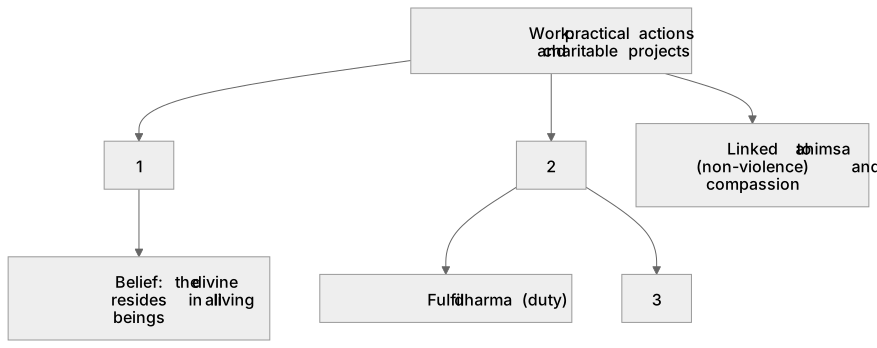
1Box 1
2Box 2
3Box 3
There is more to this lesson
The full lesson goes on to check your understanding and help you earn the marks. Create a free account to carry on, with your progress saved.
A week of Premium from your first lesson · Then the free plan continues · No card, no charge
Test your understanding of Hinduism - 3.1.4.2 Practices: The work and significance of:
Active recall beats re-reading. Take an instant quiz now to test what you’ve learned and lock it into long-term memory.
A week of Premium from your first lesson · Then the free plan continues · No card, no charge