AQA · GCSE · Religious Studies
Course version: 8062 · Version from Sept 2018
Common and divergent views within Hinduism in the way beliefs and…
Full specification wording
Hinduism: Common and divergent views within Hinduism in the way beliefs and teachings are understood and expressed should be included throughout. Students may refer to a range of different Hindu perspectives in their answers, including Shaivism and Vaishnavism. They must study the specific differences identified below.
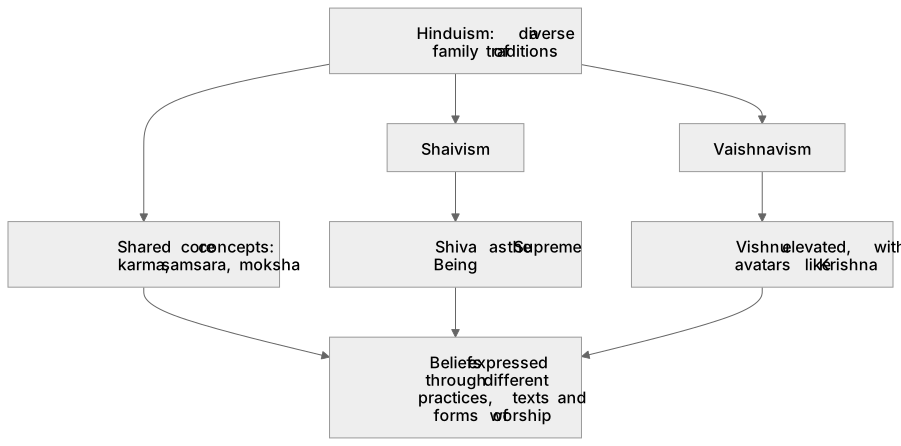
Hinduism is not a single, monolithic religion but a diverse family of traditions with shared core concepts alongside distinct sectarian differences.
- Point 4 of 4
- 4 key terms
Study notes
From the teaching notes for this specification point.
The idea
Hinduism is not a single, monolithic religion but a diverse family of traditions with shared core concepts alongside distinct sectarian differences. For example, while most Hindus accept the authority of the Vedas and concepts like karma and moksha, their expression of devotion varies significantly. The specification explicitly requires understanding the divergent perspectives of Shaivism, which focuses on Shiva as the Supreme Being, and Vaishnavism, which elevates Vishnu. Recognising these internal variations is crucial for evaluating how teachings are applied in practice, ensuring answers reflect the rich plurality of Hindu thought rather than a simplified, uniform view.
What earns the marks
- Identify core shared beliefs across Hindu traditions, such as karma, samsara, and moksha.
- Explain the distinct theological focus of Vaishnavism, centring on Vishnu and his avatars like Krishna.
- Explain the distinct theological focus of Shaivism, recognising Shiva as the ultimate reality and creator.
- Contrast how different Hindu denominations express their beliefs through specific practices, texts, and forms of worship.
Common mistakes and how to put them right
Treating Hinduism as a single uniform religion with identical beliefs for all followers.
Put it right by acknowledging it as a diverse family of traditions.
Confusing the focus of Shaivism and Vaishnavism.
Put it right by remembering Shaivism focuses on Shiva and Vaishnavism focuses on Vishnu.
Assuming divergent views mean conflict.
Put it right by explaining that Hinduism embraces plurality and different paths to the divine.
Exam tips
- Always use specific examples from both Shaivism and Vaishnavism when discussing divergent views on the nature of the divine.
- When evaluating a statement in a 12-mark question, contrast a general Hindu perspective with a specific sectarian view to show depth.
- Avoid using phrases like 'All Hindus believe'; instead, use 'Many Hindus believe' or specify a particular tradition.
Try the lesson
The start of the Hinduism: Common and divergent views within Hinduism in the way beliefs and teachings are understood and expressed should be included throughout. Students may refer to a range of different Hindu perspectives in their answers, including Shaivism and Vaishnavism. They must study the specific differences identified below. lesson, made from teaching notes for this specification point.
Have a go first
What is a primary difference in belief between the Hindu traditions of Shaivism and Vaishnavism?
Listen
Hinduism is not a single, monolithic religion but a diverse family of traditions with shared core concepts alongside distinct sectarian differences. For example, while most Hindus accept the authority of the Vedas and concepts like karma and moksha, their expression of devotion varies significantly. The specification explicitly requires understanding the divergent perspectives of Shaivism, which focuses on Shiva as the Supreme Being, and Vaishnavism, which elevates Vishnu. Recognising these internal variations is crucial for evaluating how teachings are applied in practice, ensuring answers reflect the rich plurality of Hindu thought rather than a simplified, uniform view. A strong answer earns marks for these points. Identify core shared beliefs across Hindu traditions, such as karma, samsara, and moksha. Explain the distinct theological focus of Vaishnavism, centring on Vishnu and his avatars like Krishna. Explain the distinct theological focus of Shaivism, recognising Shiva as the ultimate reality and creator. Contrast how different Hindu denominations express their beliefs through specific practices, texts, and forms of worship. A common slip: Treating Hinduism as a single uniform religion with identical beliefs for all followers. Instead, acknowledging it as a diverse family of traditions. Exam tip: Always use specific examples from both Shaivism and Vaishnavism when discussing divergent views on the nature of the divine.
See it
Key words
Say what each word means before you turn the card.
Plurality and diversity
Try answering aloud or in your head before turning the card.
Sectarian traditions
Try answering aloud or in your head before turning the card.
Expressions of faith
Try answering aloud or in your head before turning the card.
Theological divergence
Try answering aloud or in your head before turning the card.
See every definition
- Plurality and diversity
- Hinduism is a diverse family of traditions with shared core concepts alongside distinct sectarian differences, rather than a single, monolithic religion.
- Sectarian traditions
- Distinct traditions within Hinduism, such as Shaivism and Vaishnavism, which hold divergent perspectives on the nature of the divine.
- Expressions of faith
- The ways in which devotion varies significantly across traditions, including specific practices, texts, and forms of worship.
- Theological divergence
- The distinct theological focus of traditions such as Shaivism, which focuses on Shiva as the Supreme Being, and Vaishnavism, which elevates Vishnu.
Label the diagram
Some boxes have lost their names. Pick the right name for each number.
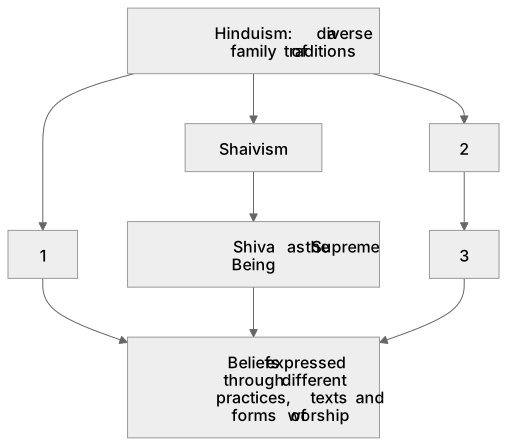
1Box 1
2Box 2
3Box 3
There is more to this lesson
The full lesson goes on to check your understanding and help you earn the marks. Create a free account to carry on, with your progress saved.
A week of Premium from your first lesson · Then the free plan continues · No card, no charge
Test your understanding of Hinduism: Common and divergent views within Hinduism in the way beliefs and teachings are understood and expressed should be included throughout. Students may refer to a range of different Hindu perspectives in their answers, including Shaivism and Vaishnavism. They must study the specific differences identified below.
Active recall beats re-reading. Take an instant quiz now to test what you’ve learned and lock it into long-term memory.
A week of Premium from your first lesson · Then the free plan continues · No card, no charge