AQA · GCSE · Religious Studies
Course version: 8062 · Version from Sept 2018
Students should study the influence of the beliefs, teachings and…
Full specification wording
Hinduism: Students should study the influence of the beliefs, teachings and practices studied on individuals, communities and societies.
Understanding Hindu concepts is only the first step; you must also explain how these ideas actively shape lives.
- Point 3 of 4
- 4 key terms
Study notes
From the teaching notes for this specification point.
The idea
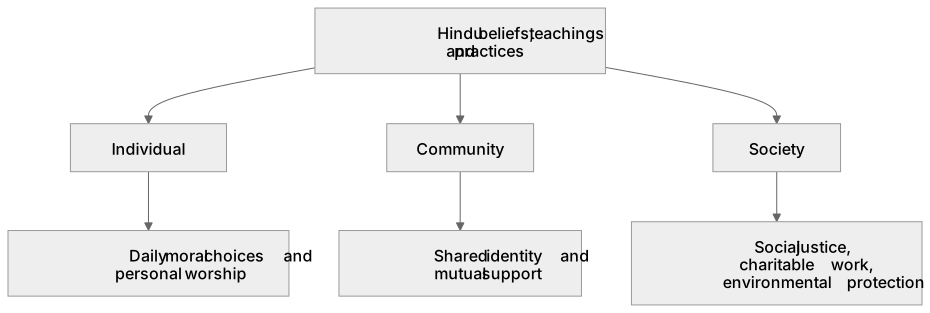
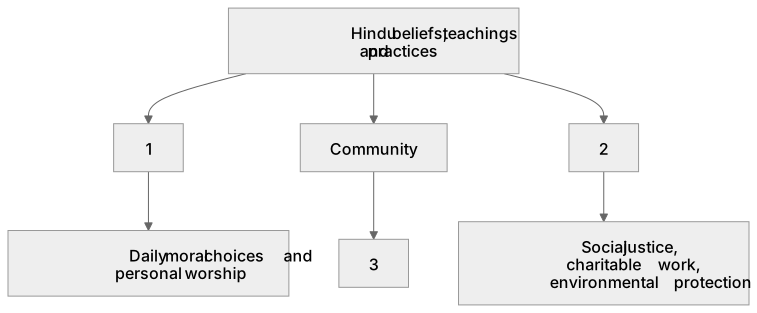
Understanding Hindu concepts is only the first step; you must also explain how these ideas actively shape lives. This requires exploring the influence of beliefs, teachings, and practices across three distinct levels: the individual, the community, and wider society. For an individual, belief in karma might influence daily moral choices and personal worship. At the community level, practices like celebrating Diwali or attending the mandir foster shared identity and mutual support. On a societal scale, teachings about ahimsa (non-violence) and dharma (duty) can drive social justice initiatives, charitable work, or environmental protection. You must connect abstract theology directly to these practical, real-world impacts across all three specified groups.
What earns the marks
- Answers must explicitly link a specific Hindu belief, teaching, or practice to a tangible outcome or action.
- Credit is given for distinguishing between impacts on a single person (e.g., personal spiritual growth) and a group (e.g., community cohesion).
- High-level responses will evaluate how societal influences, such as the application of ahimsa, shape broader cultural or legal norms.
- Explanations of practices like pilgrimage (Yatra) should detail both the individual's purification and the community bonding that occurs.
Common mistakes and how to put them right
Describing a belief without explaining its practical effect.
Put it right: Follow a definition with an example of how it changes behaviour.
Confusing individual and societal impacts.
Put it right: Ensure you clearly identify whether an action affects personal life or the wider community.
Treating all Hindus as a single homogenous group.
Put it right: Acknowledge that influences can vary between different individuals and communities within Hinduism.
Exam tips
- Use the formula 'Belief + Action = Influence' to structure your paragraphs when explaining how teachings affect daily life.
- When evaluating a statement, contrast the impact on an individual's personal devotion with the practical demands of living in a modern society.
- Memorise one clear example of how a specific Hindu charity or community group puts teachings like sewa (selfless service) into practice.
Try the lesson
The start of the Hinduism: Students should study the influence of the beliefs, teachings and practices studied on individuals, communities and societies. lesson, made from teaching notes for this specification point.
Have a go first
How might the belief in karma influence an individual Hindu's daily actions?
Listen
Understanding Hindu concepts is only the first step; you must also explain how these ideas actively shape lives. This requires exploring the influence of beliefs, teachings, and practices across three distinct levels: the individual, the community, and wider society. For an individual, belief in karma might influence daily moral choices and personal worship. At the community level, practices like celebrating Diwali or attending the mandir foster shared identity and mutual support. On a societal scale, teachings about ahimsa (non-violence) and dharma (duty) can drive social justice initiatives, charitable work, or environmental protection. You must connect abstract theology directly to these practical, real-world impacts across all three specified groups. A strong answer earns marks for these points. Answers must explicitly link a specific Hindu belief, teaching, or practice to a tangible outcome or action. Credit is given for distinguishing between impacts on a single person (e.g., personal spiritual growth) and a group (e.g., community cohesion). High-level responses will evaluate how societal influences, such as the application of ahimsa, shape broader cultural or legal norms. Explanations of practices like pilgrimage (Yatra) should detail both the individual's purification and the community bonding that occurs. Exam tip: Use the formula 'Belief + Action = Influence' to structure your paragraphs when explaining how teachings affect daily life.
See it
Key words
Say what each word means before you turn the card.
Practical application
Try answering aloud or in your head before turning the card.
Social cohesion
Try answering aloud or in your head before turning the card.
Moral conduct
Try answering aloud or in your head before turning the card.
Lived religion
Try answering aloud or in your head before turning the card.
See every definition
- Practical application
- Connecting abstract theology directly to real-world impacts across the individual, community and societal levels.
- Social cohesion
- Shared identity and mutual support fostered at the community level by practices such as celebrating Diwali or attending the mandir.
- Moral conduct
- Daily moral choices influenced, for an individual, by belief in karma.
- Lived religion
- How beliefs, teachings and practices actively shape lives across the individual, community and wider society.
Label the diagram
Some boxes have lost their names. Pick the right name for each number.
1Box 1
2Box 2
3Box 3
There is more to this lesson
The full lesson goes on to check your understanding and help you earn the marks. Create a free account to carry on, with your progress saved.
A week of Premium from your first lesson · Then the free plan continues · No card, no charge
Test your understanding of Hinduism: Students should study the influence of the beliefs, teachings and practices studied on individuals, communities and societies.
Active recall beats re-reading. Take an instant quiz now to test what you’ve learned and lock it into long-term memory.
A week of Premium from your first lesson · Then the free plan continues · No card, no charge