AQA · GCSE · Religious Studies
Course version: 8062 · Version from Sept 2018
Hajj: the role and significance of the pilgrimage to Makkah including…
Full specification wording
Islam - 3.1.5.2 Practices: Hajj: the role and significance of the pilgrimage to Makkah including origins, how hajj is performed, the actions pilgrims perform at sites including the Ka’aba at Makkah, Mina, Arafat, Muzdalifah and their significance.
Hajj is the annual pilgrimage to Makkah, originating from the trials of Prophet Ibrahim and his family.
- Point 9 of 11
- 4 key terms
Study notes
From the teaching notes for this specification point.
The idea
Hajj is the annual pilgrimage to Makkah, originating from the trials of Prophet Ibrahim and his family. It is a compulsory duty for Muslims who are physically and financially able. Pilgrims enter a state of Ihram (purity) before circling the Ka'aba seven times (Tawaf), demonstrating unity and devotion to Allah. At Mina, pilgrims throw pebbles at pillars (Jamarat) to symbolise rejecting the devil. The climax occurs at Arafat, where pilgrims stand in prayer seeking forgiveness, reflecting the Day of Judgement. At Muzdalifah, they collect pebbles and camp under the stars. These actions collectively signify submission, spiritual cleansing, and the profound equality of the global ummah before Allah.
What earns the marks
- Trace the origins of Hajj to the actions of Prophet Ibrahim, Hajar, and Ismail, which pilgrims commemorate.
- Explain the significance of Tawaf at the Ka'aba in Makkah as a symbol of the unity of the ummah and the centrality of Allah.
- Describe the stand at Mount Arafat (Wuquf) as the most crucial part of Hajj, representing the Day of Judgement and the seeking of divine mercy.
- Detail the actions at Muzdalifah (collecting pebbles) and Mina (stoning the Jamarat) as physical demonstrations of rejecting evil and temptation.
Common mistakes and how to put them right
Stating that Hajj was started by Prophet Muhammad.
Put it right by explaining that while Muhammad restored it, Hajj originates from Prophet Ibrahim.
Confusing the order or locations of events.
Put it right: Ensure you know that pilgrims go from Arafat to Muzdalifah to collect pebbles before heading to Mina to stone the pillars.
Claiming Hajj is compulsory for every Muslim regardless of circumstance.
Put it right: It is only obligatory for those who are physically and financially able.
Exam tips
- Link specific locations to their symbolic meanings, such as connecting Arafat directly to forgiveness and the Day of Judgement.
- Use Arabic terminology like 'Ihram' and 'Tawaf' to elevate the quality of your explanations.
- When discussing the significance of Hajj, mention how the identical white garments of Ihram strip away social status, emphasising equality.
Try the lesson
The start of the Islam - 3.1.5.2 Practices: Hajj: the role and significance of the pilgrimage to Makkah including origins, how hajj is performed, the actions pilgrims perform at sites including the Ka’aba at Makkah, Mina, Arafat, Muzdalifah and their significance. lesson, made from teaching notes for this specification point.
Have a go first
During the Hajj pilgrimage, what specific action do Muslims perform when they visit the Ka'aba in Makkah?
Listen
Hajj is the annual pilgrimage to Makkah, originating from the trials of Prophet Ibrahim and his family. It is a compulsory duty for Muslims who are physically and financially able. Pilgrims enter a state of Ihram (purity) before circling the Ka'aba seven times (Tawaf), demonstrating unity and devotion to Allah. At Mina, pilgrims throw pebbles at pillars (Jamarat) to symbolise rejecting the devil. The climax occurs at Arafat, where pilgrims stand in prayer seeking forgiveness, reflecting the Day of Judgement. At Muzdalifah, they collect pebbles and camp under the stars. These actions collectively signify submission, spiritual cleansing, and the profound equality of the global ummah before Allah. A strong answer earns marks for these points. Trace the origins of Hajj to the actions of Prophet Ibrahim, Hajar, and Ismail, which pilgrims commemorate. Explain the significance of Tawaf at the Ka'aba in Makkah as a symbol of the unity of the ummah and the centrality of Allah. Describe the stand at Mount Arafat (Wuquf) as the most crucial part of Hajj, representing the Day of Judgement and the seeking of divine mercy. Detail the actions at Muzdalifah (collecting pebbles) and Mina (stoning the Jamarat) as physical demonstrations of rejecting evil and temptation. A common slip: Stating that Hajj was started by Prophet Muhammad. Instead, explaining that while Muhammad restored it, Hajj originates from Prophet Ibrahim. Exam tip: Link specific locations to their symbolic meanings, such as connecting Arafat directly to forgiveness and the Day of Judgement.
See it
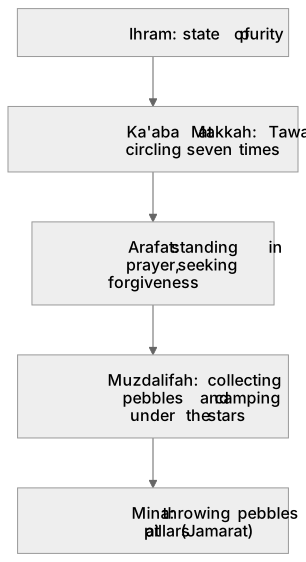
Put it in order
Put these steps in the order they happen.
- 1. Ka'aba at Makkah: Tawaf, circling seven times
- 2. Arafat: standing in prayer, seeking forgiveness
- 3. Ihram: state of purity
- 4. Mina: throwing pebbles at pillars (Jamarat)
- 5. Muzdalifah: collecting pebbles and camping under the stars
Key words
Say what each word means before you turn the card.
Pilgrimage and devotion
Try answering aloud or in your head before turning the card.
Prophethood (Ibrahim)
Try answering aloud or in your head before turning the card.
Equality and unity
Try answering aloud or in your head before turning the card.
Forgiveness and judgement
Try answering aloud or in your head before turning the card.
See every definition
- Pilgrimage and devotion
- The annual pilgrimage to Makkah, originating from the trials of Prophet Ibrahim and his family, demonstrating devotion to Allah.
- Prophethood (Ibrahim)
- The origins of Hajj are traced to the trials of Prophet Ibrahim and his family, which pilgrims commemorate.
- Equality and unity
- Circling the Ka'aba seven times demonstrates unity and devotion to Allah, and the actions collectively signify the profound equality of the global ummah before Allah.
- Forgiveness and judgement
- At Arafat pilgrims stand in prayer seeking forgiveness, reflecting the Day of Judgement.
Label the diagram
Some boxes have lost their names. Pick the right name for each number.

1Box 1
2Box 2
There is more to this lesson
The full lesson goes on to check your understanding and help you earn the marks. Create a free account to carry on, with your progress saved.
A week of Premium from your first lesson · Then the free plan continues · No card, no charge
Test your understanding of Islam - 3.1.5.2 Practices: Hajj: the role and significance of the pilgrimage to Makkah including origins, how hajj is performed, the actions pilgrims perform at sites including the Ka’aba at Makkah, Mina, Arafat, Muzdalifah and their significance.
Active recall beats re-reading. Take an instant quiz now to test what you’ve learned and lock it into long-term memory.
A week of Premium from your first lesson · Then the free plan continues · No card, no charge