AQA · GCSE · Religious Studies
Course version: 8062 · Version from Sept 2018
Zakah: the role and significance of giving alms including origins, how and…
Full specification wording
Islam - 3.1.5.2 Practices: Zakah: the role and significance of giving alms including origins, how and why it is given, benefits of receipt, Khums in Shi’a Islam.
Zakah, the third Pillar of Sunni Islam, is the compulsory giving of 2.5% of a Muslim's surplus wealth to charity, originating from the Qur'an's command to support the needy.
- Point 8 of 11
- 4 key terms
Study notes
From the teaching notes for this specification point.
The idea
Zakah, the third Pillar of Sunni Islam, is the compulsory giving of 2.5% of a Muslim's surplus wealth to charity, originating from the Qur'an's command to support the needy. It is given annually by those whose wealth exceeds the nisab (minimum threshold). Muslims give Zakah to purify their wealth, fulfil a duty to Allah, and reduce inequality. The benefits of receipt include alleviating poverty, supporting orphans, and strengthening the ummah (community). In Shi'a Islam, alongside Zakah, Muslims pay Khums, a 20% tax on surplus income. Half of Khums goes to religious leaders for Islamic education and the other half supports the poor and descendants of Muhammad, highlighting a distinct approach to almsgiving.
What earns the marks
- Explain that Zakah is a compulsory act of worship (Ibadah) requiring 2.5% of surplus wealth to be given annually.
- Identify the origins of Zakah in the Qur'an and the Sunnah as a direct command from Allah to care for the vulnerable.
- Describe the benefits of receipt, such as providing essential resources for the poor, freeing debtors, and fostering social harmony within the ummah.
- Distinguish Khums in Shi'a Islam as an additional 20% tax on surplus income, divided between religious leaders and those in need.
Common mistakes and how to put them right
Confusing Zakah with Sadaqah.
Put it right: Zakah is compulsory (2.5%) whereas Sadaqah is voluntary giving of any amount.
Stating that Khums replaces Zakah in Shi'a Islam.
Put it right: Shi'a Muslims pay both Zakah and Khums.
Believing Zakah is paid on all income.
Put it right: It is only paid on surplus wealth that exceeds the nisab threshold.
Exam tips
- Use the term 'nisab' when explaining how Zakah is calculated to demonstrate precise subject knowledge.
- When evaluating the significance of Zakah, link it to the concept of the ummah and how it prevents the hoarding of wealth.
- Clearly separate the beneficiaries of Khums (religious leaders and descendants of the Prophet) from general Zakah recipients to secure higher marks.
Try the lesson
The start of the Islam - 3.1.5.2 Practices: Zakah: the role and significance of giving alms including origins, how and why it is given, benefits of receipt, Khums in Shi’a Islam. lesson, made from teaching notes for this specification point.
Have a go first
What is the standard rate of Zakah that eligible Sunni Muslims are required to pay on their surplus wealth?
Listen
Zakah, the third Pillar of Sunni Islam, is the compulsory giving of 2.5% of a Muslim's surplus wealth to charity, originating from the Qur'an's command to support the needy. It is given annually by those whose wealth exceeds the nisab (minimum threshold). Muslims give Zakah to purify their wealth, fulfil a duty to Allah, and reduce inequality. The benefits of receipt include alleviating poverty, supporting orphans, and strengthening the ummah (community). In Shi'a Islam, alongside Zakah, Muslims pay Khums, a 20% tax on surplus income. Half of Khums goes to religious leaders for Islamic education and the other half supports the poor and descendants of Muhammad, highlighting a distinct approach to almsgiving. A strong answer earns marks for these points. Explain that Zakah is a compulsory act of worship (Ibadah) requiring 2.5% of surplus wealth to be given annually. Identify the origins of Zakah in the Qur'an and the Sunnah as a direct command from Allah to care for the vulnerable. Describe the benefits of receipt, such as providing essential resources for the poor, freeing debtors, and fostering social harmony within the ummah. Distinguish Khums in Shi'a Islam as an additional 20% tax on surplus income, divided between religious leaders and those in need. Exam tip: Use the term 'nisab' when explaining how Zakah is calculated to demonstrate precise subject knowledge.
See it

Key words
Say what each word means before you turn the card.
Zakah
Try answering aloud or in your head before turning the card.
Khums
Try answering aloud or in your head before turning the card.
nisab
Try answering aloud or in your head before turning the card.
The Ummah (community)
Try answering aloud or in your head before turning the card.
See every definition
- Zakah
- The third Pillar of Sunni Islam, it is the compulsory giving of 2.5% of a Muslim's surplus wealth to charity.
- Khums
- In Shi'a Islam, a 20% tax on surplus income, half going to religious leaders for Islamic education and half supporting the poor and descendants of Muhammad.
- nisab
- The minimum threshold of wealth that must be exceeded for Zakah to be given annually.
- The Ummah (community)
- The community whose strengthening is among the benefits of receipt of Zakah.
Label the diagram
Some boxes have lost their names. Pick the right name for each number.
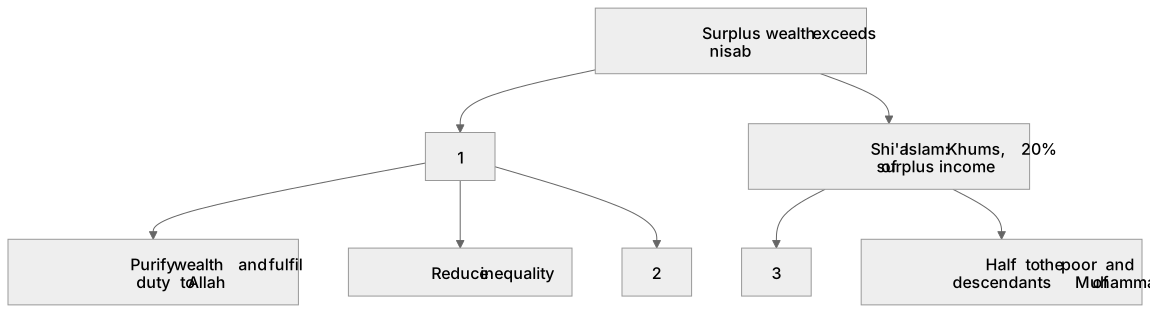
1Box 1
2Box 2
3Box 3
There is more to this lesson
The full lesson goes on to check your understanding and help you earn the marks. Create a free account to carry on, with your progress saved.
A week of Premium from your first lesson · Then the free plan continues · No card, no charge
Test your understanding of Islam - 3.1.5.2 Practices: Zakah: the role and significance of giving alms including origins, how and why it is given, benefits of receipt, Khums in Shi’a Islam.
Active recall beats re-reading. Take an instant quiz now to test what you’ve learned and lock it into long-term memory.
A week of Premium from your first lesson · Then the free plan continues · No card, no charge