AQA · GCSE · Religious Studies
Course version: 8062 · Version from Sept 2018
The importance of the sanctity of human life, including the concept of…
Full specification wording
Judaism - 3.1.6.1 Beliefs and teachings: The importance of the sanctity of human life, including the concept of ‘saving a life’ (Pikuach Nefesh).
In Judaism, the sanctity of human life is a foundational belief rooted in the idea that humans are created in the image of God (Genesis 1:27).
- Point 13 of 15
- 3 key terms
Study notes
From the teaching notes for this specification point.
The idea
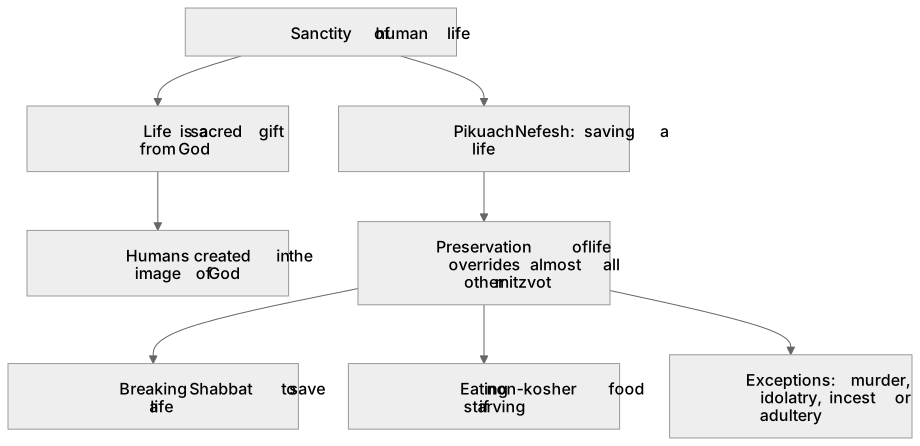
In Judaism, the sanctity of human life is a foundational belief rooted in the idea that humans are created in the image of God (Genesis 1:27). Because life is a sacred gift from God, it must be preserved and protected above all else. This principle is practically applied through the concept of Pikuach Nefesh, which means 'saving a life'. Pikuach Nefesh dictates that the preservation of human life overrides almost all other religious laws (mitzvot). For example, a Jewish doctor is required to break the strict rules of Shabbat to perform emergency surgery, or a person may eat non-kosher food if they are starving. This demonstrates that God's laws are meant to be lived by, not to cause death, highlighting the supreme value placed on human existence in Jewish teaching.
What earns the marks
- Life is sacred and holy because it is given by God and humans are made in His image.
- Pikuach Nefesh is the Jewish principle that saving a human life is more important than any other mitzvah.
- Jews are permitted, and indeed required, to break almost any Jewish law (such as Shabbat or kashrut) to save a life.
- The Talmud teaches that saving one life is like saving an entire world, emphasising the infinite value of every individual.
Common mistakes and how to put them right
Stating that Pikuach Nefesh allows Jews to break any law without exception.
Put it right: Clarify that there are three exceptions (murder, idolatry, and incest or adultery) which cannot be committed even to save a life.
Confusing Pikuach Nefesh with general charity or kindness.
Put it right: Specify that Pikuach Nefesh strictly refers to situations where a human life is in direct, immediate danger.
Believing that breaking Shabbat to save a life is a sin that requires forgiveness.
Put it right: Explain that breaking Shabbat for Pikuach Nefesh is a religious duty and a mitzvah in itself, not a sin.
Exam tips
- Use a concrete example, such as driving a pregnant woman to the hospital on Shabbat, to illustrate Pikuach Nefesh in action.
- Link the sanctity of life to the Genesis creation story, specifically the teaching that humans are made in the image of God.
- When evaluating ethical issues like abortion or euthanasia, use Pikuach Nefesh as a key argument for preserving life.
Try the lesson
The start of the Judaism - 3.1.6.1 Beliefs and teachings: The importance of the sanctity of human life, including the concept of ‘saving a life’ (Pikuach Nefesh). lesson, made from teaching notes for this specification point.
Have a go first
What does the Jewish principle of Pikuach Nefesh require a person to do?
Listen
In Judaism, the sanctity of human life is a foundational belief rooted in the idea that humans are created in the image of God (Genesis 1:27). Because life is a sacred gift from God, it must be preserved and protected above all else. This principle is practically applied through the concept of Pikuach Nefesh, which means 'saving a life'. Pikuach Nefesh dictates that the preservation of human life overrides almost all other religious laws (mitzvot). For example, a Jewish doctor is required to break the strict rules of Shabbat to perform emergency surgery, or a person may eat non-kosher food if they are starving. This demonstrates that God's laws are meant to be lived by, not to cause death, highlighting the supreme value placed on human existence in Jewish teaching. A strong answer earns marks for these points. Life is sacred and holy because it is given by God and humans are made in His image. Pikuach Nefesh is the Jewish principle that saving a human life is more important than any other mitzvah. Jews are permitted, and indeed required, to break almost any Jewish law (such as Shabbat or kashrut) to save a life. The Talmud teaches that saving one life is like saving an entire world, emphasising the infinite value of every individual. A common slip: Stating that Pikuach Nefesh allows Jews to break any law without exception. Instead, Clarify that there are three exceptions (murder, idolatry, and incest or adultery) which cannot be committed even to save a life. Exam tip: Use a concrete example, such as driving a pregnant woman to the hospital on Shabbat, to illustrate Pikuach Nefesh in action.
See it
Key words
Say what each word means before you turn the card.
Sanctity of life
Try answering aloud or in your head before turning the card.
Pikuach Nefesh
Try answering aloud or in your head before turning the card.
Mitzvot
Try answering aloud or in your head before turning the card.
See every definition
- Sanctity of life
- The belief that human life is a sacred gift from God, rooted in the idea that humans are created in the image of God.
- Pikuach Nefesh
- The principle that saving a human life overrides almost all other religious laws.
- Mitzvot
- Religious laws which the preservation of human life overrides almost all of.
Label the diagram
Some boxes have lost their names. Pick the right name for each number.
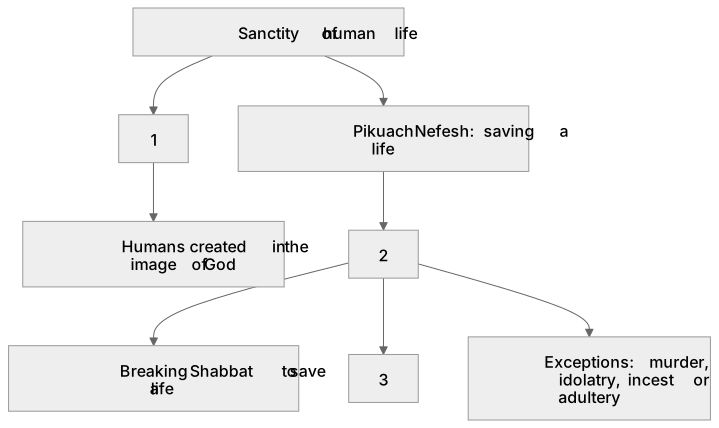
1Box 1
2Box 2
3Box 3
There is more to this lesson
The full lesson goes on to check your understanding and help you earn the marks. Create a free account to carry on, with your progress saved.
A week of Premium from your first lesson · Then the free plan continues · No card, no charge
Test your understanding of Judaism - 3.1.6.1 Beliefs and teachings: The importance of the sanctity of human life, including the concept of ‘saving a life’ (Pikuach Nefesh).
Active recall beats re-reading. Take an instant quiz now to test what you’ve learned and lock it into long-term memory.
A week of Premium from your first lesson · Then the free plan continues · No card, no charge