AQA · GCSE · Religious Studies
Course version: 8062 · Version from Sept 2018
Practices: Festivals and lifestyle
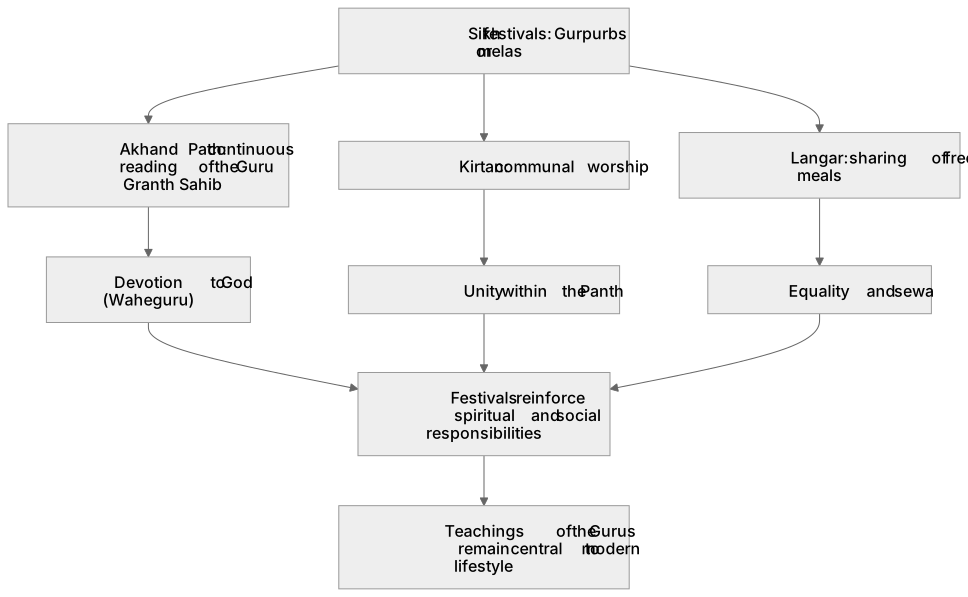
Sikh festivals, known as Gurpurbs (when celebrating Gurus) or melas (fairs), are deeply intertwined with the daily Sikh lifestyle.
Checked against the AQA 8062 specification (opens in a new tab) on .
- Point 29 of 37
- 3 key terms
Study notes
From the checked teaching notes for this specification point.
The idea
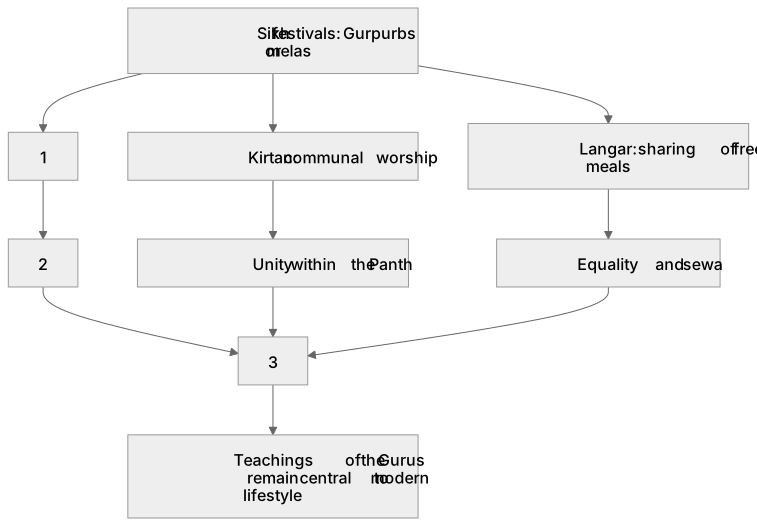
Sikh festivals, known as Gurpurbs (when celebrating Gurus) or melas (fairs), are deeply intertwined with the daily Sikh lifestyle. They are not merely historical commemorations but active expressions of core Sikh values such as equality, community service (sewa), and devotion to God (Waheguru). During festivals, the Sikh lifestyle is visibly demonstrated through continuous readings of the Guru Granth Sahib (Akhand Path), communal worship (kirtan), and the sharing of free meals in the langar. These practices reinforce the spiritual and social responsibilities of a Sikh, ensuring that the teachings of the Gurus remain central to their modern lifestyle, fostering a strong sense of identity and unity within the Panth (Sikh community).
What earns the marks
- Explain how festivals reinforce core Sikh values such as equality, devotion, and sewa.
- Describe the role of the langar during festivals as a practical demonstration of the Sikh lifestyle.
- Identify the Akhand Path (continuous reading of the Guru Granth Sahib) as a central practice during major festivals.
- Evaluate the impact of communal worship (kirtan) on strengthening the Sikh community (Panth).
Common mistakes and how to put them right
Stating that festivals are only about having fun or taking a day off.
Put it right: Emphasise that festivals are primarily spiritual events focused on remembering the Gurus and performing sewa.
Confusing Sikh festivals with Hindu festivals of the same name without noting the distinct Sikh significance.
Put it right: Explain the specific Sikh meaning, such as Bandi Chhor Divas instead of just Diwali.
Viewing the Sikh lifestyle as separate from festival observance.
Put it right: Explain that festivals are a concentrated expression of the daily Sikh lifestyle, magnifying practices like langar and prayer.
Exam tips
- Always link the celebration of a festival back to how it influences a Sikh's daily actions and lifestyle choices.
- Use specific Punjabi terms like 'sewa', 'langar', and 'kirtan' when describing festival activities to demonstrate subject knowledge.
- When evaluating the importance of festivals, contrast their spiritual benefits for the individual with their social benefits for the community.
Try the lesson
The start of the Practices: Festivals and lifestyle lesson, made from checked teaching notes for this specification point.
Have a go first
Which of the following is a common practice in the Sikh lifestyle leading up to a major festival?
Listen
Sikh festivals, known as Gurpurbs (when celebrating Gurus) or melas (fairs), are deeply intertwined with the daily Sikh lifestyle. They are not merely historical commemorations but active expressions of core Sikh values such as equality, community service (sewa), and devotion to God (Waheguru). During festivals, the Sikh lifestyle is visibly demonstrated through continuous readings of the Guru Granth Sahib (Akhand Path), communal worship (kirtan), and the sharing of free meals in the langar. These practices reinforce the spiritual and social responsibilities of a Sikh, ensuring that the teachings of the Gurus remain central to their modern lifestyle, fostering a strong sense of identity and unity within the Panth (Sikh community). A strong answer earns marks for these points. Explain how festivals reinforce core Sikh values such as equality, devotion, and sewa. Describe the role of the langar during festivals as a practical demonstration of the Sikh lifestyle. Identify the Akhand Path (continuous reading of the Guru Granth Sahib) as a central practice during major festivals. Evaluate the impact of communal worship (kirtan) on strengthening the Sikh community (Panth). A common slip: Stating that festivals are only about having fun or taking a day off. Instead, Emphasise that festivals are primarily spiritual events focused on remembering the Gurus and performing sewa. Exam tip: Always link the celebration of a festival back to how it influences a Sikh's daily actions and lifestyle choices.
See it
Key words
Say what each word means before you turn the card.
Community (Panth)
Try answering aloud or in your head before turning the card.
Sewa (Selfless Service)
Try answering aloud or in your head before turning the card.
Equality
Try answering aloud or in your head before turning the card.
See every definition
- Community (Panth)
- The Sikh community, within which festivals foster a strong sense of identity and unity.
- Sewa (Selfless Service)
- A core Sikh value actively expressed during festivals, reinforcing the spiritual and social responsibilities of a Sikh.
- Equality
- A core Sikh value actively expressed during festivals, alongside community service and devotion to God.
Label the diagram
Some boxes have lost their names. Pick the right name for each number.
1Box 1
2Box 2
3Box 3
There is more to this lesson
The full lesson goes on to check your understanding and help you earn the marks. Create a free account to carry on, with your progress saved.
A week of Premium from your first lesson · Then the free plan continues · No card, no charge
Test your understanding of Practices: Festivals and lifestyle
Active recall beats re-reading. Take an instant quiz now to test what you’ve learned and lock it into long-term memory.
A week of Premium from your first lesson · Then the free plan continues · No card, no charge