AQA · GCSE · Religious Studies
Course version: 8062 · Version from Sept 2018
The significance of meditating on the name of God (nam japna) in daily…
Full specification wording
Practices: The significance of meditating on the name of God (nam japna) in daily life and in the gurdwara.
Nam japna is the Sikh practice of meditating on the name of God, forming one of the three pillars of Sikhism established by Guru Nanak.
Checked against the AQA 8062 specification (opens in a new tab) on .
- Point 28 of 37
- 4 key terms
Study notes
From the checked teaching notes for this specification point.
The idea
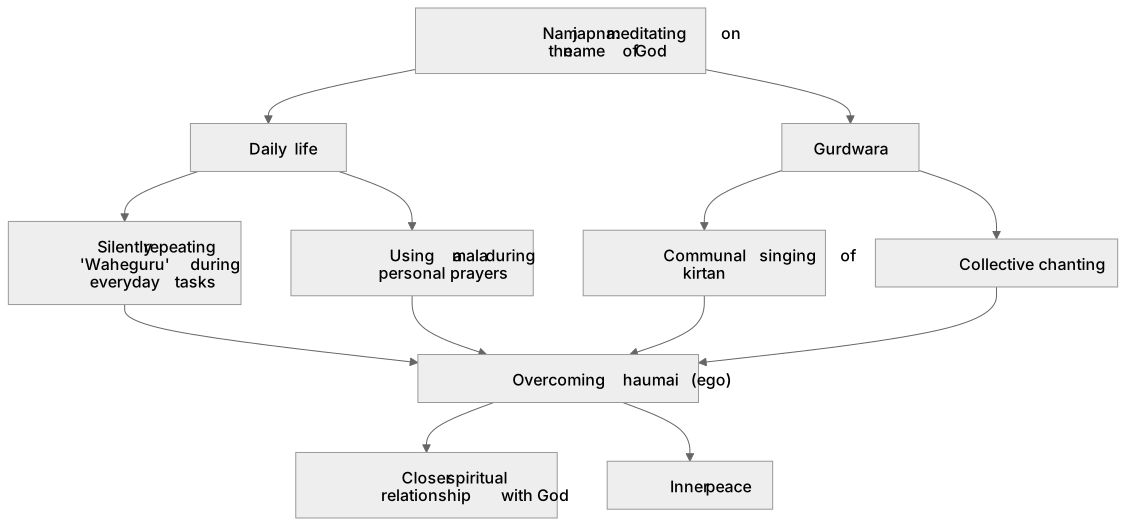
Nam japna is the Sikh practice of meditating on the name of God, forming one of the three pillars of Sikhism established by Guru Nanak. In daily life, Sikhs practice nam japna by silently repeating 'Waheguru' (Wonderful Lord) during everyday tasks or using a mala (rosary) during personal prayers, keeping God central to their existence. In the gurdwara, nam japna takes a communal form through the singing of kirtan (hymns) and collective chanting. This practice is highly significant as it helps Sikhs overcome haumai (ego), develop a closer spiritual relationship with God, and maintain inner peace. It bridges the gap between individual devotion and communal worship, ensuring faith permeates all aspects of a Sikh's life.
What earns the marks
- Define nam japna as the continuous remembrance and meditation on the name of God, often using the word 'Waheguru'.
- Explain how nam japna is practised in daily life through silent repetition during chores or focused personal prayer.
- Describe the communal practice of nam japna in the gurdwara, such as listening to or singing kirtan (hymns).
- Analyse the spiritual significance of nam japna in helping Sikhs conquer haumai (ego) and achieve mukti (liberation).
Common mistakes and how to put them right
Assuming nam japna only happens in the gurdwara.
Put it right by explaining it is a continuous practice meant to be integrated into daily life and work.
Confusing nam japna with simply reading scriptures.
Put it right by clarifying that it specifically involves meditating on or repeating God's name to cultivate inner focus.
Failing to link nam japna to its spiritual goal.
Put it right: Explicitly stating that its purpose is to eliminate ego (haumai) and connect with the divine.
Exam tips
- Explicitly distinguish between how nam japna is performed individually at home and communally in the gurdwara to fully answer the specification point.
- Use the term 'Waheguru' as a concrete example of the name of God that Sikhs meditate upon.
- Connect nam japna to the other two pillars of Sikhism (kirat karna and vand chhakna) to show a holistic understanding of Sikh daily life.
Try the lesson
The start of the Practices: The significance of meditating on the name of God (nam japna) in daily life and in the gurdwara. lesson, made from checked teaching notes for this specification point.
Have a go first
What does the Sikh practice of nam japna primarily involve in daily life?
Listen
Nam japna is the Sikh practice of meditating on the name of God, forming one of the three pillars of Sikhism established by Guru Nanak. In daily life, Sikhs practice nam japna by silently repeating 'Waheguru' (Wonderful Lord) during everyday tasks or using a mala (rosary) during personal prayers, keeping God central to their existence. In the gurdwara, nam japna takes a communal form through the singing of kirtan (hymns) and collective chanting. This practice is highly significant as it helps Sikhs overcome haumai (ego), develop a closer spiritual relationship with God, and maintain inner peace. It bridges the gap between individual devotion and communal worship, ensuring faith permeates all aspects of a Sikh's life. A strong answer earns marks for these points. Define nam japna as the continuous remembrance and meditation on the name of God, often using the word 'Waheguru'. Explain how nam japna is practised in daily life through silent repetition during chores or focused personal prayer. Describe the communal practice of nam japna in the gurdwara, such as listening to or singing kirtan (hymns). Analyse the spiritual significance of nam japna in helping Sikhs conquer haumai (ego) and achieve mukti (liberation). A common slip: Assuming nam japna only happens in the gurdwara. Instead, explaining it is a continuous practice meant to be integrated into daily life and work. Exam tip: Explicitly distinguish between how nam japna is performed individually at home and communally in the gurdwara to fully answer the specification point.
See it
Key words
Say what each word means before you turn the card.
Nam japna
Try answering aloud or in your head before turning the card.
Haumai
Try answering aloud or in your head before turning the card.
Kirtan
Try answering aloud or in your head before turning the card.
Waheguru
Try answering aloud or in your head before turning the card.
See every definition
- Nam japna
- The Sikh practice of meditating on the name of God, forming one of the three pillars of Sikhism established by Guru Nanak.
- Haumai
- Ego, which the practice of nam japna helps Sikhs to overcome.
- Kirtan
- Hymns sung in the gurdwara as a communal form of nam japna.
- Waheguru
- Wonderful Lord, the word Sikhs silently repeat during everyday tasks in the practice of nam japna.
Label the diagram
Some boxes have lost their names. Pick the right name for each number.
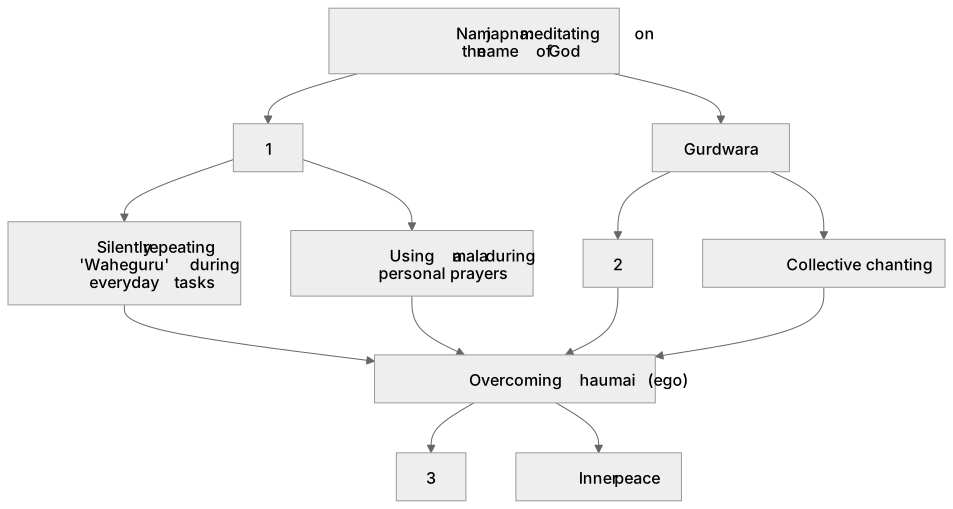
1Box 1
2Box 2
3Box 3
There is more to this lesson
The full lesson goes on to check your understanding and help you earn the marks. Create a free account to carry on, with your progress saved.
A week of Premium from your first lesson · Then the free plan continues · No card, no charge
Test your understanding of Practices: The significance of meditating on the name of God (nam japna) in daily life and in the gurdwara.
Active recall beats re-reading. Take an instant quiz now to test what you’ve learned and lock it into long-term memory.
A week of Premium from your first lesson · Then the free plan continues · No card, no charge