AQA · GCSE · Religious Studies
Course version: 8062 · Version from Sept 2018
Gurpurbs, including Guru Nanak’s birthday and differences in the way…
Full specification wording
Practices: Gurpurbs, including Guru Nanak’s birthday and differences in the way gurpurbs are celebrated in India and Great Britain.
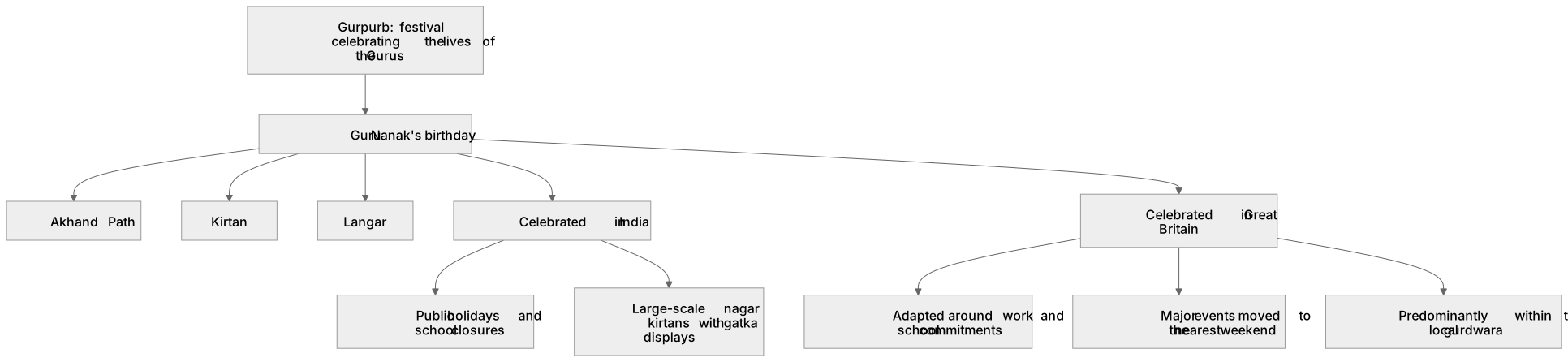
Gurpurbs are Sikh festivals celebrating the lives of the Gurus, such as anniversaries of their births or martyrdoms.
Checked against the AQA 8062 specification (opens in a new tab) on .
- Point 33 of 37
- 4 key terms
Study notes
From the checked teaching notes for this specification point.
The idea
Gurpurbs are Sikh festivals celebrating the lives of the Gurus, such as anniversaries of their births or martyrdoms. A major Gurpurb is Guru Nanak’s birthday, commemorating the founder of Sikhism. Celebrations typically involve an Akhand Path (continuous reading of the Guru Granth Sahib), kirtan (singing hymns), and a langar (community meal). In India, celebrations are vast, featuring massive street processions (nagar kirtans) with martial arts (gatka) displays, school closures, and public holidays. In Great Britain, while nagar kirtans still occur in cities with large Sikh populations, celebrations are often adapted to fit around work and school commitments, with major events frequently moved to the nearest weekend and taking place predominantly within the local gurdwara rather than as national public holidays.
What earns the marks
- Define Gurpurb as a festival linked to the lives of the ten human Gurus.
- Describe the specific practices of Guru Nanak's birthday, including the Akhand Path and langar.
- Explain that in India, Gurpurbs are often public holidays with large-scale nagar kirtans (street processions).
- Contrast this with Great Britain, where celebrations may be moved to weekends to accommodate work and school schedules.
Common mistakes and how to put them right
Confusing Gurpurbs with Hindu festivals like Diwali.
Put it right: Gurpurbs are specifically Sikh festivals commemorating the Gurus, whereas Diwali (Bandi Chhor Divas for Sikhs) has a different historical focus.
Assuming celebrations in Great Britain are identical to those in India.
Put it right: Recognise that British celebrations are often adapted to weekends due to the lack of public holidays for Sikh festivals.
Stating that Guru Nanak's birthday is the only Gurpurb.
Put it right: Gurpurbs celebrate various events, including the martyrdom of Guru Arjan and the birth of Guru Gobind Singh.
Exam tips
- Use the term 'nagar kirtan' when describing the street processions that take place during Gurpurbs.
- When asked to compare, explicitly use comparative language to contrast the scale and timing of celebrations in India versus Great Britain.
- Link the celebration of Guru Nanak's birthday to his specific teachings on equality, demonstrated through the langar.
Try the lesson
The start of the Practices: Gurpurbs, including Guru Nanak’s birthday and differences in the way gurpurbs are celebrated in India and Great Britain. lesson, made from checked teaching notes for this specification point.
Have a go first
What does the term 'Gurpurb' refer to in Sikhism?
Listen
Gurpurbs are Sikh festivals celebrating the lives of the Gurus, such as anniversaries of their births or martyrdoms. A major Gurpurb is Guru Nanak’s birthday, commemorating the founder of Sikhism. Celebrations typically involve an Akhand Path (continuous reading of the Guru Granth Sahib), kirtan (singing hymns), and a langar (community meal). In India, celebrations are vast, featuring massive street processions (nagar kirtans) with martial arts (gatka) displays, school closures, and public holidays. In Great Britain, while nagar kirtans still occur in cities with large Sikh populations, celebrations are often adapted to fit around work and school commitments, with major events frequently moved to the nearest weekend and taking place predominantly within the local gurdwara rather than as national public holidays. A strong answer earns marks for these points. Define Gurpurb as a festival linked to the lives of the ten human Gurus. Describe the specific practices of Guru Nanak's birthday, including the Akhand Path and langar. Explain that in India, Gurpurbs are often public holidays with large-scale nagar kirtans (street processions). Contrast this with Great Britain, where celebrations may be moved to weekends to accommodate work and school schedules. A common slip: Confusing Gurpurbs with Hindu festivals like Diwali. Instead, Gurpurbs are specifically Sikh festivals commemorating the Gurus, whereas Diwali (Bandi Chhor Divas for Sikhs) has a different historical focus. Exam tip: Use the term 'nagar kirtan' when describing the street processions that take place during Gurpurbs.
See it
Key words
Say what each word means before you turn the card.
Gurpurbs
Try answering aloud or in your head before turning the card.
Akhand Path
Try answering aloud or in your head before turning the card.
Nagar kirtans
Try answering aloud or in your head before turning the card.
Langar
Try answering aloud or in your head before turning the card.
See every definition
- Gurpurbs
- Sikh festivals celebrating the lives of the Gurus, such as anniversaries of their births or martyrdoms.
- Akhand Path
- Continuous reading of the Guru Granth Sahib, which celebrations typically involve.
- Nagar kirtans
- Massive street processions held during celebrations in India, and still occurring in British cities with large Sikh populations.
- Langar
- Community meal that celebrations typically involve.
Label the diagram
Some boxes have lost their names. Pick the right name for each number.
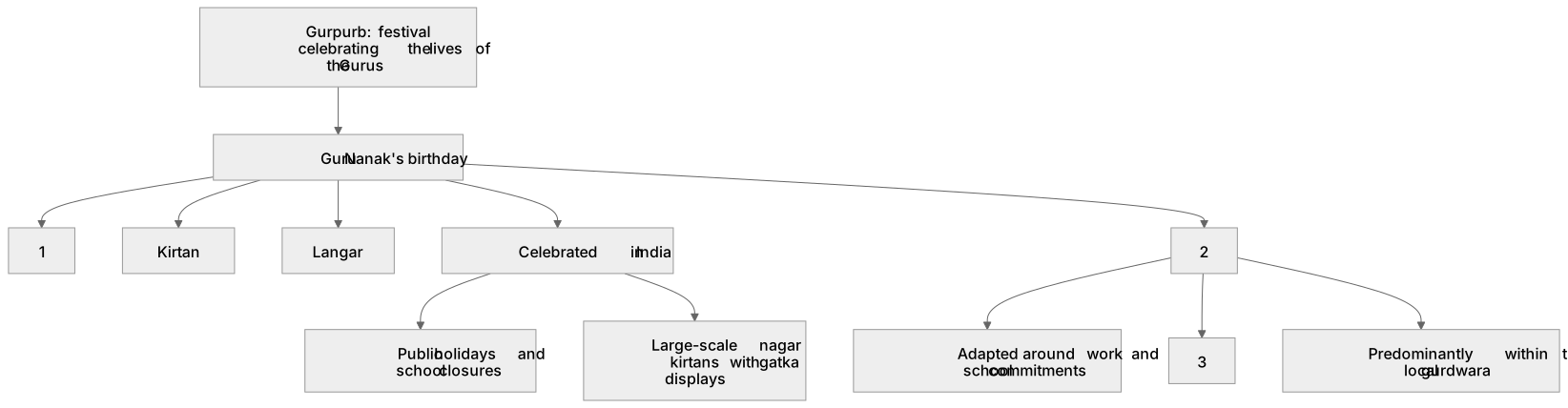
1Box 1
2Box 2
3Box 3
There is more to this lesson
The full lesson goes on to check your understanding and help you earn the marks. Create a free account to carry on, with your progress saved.
A week of Premium from your first lesson · Then the free plan continues · No card, no charge
Test your understanding of Practices: Gurpurbs, including Guru Nanak’s birthday and differences in the way gurpurbs are celebrated in India and Great Britain.
Active recall beats re-reading. Take an instant quiz now to test what you’ve learned and lock it into long-term memory.
A week of Premium from your first lesson · Then the free plan continues · No card, no charge