AQA · GCSE · Religious Studies
Course version: 8062 · Version from Sept 2018
The importance of visiting Sikh historical gurdwaras, including the Golden…
Full specification wording
Practices: The importance of visiting Sikh historical gurdwaras, including the Golden Temple (Harimandir Sahib) in Amritsar.
Visiting historical gurdwaras is a profound spiritual practice for many Sikhs, offering a tangible connection to the history and sacrifices of the Gurus.
Checked against the AQA 8062 specification (opens in a new tab) on .
- Point 34 of 37
- 4 key terms
Study notes
From the checked teaching notes for this specification point.
The idea
Visiting historical gurdwaras is a profound spiritual practice for many Sikhs, offering a tangible connection to the history and sacrifices of the Gurus. These sites provide inspiration, strengthen community bonds, and deepen personal faith. The most significant of these is the Golden Temple, or Harimandir Sahib, located in Amritsar. Built by Guru Arjan, it features four entrances symbolising that people from all castes and directions are welcome, reflecting the core Sikh belief in equality. Pilgrimage to the Harimandir Sahib involves bathing in the amrit sarovar (pool of nectar) for spiritual cleansing, listening to continuous kirtan, and volunteering in the world's largest langar. While pilgrimage is not a mandatory duty in Sikhism, visiting such historical sites profoundly enriches a Sikh's spiritual journey and historical identity.
What earns the marks
- Explain that historical gurdwaras connect Sikhs to the lives, teachings, and sacrifices of the ten Gurus.
- Identify the Golden Temple (Harimandir Sahib) in Amritsar as the most prominent historical gurdwara.
- Describe the architectural symbolism of the Harimandir Sahib, such as its four doors representing universal equality and welcome.
- Discuss the spiritual benefits of visiting, including bathing in the sarovar (pool) and participating in sewa (selfless service) at the langar.
- Note that while visiting is highly valued for spiritual growth, Sikhism does not consider pilgrimage a mandatory requirement for salvation.
Common mistakes and how to put them right
Claiming that pilgrimage to Amritsar is a mandatory duty like the Islamic Hajj.
Put it right: State that while highly beneficial and important, pilgrimage is not compulsory in Sikhism.
Referring to the site only as the Golden Temple.
Put it right: Use its proper Sikh name, Harimandir Sahib, alongside the English translation to demonstrate accurate subject knowledge.
Stating the water in the sarovar washes away physical sins.
Put it right: Explain that bathing in the pool is a symbol of spiritual cleansing and inner purity rather than a magical removal of sin.
Exam tips
- Mention the four doors of the Harimandir Sahib as a concrete example of how Sikh architecture reflects the belief in equality.
- Use the concept of sewa (selfless service) when explaining what Sikhs do when they visit historical gurdwaras.
- Evaluate the importance of pilgrimage by contrasting the spiritual inspiration gained from visiting with Guru Nanak's teaching that true pilgrimage is an internal journey.
Try the lesson
The start of the Practices: The importance of visiting Sikh historical gurdwaras, including the Golden Temple (Harimandir Sahib) in Amritsar. lesson, made from checked teaching notes for this specification point.
Have a go first
In which city is the Golden Temple (Harimandir Sahib) located?
Listen
Visiting historical gurdwaras is a profound spiritual practice for many Sikhs, offering a tangible connection to the history and sacrifices of the Gurus. These sites provide inspiration, strengthen community bonds, and deepen personal faith. The most significant of these is the Golden Temple, or Harimandir Sahib, located in Amritsar. Built by Guru Arjan, it features four entrances symbolising that people from all castes and directions are welcome, reflecting the core Sikh belief in equality. Pilgrimage to the Harimandir Sahib involves bathing in the amrit sarovar (pool of nectar) for spiritual cleansing, listening to continuous kirtan, and volunteering in the world's largest langar. While pilgrimage is not a mandatory duty in Sikhism, visiting such historical sites profoundly enriches a Sikh's spiritual journey and historical identity. A strong answer earns marks for these points. Explain that historical gurdwaras connect Sikhs to the lives, teachings, and sacrifices of the ten Gurus. Identify the Golden Temple (Harimandir Sahib) in Amritsar as the most prominent historical gurdwara. Describe the architectural symbolism of the Harimandir Sahib, such as its four doors representing universal equality and welcome. Discuss the spiritual benefits of visiting, including bathing in the sarovar (pool) and participating in sewa (selfless service) at the langar. A common slip: Claiming that pilgrimage to Amritsar is a mandatory duty like the Islamic Hajj. Instead, state that while highly beneficial and important, pilgrimage is not compulsory in Sikhism. Exam tip: Mention the four doors of the Harimandir Sahib as a concrete example of how Sikh architecture reflects the belief in equality.
See it

Key words
Say what each word means before you turn the card.
Pilgrimage and sacred spaces
Try answering aloud or in your head before turning the card.
Equality and universalism
Try answering aloud or in your head before turning the card.
Sewa (selfless service)
Try answering aloud or in your head before turning the card.
Spiritual cleansing
Try answering aloud or in your head before turning the card.
See every definition
- Pilgrimage and sacred spaces
- Visiting historical gurdwaras is a profound spiritual practice for many Sikhs, offering a tangible connection to the history and sacrifices of the Gurus.
- Equality and universalism
- Four entrances symbolise that people from all castes and directions are welcome, reflecting the core Sikh belief in equality.
- Sewa (selfless service)
- Volunteering in the world's largest langar is part of pilgrimage to the Harimandir Sahib.
- Spiritual cleansing
- Bathing in the amrit sarovar, the pool of nectar, is for spiritual cleansing.
Label the diagram
Some boxes have lost their names. Pick the right name for each number.
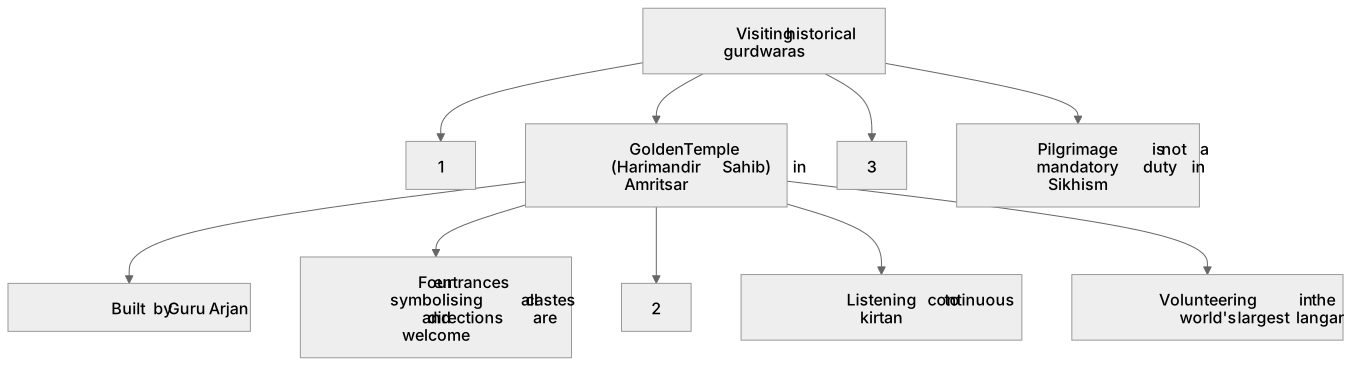
1Box 1
2Box 2
3Box 3
There is more to this lesson
The full lesson goes on to check your understanding and help you earn the marks. Create a free account to carry on, with your progress saved.
A week of Premium from your first lesson · Then the free plan continues · No card, no charge
Test your understanding of Practices: The importance of visiting Sikh historical gurdwaras, including the Golden Temple (Harimandir Sahib) in Amritsar.
Active recall beats re-reading. Take an instant quiz now to test what you’ve learned and lock it into long-term memory.
A week of Premium from your first lesson · Then the free plan continues · No card, no charge