AQA · GCSE · Religious Studies
Course version: 8062 · Version from Sept 2018
Practices: Pesach.
Pesach, or Passover, is a major Jewish festival commemorating the liberation of the Israelites from slavery in ancient Egypt, as detailed in the book of Exodus.
Checked against the AQA 8062 specification (opens in a new tab) on .
- Point 21 of 37
- 4 key terms
Study notes
From the checked teaching notes for this specification point.
The idea
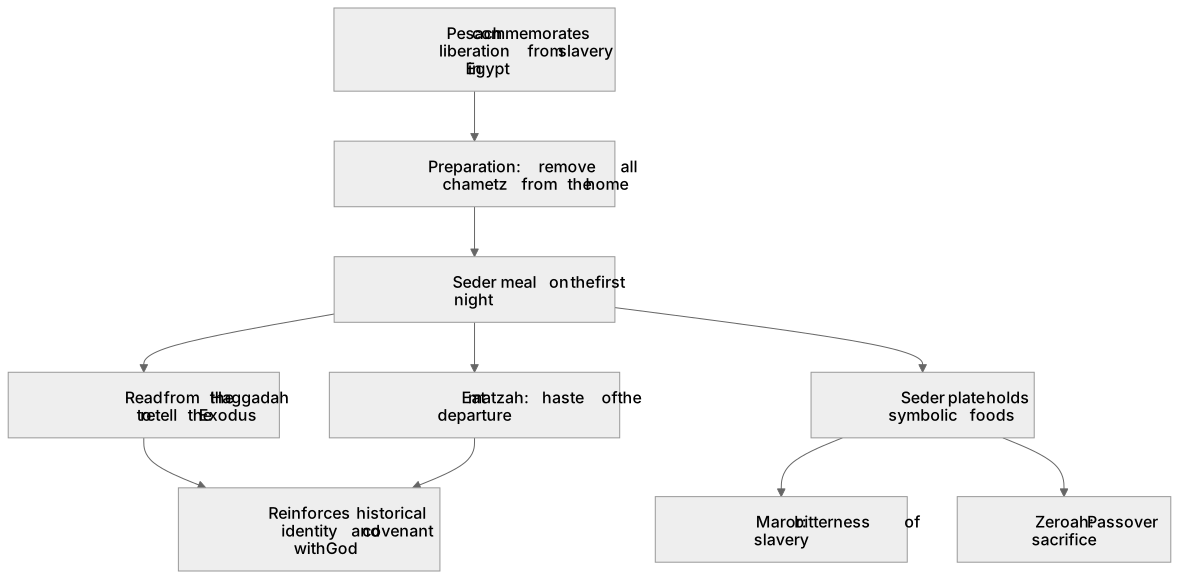
Pesach, or Passover, is a major Jewish festival commemorating the liberation of the Israelites from slavery in ancient Egypt, as detailed in the book of Exodus. The festival lasts for seven or eight days and requires the complete removal of chametz (leavened food) from the home. The focal point is the Seder meal held on the first night, where families read from the Haggadah to retell the story of the Exodus. A Seder plate holds symbolic foods, such as maror (bitter herbs) representing the bitterness of slavery, and zeroah (a roasted bone) symbolising the Passover sacrifice. Jews eat matzah (unleavened bread) to remember the haste with which their ancestors fled Egypt, reinforcing their historical identity and covenant with God.
What earns the marks
- Explain the historical and theological origins of Pesach, specifically the Exodus from Egypt and God's deliverance of the Israelites.
- Describe the preparation for Pesach, including the thorough cleaning of the home to remove all traces of chametz (leaven).
- Detail the components of the Seder meal, including the reading of the Haggadah and the symbolic foods on the Seder plate.
- Explain the symbolism of specific foods, such as matzah representing the hasty departure and maror representing the bitterness of slavery.
Common mistakes and how to put them right
Referring to the festival only as a celebration of spring.
Put it right: While it occurs in spring, its primary religious significance is the historical liberation from Egyptian slavery.
Confusing the symbolic foods on the Seder plate.
Put it right: Ensure you correctly pair the food with its meaning, such as charoset representing the mortar used by the slaves, not the bitterness.
Stating that Pesach is only celebrated in the synagogue.
Put it right: Pesach is primarily a home-based festival centred around the family Seder meal.
Exam tips
- Memorise at least three items on the Seder plate and their exact symbolic meanings to use as concrete evidence in your answers.
- Connect the observance of Pesach to the broader Jewish concept of the covenant and God's role as a redeemer.
- Use the term 'Haggadah' when discussing how the story of the Exodus is passed down to the next generation during the Seder.
Try the lesson
The start of the Practices: Pesach. lesson, made from checked teaching notes for this specification point.
Have a go first
Which historical event is commemorated by the Jewish festival of Pesach?
Listen
Pesach, or Passover, is a major Jewish festival commemorating the liberation of the Israelites from slavery in ancient Egypt, as detailed in the book of Exodus. The festival lasts for seven or eight days and requires the complete removal of chametz (leavened food) from the home. The focal point is the Seder meal held on the first night, where families read from the Haggadah to retell the story of the Exodus. A Seder plate holds symbolic foods, such as maror (bitter herbs) representing the bitterness of slavery, and zeroah (a roasted bone) symbolising the Passover sacrifice. Jews eat matzah (unleavened bread) to remember the haste with which their ancestors fled Egypt, reinforcing their historical identity and covenant with God. A strong answer earns marks for these points. Explain the historical and theological origins of Pesach, specifically the Exodus from Egypt and God's deliverance of the Israelites. Describe the preparation for Pesach, including the thorough cleaning of the home to remove all traces of chametz (leaven). Detail the components of the Seder meal, including the reading of the Haggadah and the symbolic foods on the Seder plate. Explain the symbolism of specific foods, such as matzah representing the hasty departure and maror representing the bitterness of slavery. A common slip: Referring to the festival only as a celebration of spring. Instead, while it occurs in spring, its primary religious significance is the historical liberation from Egyptian slavery. Exam tip: Memorise at least three items on the Seder plate and their exact symbolic meanings to use as concrete evidence in your answers.
See it
Key words
Say what each word means before you turn the card.
Pesach
Try answering aloud or in your head before turning the card.
chametz
Try answering aloud or in your head before turning the card.
Seder meal
Try answering aloud or in your head before turning the card.
matzah
Try answering aloud or in your head before turning the card.
See every definition
- Pesach
- A major Jewish festival commemorating the liberation of the Israelites from slavery in ancient Egypt, as detailed in the book of Exodus.
- chametz
- Leavened food, which must be completely removed from the home for the seven or eight days of the festival.
- Seder meal
- The focal point of the festival, held on the first night, where families read from the Haggadah to retell the story of the Exodus.
- matzah
- Unleavened bread eaten to remember the haste with which the ancestors fled Egypt.
Label the diagram
Some boxes have lost their names. Pick the right name for each number.
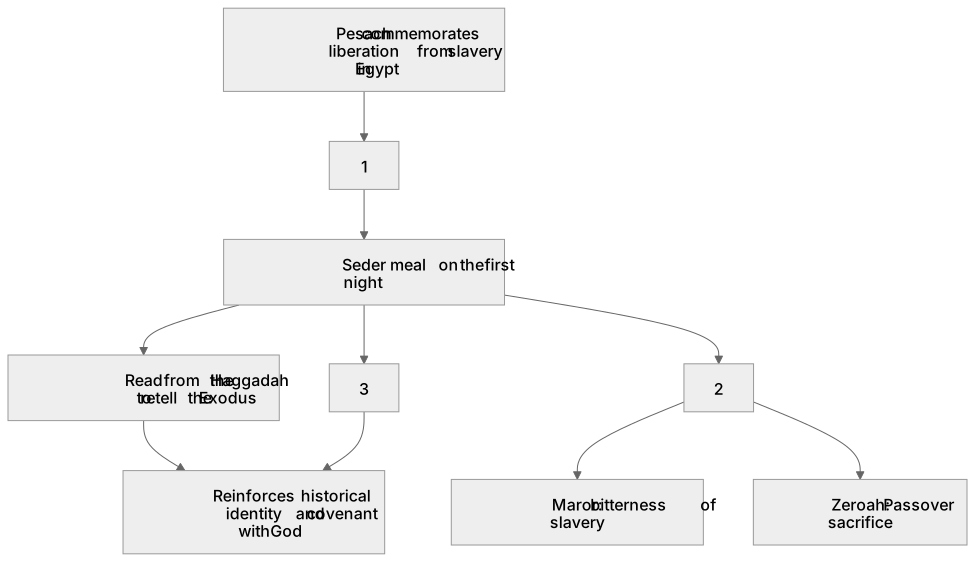
1Box 1
2Box 2
3Box 3
There is more to this lesson
The full lesson goes on to check your understanding and help you earn the marks. Create a free account to carry on, with your progress saved.
A week of Premium from your first lesson · Then the free plan continues · No card, no charge
Test your understanding of Practices: Pesach.
Active recall beats re-reading. Take an instant quiz now to test what you’ve learned and lock it into long-term memory.
A week of Premium from your first lesson · Then the free plan continues · No card, no charge