AQA · GCSE · Religious Studies
Course version: 8062 · Version from Sept 2018
Practices: Public acts of worship including:
Public acts of worship in Judaism are communal religious expressions that unite the congregation, reinforcing Jewish identity and shared faith.
Checked against the AQA 8062 specification (opens in a new tab) on .
- Point 4 of 37
- 4 key terms
Study notes
From the checked teaching notes for this specification point.
The idea
Public acts of worship in Judaism are communal religious expressions that unite the congregation, reinforcing Jewish identity and shared faith. Unlike private prayer, public worship requires a minyan (a quorum of ten adults) for certain prayers like the Kaddish or the reading of the Torah. These acts take place primarily in the synagogue, serving as a focal point for the community. Public worship provides a structured environment for Jews to connect with God collectively, celebrate festivals, and observe Shabbat. It emphasises the importance of community (Klal Yisrael) and ensures the continuity of Jewish traditions passed down through generations.
What earns the marks
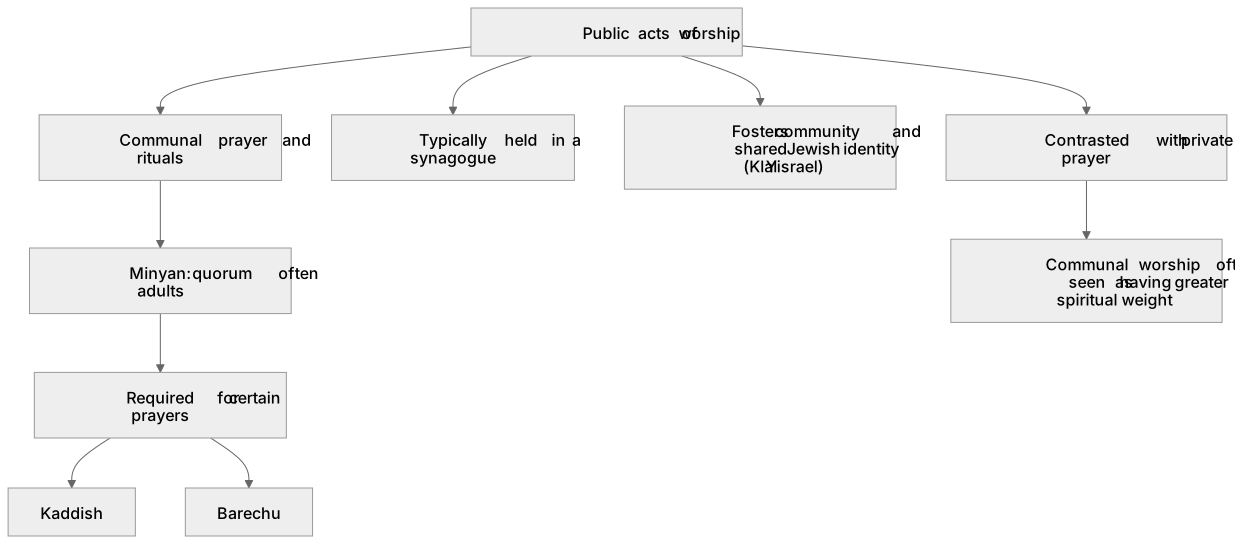
- Define public worship as communal prayer and rituals, typically held in a synagogue.
- Explain the requirement of a minyan (ten adults) for specific prayers such as the Kaddish and the Barechu.
- Discuss the role of public worship in fostering a sense of community and shared Jewish identity (Klal Yisrael).
- Contrast public worship with private prayer, noting that communal worship is often seen as having greater spiritual weight.
Common mistakes and how to put them right
Confusing public worship with private prayer.
Put it right: Ensure public worship is explicitly linked to communal settings like the synagogue and often requires a minyan.
Assuming all prayers can be said alone.
Put it right: Specify that certain prayers, like the Mourner's Kaddish, strictly require a public gathering of ten adults.
Stating that public worship only happens on Shabbat.
Put it right: Note that public acts of worship occur daily in many communities, as well as on festivals.
Exam tips
- Use the term 'minyan' when discussing the requirements for public worship to demonstrate subject-specific vocabulary.
- Link the concept of public worship to the strengthening of the Jewish community and the preservation of faith.
- Be prepared to evaluate whether public worship is more important than private worship in the home.
Try the lesson
The start of the Practices: Public acts of worship including: lesson, made from checked teaching notes for this specification point.
Have a go first
What is the term for the quorum of ten Jewish adults required for a full public worship service?
Listen
Public acts of worship in Judaism are communal religious expressions that unite the congregation, reinforcing Jewish identity and shared faith. Unlike private prayer, public worship requires a minyan (a quorum of ten adults) for certain prayers like the Kaddish or the reading of the Torah. These acts take place primarily in the synagogue, serving as a focal point for the community. Public worship provides a structured environment for Jews to connect with God collectively, celebrate festivals, and observe Shabbat. It emphasises the importance of community (Klal Yisrael) and ensures the continuity of Jewish traditions passed down through generations. A strong answer earns marks for these points. Define public worship as communal prayer and rituals, typically held in a synagogue. Explain the requirement of a minyan (ten adults) for specific prayers such as the Kaddish and the Barechu. Discuss the role of public worship in fostering a sense of community and shared Jewish identity (Klal Yisrael). Contrast public worship with private prayer, noting that communal worship is often seen as having greater spiritual weight. A common slip: Confusing public worship with private prayer. Instead, ensure public worship is explicitly linked to communal settings like the synagogue and often requires a minyan. Exam tip: Use the term 'minyan' when discussing the requirements for public worship to demonstrate subject-specific vocabulary.
See it
Key words
Say what each word means before you turn the card.
Community (Klal Yisrael)
Try answering aloud or in your head before turning the card.
Synagogue
Try answering aloud or in your head before turning the card.
Minyan
Try answering aloud or in your head before turning the card.
Tradition
Try answering aloud or in your head before turning the card.
See every definition
- Community (Klal Yisrael)
- Emphasised in public worship, it ensures the continuity of Jewish traditions passed down through generations.
- Synagogue
- Serves as a focal point for the community where public acts of worship take place.
- Minyan
- A quorum of ten adults required for certain prayers like the Kaddish or the reading of the Torah.
- Tradition
- Jewish traditions are passed down through generations and their continuity is ensured by public worship.
Label the diagram
Some boxes have lost their names. Pick the right name for each number.
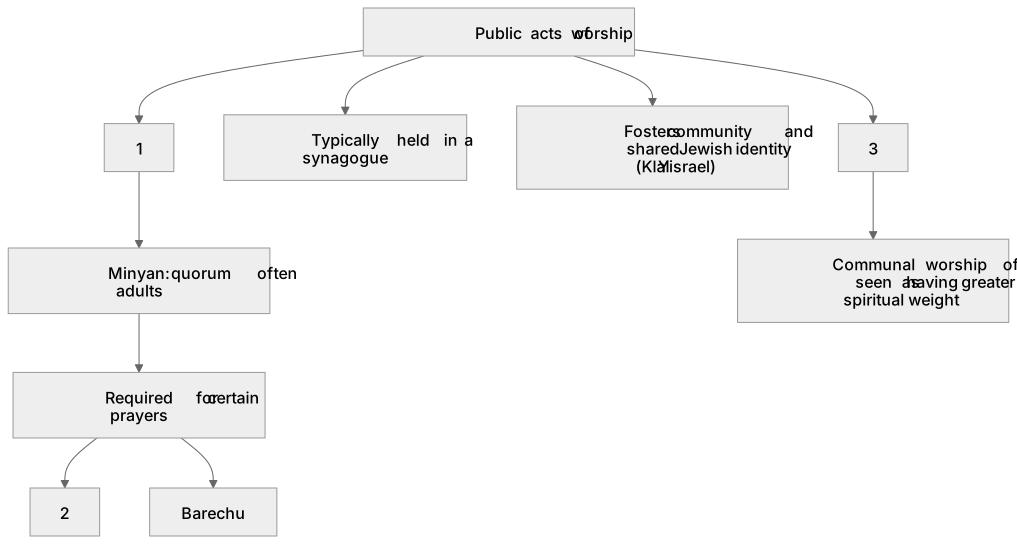
1Box 1
2Box 2
3Box 3
There is more to this lesson
The full lesson goes on to check your understanding and help you earn the marks. Create a free account to carry on, with your progress saved.
A week of Premium from your first lesson · Then the free plan continues · No card, no charge
Test your understanding of Practices: Public acts of worship including:
Active recall beats re-reading. Take an instant quiz now to test what you’ve learned and lock it into long-term memory.
A week of Premium from your first lesson · Then the free plan continues · No card, no charge