AQA · GCSE · Religious Studies
Course version: 8062 · Version from Sept 2018
The design and religious features of synagogues including bimah (reading…
Full specification wording
Practices: The design and religious features of synagogues including bimah (reading platform), aron hakodesh (ark), ner tamid (ever burning light) and associated practices; differences between Orthodox and Reform synagogues.
Synagogue design reflects deep religious symbolism.
Checked against the AQA 8062 specification (opens in a new tab) on .
- Point 3 of 37
- 4 key terms
Study notes
From the checked teaching notes for this specification point.
The idea
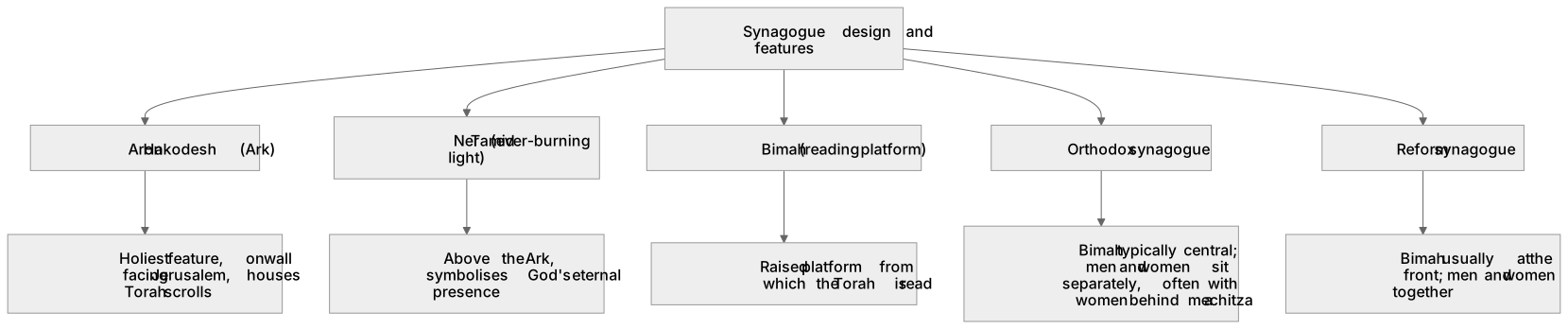
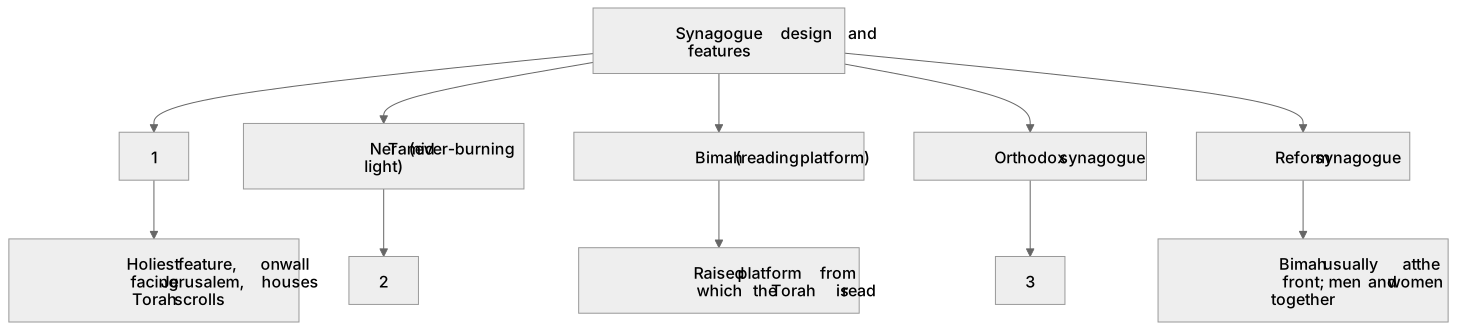
Synagogue design reflects deep religious symbolism. The Aron Hakodesh (Ark) is the holiest feature, situated on the wall facing Jerusalem, housing the handwritten Torah scrolls. Above it shines the Ner Tamid (ever-burning light), symbolising God's eternal presence and the menorah in the ancient Temple. The Bimah is a raised reading platform from which the Torah is read. In Orthodox synagogues, the Bimah is typically central, and men and women sit separately, often with women behind a screen (mechitza), reflecting traditional roles. Conversely, Reform synagogues usually place the Bimah at the front and allow men and women to sit together, emphasising egalitarianism in their associated worship practices.
What earns the marks
- Identify the Aron Hakodesh as the focal point housing the Torah scrolls, usually facing Jerusalem.
- Explain the symbolism of the Ner Tamid representing God's eternal presence.
- Describe the Bimah as the raised platform for reading the Torah, highlighting its central position in Orthodox synagogues.
- Contrast seating arrangements: separate seating (mechitza) in Orthodox synagogues versus mixed seating in Reform synagogues.
- Explain how the layout reflects differing beliefs about gender roles and tradition between Orthodox and Reform Judaism.
Common mistakes and how to put them right
Stating the Ner Tamid is a candle that is replaced daily.
Put it right: Explain that it is an ever-burning light, nowadays usually electric, symbolising God's constant presence.
Claiming all synagogues have the exact same layout.
Put it right: Distinguish between the central Bimah in Orthodox synagogues and the front-facing Bimah in Reform synagogues.
Using the term 'altar' instead of Bimah.
Put it right: Use the correct term 'Bimah' for the reading platform, as synagogues do not have altars for sacrifice.
Exam tips
- Always link physical features to their religious meaning, such as connecting the Ner Tamid to God's omnipresence.
- Use specific examples of differences between Orthodox and Reform layouts to support answers on denominational diversity.
- Ensure you can spell and define key terms like Aron Hakodesh, Bimah, and Ner Tamid accurately.
Try the lesson
The start of the Practices: The design and religious features of synagogues including bimah (reading platform), aron hakodesh (ark), ner tamid (ever burning light) and associated practices; differences between Orthodox and Reform synagogues. lesson, made from checked teaching notes for this specification point.
Have a go first
What is the purpose of the Aron Hakodesh (Ark) in a synagogue?
Listen
Synagogue design reflects deep religious symbolism. The Aron Hakodesh (Ark) is the holiest feature, situated on the wall facing Jerusalem, housing the handwritten Torah scrolls. Above it shines the Ner Tamid (ever-burning light), symbolising God's eternal presence and the menorah in the ancient Temple. The Bimah is a raised reading platform from which the Torah is read. In Orthodox synagogues, the Bimah is typically central, and men and women sit separately, often with women behind a screen (mechitza), reflecting traditional roles. Conversely, Reform synagogues usually place the Bimah at the front and allow men and women to sit together, emphasising egalitarianism in their associated worship practices. A strong answer earns marks for these points. Identify the Aron Hakodesh as the focal point housing the Torah scrolls, usually facing Jerusalem. Explain the symbolism of the Ner Tamid representing God's eternal presence. Describe the Bimah as the raised platform for reading the Torah, highlighting its central position in Orthodox synagogues. Contrast seating arrangements: separate seating (mechitza) in Orthodox synagogues versus mixed seating in Reform synagogues. A common slip: Stating the Ner Tamid is a candle that is replaced daily. Instead, Explain that it is an ever-burning light, nowadays usually electric, symbolising God's constant presence. Exam tip: Always link physical features to their religious meaning, such as connecting the Ner Tamid to God's omnipresence.
See it
Key words
Say what each word means before you turn the card.
Aron Hakodesh
Try answering aloud or in your head before turning the card.
Ner Tamid
Try answering aloud or in your head before turning the card.
Bimah
Try answering aloud or in your head before turning the card.
Denominational Differences
Try answering aloud or in your head before turning the card.
See every definition
- Aron Hakodesh
- The holiest feature, situated on the wall facing Jerusalem, housing the handwritten Torah scrolls.
- Ner Tamid
- An ever-burning light above the Ark, symbolising God's eternal presence and the menorah in the ancient Temple.
- Bimah
- A raised reading platform from which the Torah is read, typically central in Orthodox synagogues and at the front in Reform synagogues.
- Denominational Differences
- Contrasts between Orthodox and Reform synagogues, such as the Bimah's position and separate or mixed seating reflecting beliefs about gender roles and tradition.
Label the diagram
Some boxes have lost their names. Pick the right name for each number.
1Box 1
2Box 2
3Box 3
There is more to this lesson
The full lesson goes on to check your understanding and help you earn the marks. Create a free account to carry on, with your progress saved.
A week of Premium from your first lesson · Then the free plan continues · No card, no charge
Test your understanding of Practices: The design and religious features of synagogues including bimah (reading platform), aron hakodesh (ark), ner tamid (ever burning light) and associated practices; differences between Orthodox and Reform synagogues.
Active recall beats re-reading. Take an instant quiz now to test what you’ve learned and lock it into long-term memory.
A week of Premium from your first lesson · Then the free plan continues · No card, no charge