AQA · GCSE · Religious Studies
Course version: 8062 · Version from Sept 2018
Practices: separation of milk and meat.
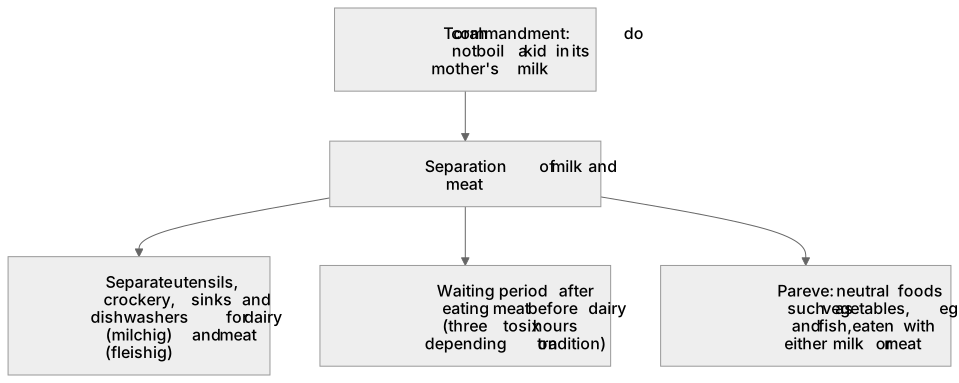
The separation of milk and meat is a fundamental aspect of Kashrut, the Jewish dietary laws.
Checked against the AQA 8062 specification (opens in a new tab) on .
- Point 18 of 37
- 4 key terms
Study notes
From the checked teaching notes for this specification point.
The idea
The separation of milk and meat is a fundamental aspect of Kashrut, the Jewish dietary laws. This practice originates from the Torah commandment, "Do not boil a kid in its mother's milk" (Exodus 23:19). To ensure strict adherence, Orthodox Jews maintain completely separate sets of utensils, crockery, and sometimes even sinks and dishwashers for dairy (milchig) and meat (fleishig) products. Furthermore, a specific waiting period is observed after eating meat before consuming dairy, which can range from three to six hours depending on the tradition, allowing for complete digestion. Neutral foods, known as pareve (such as vegetables, eggs, and fish), can be eaten with either milk or meat, providing flexibility within these strict dietary boundaries.
What earns the marks
- Identifies the Torah origin of the practice, specifically the commandment not to boil a kid in its mother's milk.
- Explains the practical application in a kosher kitchen, such as using separate utensils, plates, and sinks for meat and dairy.
- Describes the waiting period required between consuming meat and dairy products.
- Defines 'pareve' as neutral foods that can be consumed with either meat or dairy without breaking dietary laws.
Common mistakes and how to put them right
Stating that Jews cannot eat meat or milk at all.
Put it right: Clarify that both can be eaten, but they must not be prepared, cooked, or consumed together.
Believing pareve foods are a type of meat.
Put it right: Explain that pareve refers to neutral foods like fruit, vegetables, and eggs that are neither meat nor dairy.
Assuming all Jewish people follow these rules strictly.
Put it right: Note that while Orthodox Jews strictly observe these laws, Reform or Liberal Jews may adapt or choose not to follow them.
Exam tips
- Use the specific terms 'Kashrut' and 'kosher' when discussing dietary laws to demonstrate accurate subject vocabulary.
- Reference the specific Torah commandment about not boiling a kid in its mother's milk to support your explanation of the origins.
- Contrast Orthodox and Reform approaches to dietary laws to access higher marks in evaluation questions.
Try the lesson
The start of the Practices: separation of milk and meat. lesson, made from checked teaching notes for this specification point.
Have a go first
Which of the following is a fundamental rule regarding milk and meat in Jewish dietary law (Kashrut)?
Listen
The separation of milk and meat is a fundamental aspect of Kashrut, the Jewish dietary laws. This practice originates from the Torah commandment, "Do not boil a kid in its mother's milk" (Exodus 23:19). To ensure strict adherence, Orthodox Jews maintain completely separate sets of utensils, crockery, and sometimes even sinks and dishwashers for dairy (milchig) and meat (fleishig) products. Furthermore, a specific waiting period is observed after eating meat before consuming dairy, which can range from three to six hours depending on the tradition, allowing for complete digestion. Neutral foods, known as pareve (such as vegetables, eggs, and fish), can be eaten with either milk or meat, providing flexibility within these strict dietary boundaries. A strong answer earns marks for these points. Identifies the Torah origin of the practice, specifically the commandment not to boil a kid in its mother's milk. Explains the practical application in a kosher kitchen, such as using separate utensils, plates, and sinks for meat and dairy. Describes the waiting period required between consuming meat and dairy products. Defines 'pareve' as neutral foods that can be consumed with either meat or dairy without breaking dietary laws. A common slip: Stating that Jews cannot eat meat or milk at all. Instead, Clarify that both can be eaten, but they must not be prepared, cooked, or consumed together. Exam tip: Use the specific terms 'Kashrut' and 'kosher' when discussing dietary laws to demonstrate accurate subject vocabulary.
See it
Key words
Say what each word means before you turn the card.
Kashrut
Try answering aloud or in your head before turning the card.
Pareve
Try answering aloud or in your head before turning the card.
Orthodox
Try answering aloud or in your head before turning the card.
Reform
Try answering aloud or in your head before turning the card.
See every definition
- Kashrut
- The Jewish dietary laws, of which the separation of milk and meat is a fundamental aspect.
- Pareve
- Neutral foods, such as vegetables, eggs and fish, that can be eaten with either milk or meat.
- Orthodox
- Jews who strictly observe the dietary laws, maintaining completely separate sets of utensils, crockery and sometimes sinks and dishwashers for dairy and meat products.
- Reform
- Jews who may adapt or choose not to follow the dietary laws strictly.
Label the diagram
Some boxes have lost their names. Pick the right name for each number.
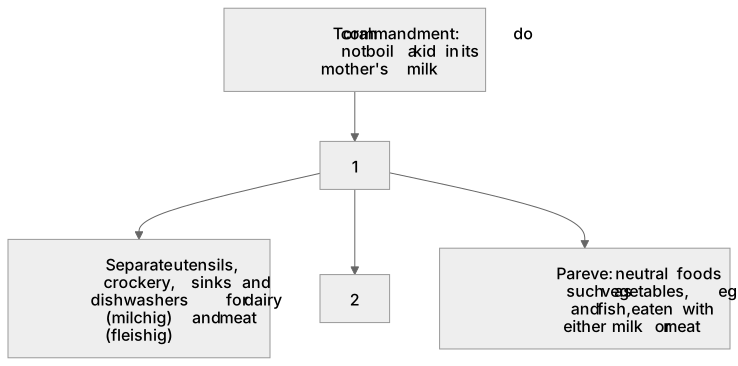
1Box 1
2Box 2
There is more to this lesson
The full lesson goes on to check your understanding and help you earn the marks. Create a free account to carry on, with your progress saved.
A week of Premium from your first lesson · Then the free plan continues · No card, no charge
Test your understanding of Practices: separation of milk and meat.
Active recall beats re-reading. Take an instant quiz now to test what you’ve learned and lock it into long-term memory.
A week of Premium from your first lesson · Then the free plan continues · No card, no charge