AQA · GCSE · Religious Studies
Course version: 8062 · Version from Sept 2018
Practices: kosher and trefah
In Judaism, food is categorised into what is permissible and forbidden.
Checked against the AQA 8062 specification (opens in a new tab) on .
- Point 17 of 37
- 4 key terms
Study notes
From the checked teaching notes for this specification point.
The idea
In Judaism, food is categorised into what is permissible and forbidden. 'Kosher' translates to 'fit' or 'proper' and refers to foods Jews are allowed to eat according to Leviticus. This includes animals with cloven hooves that chew the cud, such as cows, and fish with both fins and scales. 'Trefah' literally means 'torn' but describes any food that is forbidden or incorrectly prepared. Examples of trefah foods include pork and shellfish. Furthermore, for meat to be kosher, the animal must be slaughtered using a specific method called Shechitah, performed by a trained shochet. The strict separation of meat and dairy products is also a fundamental requirement for a meal to remain kosher.
What earns the marks
- Define 'kosher' as food that is permitted and 'trefah' as food that is forbidden under Jewish law.
- Identify specific kosher animals (e.g., cows, sheep, fish with fins and scales) and trefah animals (e.g., pigs, shellfish).
- Explain the requirement for Shechitah (ritual slaughter) for meat to be considered kosher.
- Describe the prohibition of mixing meat and dairy as a key component of keeping a kosher diet.
Common mistakes and how to put them right
Translating trefah simply as 'bad' or 'unhealthy'.
Put it right: Define trefah accurately as 'torn' or 'forbidden' according to Jewish religious law.
Stating that any beef or lamb is automatically kosher.
Put it right: Clarify that permitted animals must also be slaughtered ritually (Shechitah) to be kosher.
Believing that kosher food is blessed by a rabbi to make it holy.
Put it right: Explain that a rabbi merely supervises the production to ensure the laws of Kashrut are followed; the blessing does not make the food kosher.
Exam tips
- Provide specific examples of both kosher and trefah foods to support your explanations in exam answers.
- Remember to mention the separation of meat and dairy when discussing what makes a meal kosher.
- Use the terms 'kosher' and 'trefah' accurately in contrast to demonstrate clear understanding of Jewish dietary categories.
Try the lesson
The start of the Practices: kosher and trefah lesson, made from checked teaching notes for this specification point.
Have a go first
In Jewish dietary law, what is the meaning of the term 'trefah'?
Listen
In Judaism, food is categorised into what is permissible and forbidden. Kosher' translates to 'fit' or 'proper' and refers to foods Jews are allowed to eat according to Leviticus. This includes animals with cloven hooves that chew the cud, such as cows, and fish with both fins and scales. Trefah' literally means 'torn' but describes any food that is forbidden or incorrectly prepared. Examples of trefah foods include pork and shellfish. Furthermore, for meat to be kosher, the animal must be slaughtered using a specific method called Shechitah, performed by a trained shochet. The strict separation of meat and dairy products is also a fundamental requirement for a meal to remain kosher. A strong answer earns marks for these points. Define 'kosher' as food that is permitted and 'trefah' as food that is forbidden under Jewish law. Identify specific kosher animals (e.g., cows, sheep, fish with fins and scales) and trefah animals (e.g., pigs, shellfish). Explain the requirement for Shechitah (ritual slaughter) for meat to be considered kosher. Describe the prohibition of mixing meat and dairy as a key component of keeping a kosher diet. A common slip: Translating trefah simply as 'bad' or 'unhealthy'. Instead, Define trefah accurately as 'torn' or 'forbidden' according to Jewish religious law. Exam tip: Provide specific examples of both kosher and trefah foods to support your explanations in exam answers.
See it

Key words
Say what each word means before you turn the card.
Kosher
Try answering aloud or in your head before turning the card.
Trefah
Try answering aloud or in your head before turning the card.
Shechitah
Try answering aloud or in your head before turning the card.
Separation of meat and dairy
Try answering aloud or in your head before turning the card.
See every definition
- Kosher
- Foods Jews are allowed to eat according to Leviticus, including animals with cloven hooves that chew the cud and fish with both fins and scales.
- Trefah
- Literally means 'torn' but describes any food that is forbidden or incorrectly prepared, such as pork and shellfish.
- Shechitah
- The specific method by which an animal must be slaughtered, performed by a trained shochet, for meat to be kosher.
- Separation of meat and dairy
- A fundamental requirement for a meal to remain kosher, involving the strict separation of meat and dairy products.
Label the diagram
Some boxes have lost their names. Pick the right name for each number.
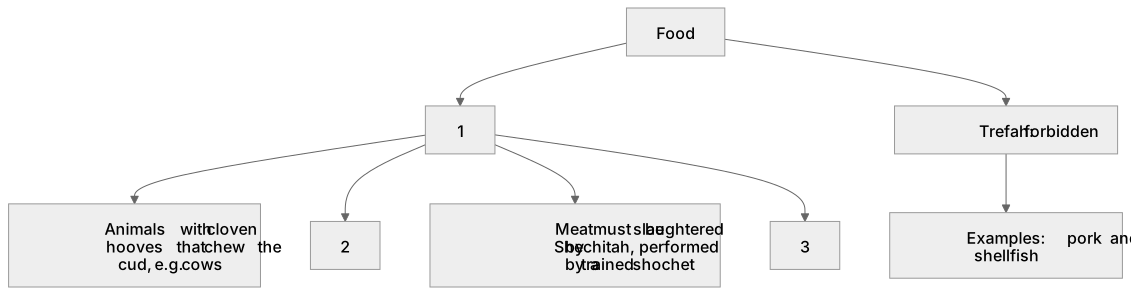
1Box 1
2Box 2
3Box 3
There is more to this lesson
The full lesson goes on to check your understanding and help you earn the marks. Create a free account to carry on, with your progress saved.
A week of Premium from your first lesson · Then the free plan continues · No card, no charge
Test your understanding of Practices: kosher and trefah
Active recall beats re-reading. Take an instant quiz now to test what you’ve learned and lock it into long-term memory.
A week of Premium from your first lesson · Then the free plan continues · No card, no charge