AQA · GCSE · Religious Studies
Course version: 8062 · Version from Sept 2018
Practices: the marriage ceremony
The Jewish marriage ceremony (Kiddushin and Nisuin) is a profound spiritual event uniting two people under God.
Checked against the AQA 8062 specification (opens in a new tab) on .
- Point 14 of 37
Study notes
From the checked teaching notes for this specification point.
The idea
The Jewish marriage ceremony (Kiddushin and Nisuin) is a profound spiritual event uniting two people under God. It takes place under a chuppah (canopy), symbolising the couple's new home and the openness of Abraham's tent. Key rituals include the signing and reading of the ketubah (marriage contract), which outlines the husband's duties. The groom places a plain ring on the bride's finger, declaring her consecrated to him. Seven blessings (Sheva Brachot) are recited, praising God for creation and joy. Finally, the groom breaks a glass under his foot, serving as a poignant reminder of the destruction of the Temple in Jerusalem, demonstrating that even in moments of supreme joy, Jews remember their history and communal sorrow.
What earns the marks
- Explain the symbolism of the chuppah as the couple's new home and God's sheltering presence.
- Describe the role of the ketubah as a legal and spiritual marriage contract detailing responsibilities.
- Detail the exchange of the ring or rings as a symbol of eternal commitment and consecration.
- Explain the breaking of the glass as a reminder of the destruction of the Temple in Jerusalem.
Common mistakes and how to put them right
Confusing the chuppah with a simple decoration.
Put it right: Explain it symbolises the couple's new home and God's presence.
Stating the glass is broken for good luck.
Put it right: It is broken to remember the destruction of the Temple in Jerusalem.
Assuming the ketubah is just a modern certificate.
Put it right: It is a traditional legal contract outlining the husband's obligations to his wife.
Exam tips
- Use specific Hebrew terms like chuppah and ketubah to demonstrate accurate subject knowledge.
- Link the breaking of the glass to the broader Jewish theme of remembering historical hardship during joyous occasions.
- When evaluating the importance of marriage, contrast Orthodox and Reform practices, such as both partners exchanging rings in Reform Judaism.
Try the lesson
The start of the Practices: the marriage ceremony lesson, made from checked teaching notes for this specification point.
Have a go first
Which of the following is a central feature of a traditional Jewish marriage ceremony?
Listen
The Jewish marriage ceremony (Kiddushin and Nisuin) is a profound spiritual event uniting two people under God. It takes place under a chuppah (canopy), symbolising the couple's new home and the openness of Abraham's tent. Key rituals include the signing and reading of the ketubah (marriage contract), which outlines the husband's duties. The groom places a plain ring on the bride's finger, declaring her consecrated to him. Seven blessings (Sheva Brachot) are recited, praising God for creation and joy. Finally, the groom breaks a glass under his foot, serving as a poignant reminder of the destruction of the Temple in Jerusalem, demonstrating that even in moments of supreme joy, Jews remember their history and communal sorrow. A strong answer earns marks for these points. Explain the symbolism of the chuppah as the couple's new home and God's sheltering presence. Describe the role of the ketubah as a legal and spiritual marriage contract detailing responsibilities. Detail the exchange of the ring or rings as a symbol of eternal commitment and consecration. Explain the breaking of the glass as a reminder of the destruction of the Temple in Jerusalem. A common slip: Confusing the chuppah with a simple decoration. Instead, explain it symbolises the couple's new home and God's presence. Exam tip: Use specific Hebrew terms like chuppah and ketubah to demonstrate accurate subject knowledge.
See it
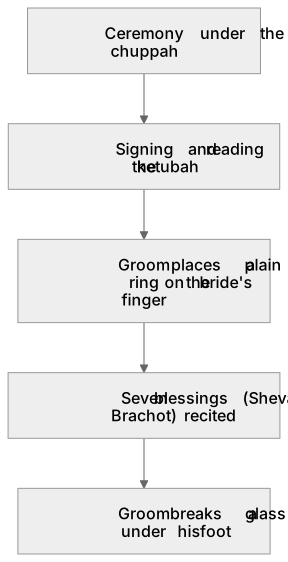
Put it in order
Put these steps in the order they happen.
- 1. Signing and reading of the ketubah
- 2. Groom places a plain ring on the bride's finger
- 3. Ceremony under the chuppah
- 4. Groom breaks a glass under his foot
- 5. Seven blessings (Sheva Brachot) recited
Label the diagram
Some boxes have lost their names. Pick the right name for each number.
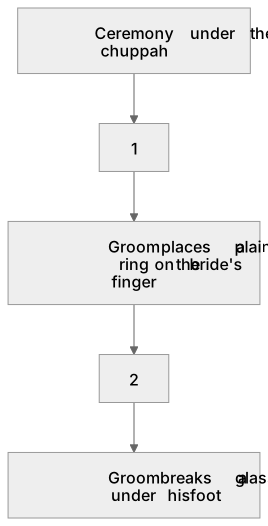
1Box 1
2Box 2
There is more to this lesson
The full lesson goes on to check your understanding and help you earn the marks. Create a free account to carry on, with your progress saved.
A week of Premium from your first lesson · Then the free plan continues · No card, no charge
Test your understanding of Practices: the marriage ceremony
Active recall beats re-reading. Take an instant quiz now to test what you’ve learned and lock it into long-term memory.
A week of Premium from your first lesson · Then the free plan continues · No card, no charge