AQA · GCSE · Religious Studies
Course version: 8062 · Version from Sept 2018
Practices: mourning rituals.
Jewish mourning rituals provide a structured pathway for grief, balancing respect for the dead (kavod ha-met) with comforting the living (nichum aveilim).
Checked against the AQA 8062 specification (opens in a new tab) on .
- Point 15 of 37
- 4 key terms
Study notes
From the checked teaching notes for this specification point.
The idea
Jewish mourning rituals provide a structured pathway for grief, balancing respect for the dead (kavod ha-met) with comforting the living (nichum aveilim). Upon hearing of a death, Jews may tear their clothes (keriah) to express sorrow. The most intense mourning period is Shiva, lasting seven days, where mourners stay home, sit on low stools, cover mirrors, and recite the Kaddish prayer daily. This is followed by Sheloshim, a thirty-day period of reduced mourning where normal activities resume but celebrations are avoided. For a parent, mourning lasts a full year. The anniversary of the death, Yahrzeit, is marked annually by lighting a 24-hour candle and reciting Kaddish, ensuring the deceased is remembered while helping the bereaved gradually reintegrate into daily life.
What earns the marks
- Describe the practice of keriah (tearing of clothes) as an outward expression of internal grief.
- Explain the rules of Shiva, including sitting on low stools, covering mirrors, and remaining at home for seven days.
- Outline the purpose of reciting the Mourner's Kaddish, which praises God rather than mentioning death.
- Detail the observance of Yahrzeit, including lighting a memorial candle on the anniversary of the death.
Common mistakes and how to put them right
Claiming the Kaddish is a prayer about death.
Put it right: Clarify that the Kaddish is a prayer praising God and affirming faith during hardship.
Confusing Shiva with the funeral itself.
Put it right: Shiva is the seven-day mourning period that begins immediately after the burial.
Stating that mourning ends completely after Shiva.
Put it right: Explain the structured stages of Sheloshim (30 days) and the 11-month period for parents.
Exam tips
- Clearly distinguish between the different stages of mourning: Shiva (7 days), Sheloshim (30 days), and Yahrzeit (anniversary).
- Explain how mourning rituals serve a dual purpose: showing respect for the deceased and providing psychological support for the bereaved.
- Mention the role of the community during Shiva, such as providing meals and forming a minyan for prayers.
Try the lesson
The start of the Practices: mourning rituals. lesson, made from checked teaching notes for this specification point.
Have a go first
Which of the following is a traditional Jewish mourning ritual observed immediately after a close relative's funeral?
Listen
Jewish mourning rituals provide a structured pathway for grief, balancing respect for the dead (kavod ha-met) with comforting the living (nichum aveilim). Upon hearing of a death, Jews may tear their clothes (keriah) to express sorrow. The most intense mourning period is Shiva, lasting seven days, where mourners stay home, sit on low stools, cover mirrors, and recite the Kaddish prayer daily. This is followed by Sheloshim, a thirty-day period of reduced mourning where normal activities resume but celebrations are avoided. For a parent, mourning lasts a full year. The anniversary of the death, Yahrzeit, is marked annually by lighting a 24-hour candle and reciting Kaddish, ensuring the deceased is remembered while helping the bereaved gradually reintegrate into daily life. A strong answer earns marks for these points. Describe the practice of keriah (tearing of clothes) as an outward expression of internal grief. Explain the rules of Shiva, including sitting on low stools, covering mirrors, and remaining at home for seven days. Outline the purpose of reciting the Mourner's Kaddish, which praises God rather than mentioning death. Detail the observance of Yahrzeit, including lighting a memorial candle on the anniversary of the death. A common slip: Claiming the Kaddish is a prayer about death. Instead, clarify that the Kaddish is a prayer praising God and affirming faith during hardship. Exam tip: Clearly distinguish between the different stages of mourning: Shiva (7 days), Sheloshim (30 days), and Yahrzeit (anniversary).
See it
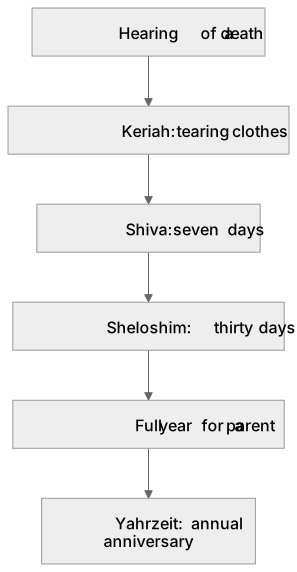
Put it in order
Put these steps in the order they happen.
- 1. Shiva: seven days
- 2. Keriah: tearing clothes
- 3. Hearing of a death
- 4. Yahrzeit: annual anniversary
- 5. Full year for a parent
- 6. Sheloshim: thirty days
Key words
Say what each word means before you turn the card.
Grief and comfort
Try answering aloud or in your head before turning the card.
Community support
Try answering aloud or in your head before turning the card.
Tradition and law
Try answering aloud or in your head before turning the card.
Sanctity of life
Try answering aloud or in your head before turning the card.
See every definition
- Grief and comfort
- Jewish mourning rituals provide a structured pathway for grief, balancing respect for the dead with comforting the living.
- Community support
- During Shiva the community provides meals and forms a minyan for prayers.
- Tradition and law
- Mourning follows structured stages: Shiva lasting seven days, Sheloshim of thirty days, and for a parent a full year.
- Sanctity of life
- Respect for the dead is shown through rituals such as keriah, tearing clothes to express sorrow.
Label the diagram
Some boxes have lost their names. Pick the right name for each number.
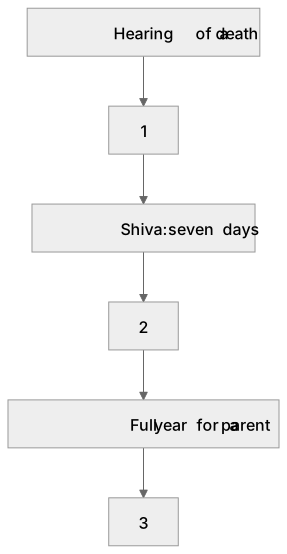
1Box 1
2Box 2
3Box 3
There is more to this lesson
The full lesson goes on to check your understanding and help you earn the marks. Create a free account to carry on, with your progress saved.
A week of Premium from your first lesson · Then the free plan continues · No card, no charge
Test your understanding of Practices: mourning rituals.
Active recall beats re-reading. Take an instant quiz now to test what you’ve learned and lock it into long-term memory.
A week of Premium from your first lesson · Then the free plan continues · No card, no charge