AQA · GCSE · Religious Studies
Course version: 8062 · Version from Sept 2018
Practices: The significance and use of the names Singh and Kaur.
In Sikhism, the names Singh ('Lion') and Kaur ('Princess') hold profound historical and spiritual significance.
Checked against the AQA 8062 specification (opens in a new tab) on .
- Point 37 of 37
- 3 key terms
Study notes
From the checked teaching notes for this specification point.
The idea
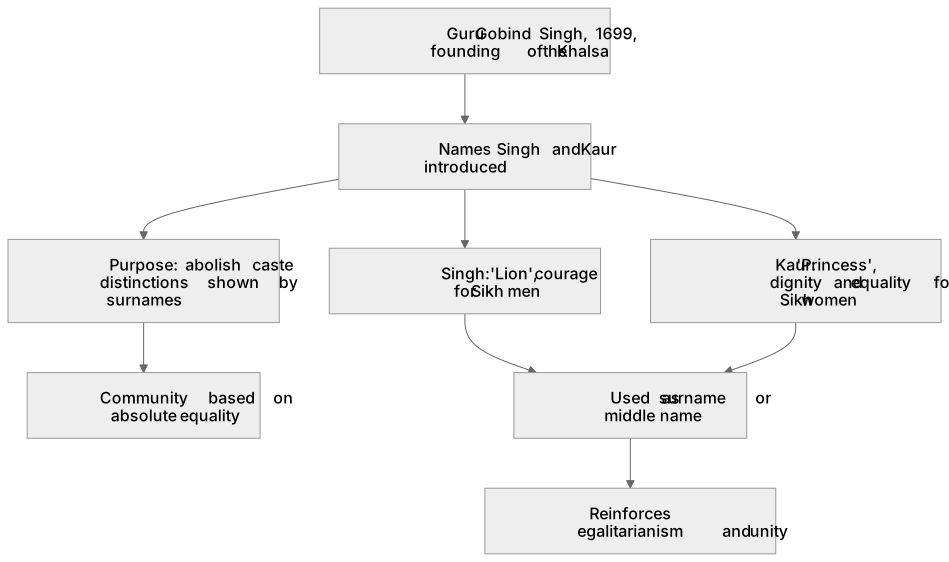
In Sikhism, the names Singh ('Lion') and Kaur ('Princess') hold profound historical and spiritual significance. Introduced by Guru Gobind Singh in 1699 during the formation of the Khalsa, these names were designed to eliminate the caste system, traditionally identifiable by a person's surname. By giving all Sikh men the name Singh and all Sikh women the name Kaur, the Guru established a community based on absolute equality. In practice, these names are used as a surname or a middle name by Sikhs worldwide. For example, a woman named Sandeep Kaur signifies her equal status and royal dignity, while a man named Harjot Singh reflects courage. This naming convention reinforces the Sikh commitment to egalitarianism and unity.
What earns the marks
- Singh translates to 'Lion', representing bravery and courage for Sikh men.
- Kaur translates to 'Princess', representing dignity, equality and grace for Sikh women.
- The names were introduced by Guru Gobind Singh in 1699 at the founding of the Khalsa.
- Their primary purpose was to abolish caste distinctions, which were historically indicated by surnames.
Common mistakes and how to put them right
Stating that Singh and Kaur are only given to Khalsa Sikhs.
Put it right: Clarify that while they originated with the Khalsa, they are used by most Sikhs today regardless of initiation status.
Claiming the names were introduced by Guru Nanak.
Put it right: Specify that Guru Gobind Singh, the tenth Guru, introduced these names in 1699.
Believing Singh and Kaur are only used as surnames.
Put it right: Note that they are frequently used as middle names alongside a family surname.
Exam tips
- Link the use of Singh and Kaur directly to the Sikh principle of equality and the rejection of the caste system.
- Use the translations 'Lion' and 'Princess' to explain the qualities Guru Gobind Singh wanted Sikhs to embody.
- When discussing the Khalsa, mention the introduction of these names as a key part of the initiation ceremony (Amrit Sanskar).
Try the lesson
The start of the Practices: The significance and use of the names Singh and Kaur. lesson, made from checked teaching notes for this specification point.
Have a go first
What is the literal meaning of the name 'Kaur', which is given to female Sikhs?
Listen
In Sikhism, the names Singh ('Lion') and Kaur ('Princess') hold profound historical and spiritual significance. Introduced by Guru Gobind Singh in 1699 during the formation of the Khalsa, these names were designed to eliminate the caste system, traditionally identifiable by a person's surname. By giving all Sikh men the name Singh and all Sikh women the name Kaur, the Guru established a community based on absolute equality. In practice, these names are used as a surname or a middle name by Sikhs worldwide. For example, a woman named Sandeep Kaur signifies her equal status and royal dignity, while a man named Harjot Singh reflects courage. This naming convention reinforces the Sikh commitment to egalitarianism and unity. A strong answer earns marks for these points. Singh translates to 'Lion', representing bravery and courage for Sikh men. Kaur translates to 'Princess', representing dignity, equality and grace for Sikh women. The names were introduced by Guru Gobind Singh in 1699 at the founding of the Khalsa. Their primary purpose was to abolish caste distinctions, which were historically indicated by surnames. A common slip: Stating that Singh and Kaur are only given to Khalsa Sikhs. Instead, Clarify that while they originated with the Khalsa, they are used by most Sikhs today regardless of initiation status. Exam tip: Link the use of Singh and Kaur directly to the Sikh principle of equality and the rejection of the caste system.
See it
Key words
Say what each word means before you turn the card.
Equality and egalitarianism
Try answering aloud or in your head before turning the card.
The Khalsa and Amrit Sanskar
Try answering aloud or in your head before turning the card.
Rejection of the caste system
Try answering aloud or in your head before turning the card.
See every definition
- Equality and egalitarianism
- The names Singh and Kaur established a community based on absolute equality, reinforcing the Sikh commitment to egalitarianism and unity.
- The Khalsa and Amrit Sanskar
- The names were introduced by Guru Gobind Singh in 1699 during the formation of the Khalsa, and their introduction is a key part of the initiation ceremony.
- Rejection of the caste system
- The names were designed to eliminate the caste system, which was traditionally identifiable by a person's surname.
Label the diagram
Some boxes have lost their names. Pick the right name for each number.
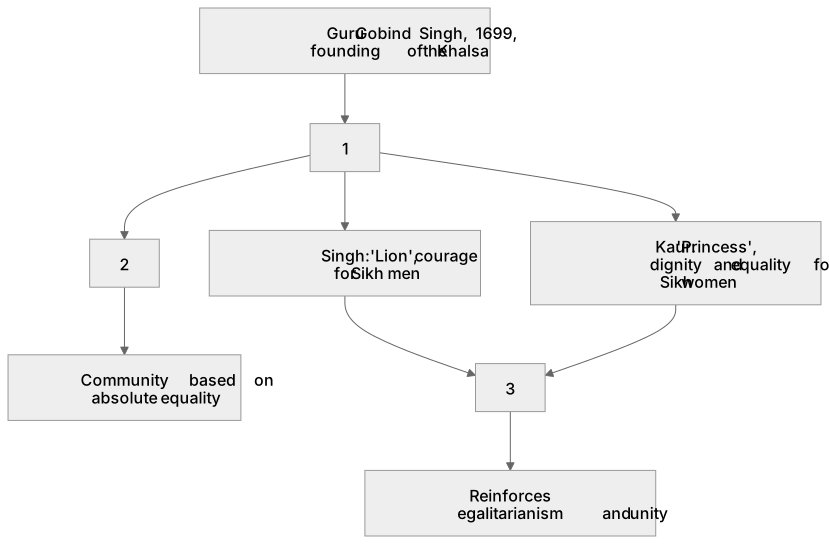
1Box 1
2Box 2
3Box 3
There is more to this lesson
The full lesson goes on to check your understanding and help you earn the marks. Create a free account to carry on, with your progress saved.
A week of Premium from your first lesson · Then the free plan continues · No card, no charge
Test your understanding of Practices: The significance and use of the names Singh and Kaur.
Active recall beats re-reading. Take an instant quiz now to test what you’ve learned and lock it into long-term memory.
A week of Premium from your first lesson · Then the free plan continues · No card, no charge