AQA · GCSE · Religious Studies
Course version: 8062 · Version from Sept 2018
Sewa: the importance and priority of service to others, including physical…
Full specification wording
Sikhism - 3.1.7.1 Beliefs and teachings: Sewa: the importance and priority of service to others, including physical (tan), mental (man) and material (dhan).
Sewa (selfless service) is a fundamental priority in Sikhism, demonstrating love for God through serving humanity without expecting reward.
Checked against the AQA 8062 specification (opens in a new tab) on .
- Point 15 of 16
- 3 key terms
Study notes
From the checked teaching notes for this specification point.
The idea
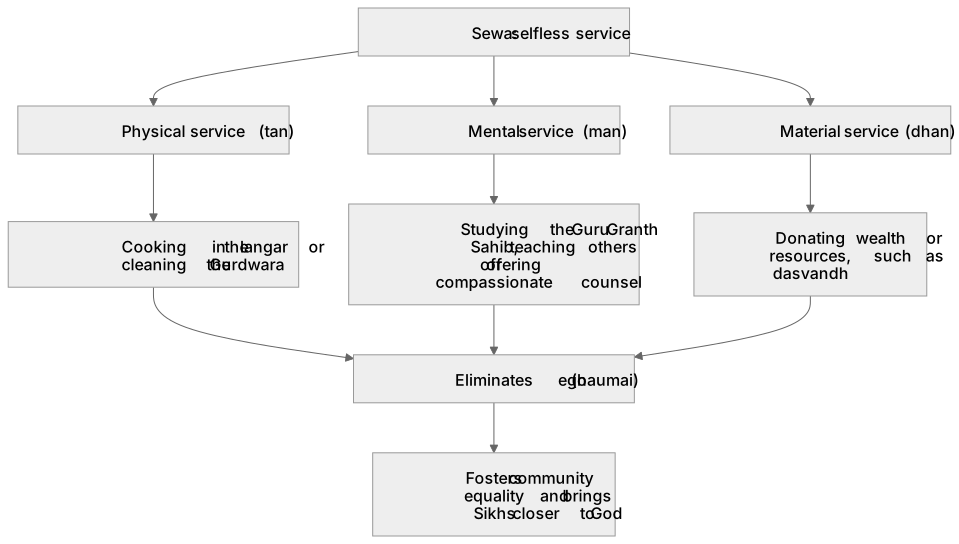
Sewa (selfless service) is a fundamental priority in Sikhism, demonstrating love for God through serving humanity without expecting reward. It is divided into three distinct forms. Physical service (tan) involves using the body, such as cooking in the langar or cleaning the Gurdwara. Mental service (man) requires using the mind, which includes studying the Guru Granth Sahib, teaching others, or offering compassionate counsel. Material service (dhan) involves giving wealth or resources, such as donating ten percent of income (dasvandh) to charity. Together, these practices eliminate ego (haumai), foster community equality, and bring Sikhs closer to God by recognising the divine spark in all people.
What earns the marks
- Define Sewa as selfless service performed without any expectation of personal reward or recognition.
- Explain physical Sewa (tan) using examples like serving food in the langar or maintaining the Gurdwara.
- Describe mental Sewa (man) through examples such as teaching Punjabi, reading scriptures, or offering emotional support.
- Outline material Sewa (dhan) by referencing the donation of money (dasvandh) or resources to those in need.
- Connect the practice of Sewa to the reduction of ego (haumai) and the pursuit of spiritual liberation (mukti).
Common mistakes and how to put them right
Confusing the Punjabi terms for the three types of Sewa.
Put it right: Memorise the specific pairings: tan is physical, man is mental, and dhan is material.
Describing Sewa merely as secular charity or volunteering.
Put it right: Emphasise the spiritual dimension; it is a religious duty performed to serve God by serving humanity.
Omitting mental Sewa (man) when giving examples.
Put it right: Ensure you include mental service, such as teaching or studying the Guru Granth Sahib, alongside physical and financial giving.
Exam tips
- Use the specific Punjabi terms (tan, man, dhan) in your answers to demonstrate precise subject knowledge.
- Link Sewa directly to the concept of equality, showing how serving others breaks down social barriers.
- When evaluating the importance of Sewa, contrast it with the barrier of ego (haumai) to show its spiritual necessity.
Try the lesson
The start of the Sikhism - 3.1.7.1 Beliefs and teachings: Sewa: the importance and priority of service to others, including physical (tan), mental (man) and material (dhan). lesson, made from checked teaching notes for this specification point.
Have a go first
Which of the following actions is an example of 'tan' sewa in the Sikh tradition?
Listen
Sewa (selfless service) is a fundamental priority in Sikhism, demonstrating love for God through serving humanity without expecting reward. It is divided into three distinct forms. Physical service (tan) involves using the body, such as cooking in the langar or cleaning the Gurdwara. Mental service (man) requires using the mind, which includes studying the Guru Granth Sahib, teaching others, or offering compassionate counsel. Material service (dhan) involves giving wealth or resources, such as donating ten percent of income (dasvandh) to charity. Together, these practices eliminate ego (haumai), foster community equality, and bring Sikhs closer to God by recognising the divine spark in all people. A strong answer earns marks for these points. Define Sewa as selfless service performed without any expectation of personal reward or recognition. Explain physical Sewa (tan) using examples like serving food in the langar or maintaining the Gurdwara. Describe mental Sewa (man) through examples such as teaching Punjabi, reading scriptures, or offering emotional support. Outline material Sewa (dhan) by referencing the donation of money (dasvandh) or resources to those in need. A common slip: Confusing the Punjabi terms for the three types of Sewa. Instead, Memorise the specific pairings: tan is physical, man is mental, and dhan is material. Exam tip: Use the specific Punjabi terms (tan, man, dhan) in your answers to demonstrate precise subject knowledge.
See it
Key words
Say what each word means before you turn the card.
Sewa
Try answering aloud or in your head before turning the card.
Equality
Try answering aloud or in your head before turning the card.
Spiritual liberation
Try answering aloud or in your head before turning the card.
See every definition
- Sewa
- Selfless service performed without any expectation of personal reward or recognition, demonstrating love for God through serving humanity.
- Equality
- Fostered by these practices, which break down social barriers and recognise the divine spark in all people.
- Spiritual liberation
- The goal of mukti, pursued through the practice of Sewa and the reduction of ego (haumai).
Label the diagram
Some boxes have lost their names. Pick the right name for each number.
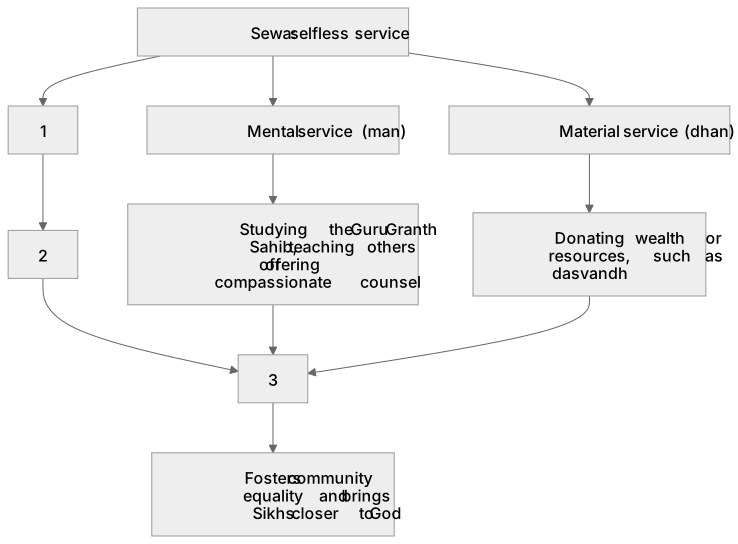
1Box 1
2Box 2
3Box 3
There is more to this lesson
The full lesson goes on to check your understanding and help you earn the marks. Create a free account to carry on, with your progress saved.
A week of Premium from your first lesson · Then the free plan continues · No card, no charge
Test your understanding of Sikhism - 3.1.7.1 Beliefs and teachings: Sewa: the importance and priority of service to others, including physical (tan), mental (man) and material (dhan).
Active recall beats re-reading. Take an instant quiz now to test what you’ve learned and lock it into long-term memory.
A week of Premium from your first lesson · Then the free plan continues · No card, no charge