AQA · GCSE · Religious Studies
Course version: 8062 · Version from Sept 2018
The role and importance of the sangat (religious community).
Full specification wording
Sikhism - 3.1.7.1 Beliefs and teachings: The role and importance of the sangat (religious community).
The sangat is the Sikh religious community, playing a central role in a Sikh's spiritual and social life.
Checked against the AQA 8062 specification (opens in a new tab) on .
- Point 16 of 16
- 4 key terms
Study notes
From the checked teaching notes for this specification point.
The idea
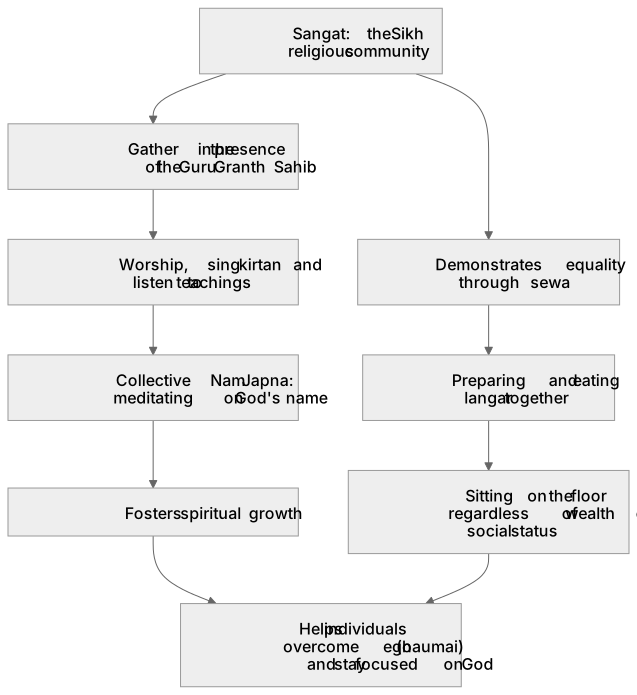
The sangat is the Sikh religious community, playing a central role in a Sikh's spiritual and social life. It provides a supportive environment where Sikhs gather in the presence of the Guru Granth Sahib to worship, sing kirtan (hymns), and listen to teachings. The sangat is vital because it fosters spiritual growth; Sikhs believe that meditating on God's name (Nam Japna) is more powerful when done collectively. Furthermore, the sangat actively demonstrates core Sikh principles like equality (sewa) through shared practices such as preparing and eating the langar (community meal) together, sitting on the floor regardless of wealth or social status. This collective unity helps individuals overcome ego (haumai) and stay focused on God.
What earns the marks
- Define the sangat as the holy congregation or religious community of Sikhs.
- Explain its role in collective worship, such as singing kirtan and reading the Guru Granth Sahib.
- Discuss its importance in providing spiritual support and helping individuals overcome ego (haumai).
- Describe how the sangat puts equality into practice through sewa (selfless service) and the langar.
Common mistakes and how to put them right
Confusing the sangat with the Khalsa.
Put it right: The Khalsa is the community of initiated Sikhs, whereas the sangat includes all who gather for worship.
Viewing the sangat merely as a social club.
Put it right: It must be corrected to emphasise its primary spiritual function in the presence of the Guru Granth Sahib.
Thinking the sangat only exists inside the gurdwara.
Put it right by noting that the sangat can gather anywhere the Guru Granth Sahib is present.
Exam tips
- Use the term 'sangat' alongside its English translation 'religious community' to show precise subject knowledge.
- Link the concept of the sangat to core Sikh values like equality and sewa (selfless service) in evaluation questions.
- Include a reference to the Guru Granth Sahib when explaining what makes a gathering a true sangat.
Try the lesson
The start of the Sikhism - 3.1.7.1 Beliefs and teachings: The role and importance of the sangat (religious community). lesson, made from checked teaching notes for this specification point.
Have a go first
What is the meaning of the term 'sangat' in Sikhism?
Listen
The sangat is the Sikh religious community, playing a central role in a Sikh's spiritual and social life. It provides a supportive environment where Sikhs gather in the presence of the Guru Granth Sahib to worship, sing kirtan (hymns), and listen to teachings. The sangat is vital because it fosters spiritual growth; Sikhs believe that meditating on God's name (Nam Japna) is more powerful when done collectively. Furthermore, the sangat actively demonstrates core Sikh principles like equality (sewa) through shared practices such as preparing and eating the langar (community meal) together, sitting on the floor regardless of wealth or social status. This collective unity helps individuals overcome ego (haumai) and stay focused on God. A strong answer earns marks for these points. Define the sangat as the holy congregation or religious community of Sikhs. Explain its role in collective worship, such as singing kirtan and reading the Guru Granth Sahib. Discuss its importance in providing spiritual support and helping individuals overcome ego (haumai). Describe how the sangat puts equality into practice through sewa (selfless service) and the langar. A common slip: Thinking the sangat only exists inside the gurdwara. Instead, noting that the sangat can gather anywhere the Guru Granth Sahib is present. Exam tip: Use the term 'sangat' alongside its English translation 'religious community' to show precise subject knowledge.
See it
Key words
Say what each word means before you turn the card.
Community
Try answering aloud or in your head before turning the card.
Equality
Try answering aloud or in your head before turning the card.
Spiritual growth
Try answering aloud or in your head before turning the card.
Sewa (selfless service)
Try answering aloud or in your head before turning the card.
See every definition
- Community
- The Sikh religious community, called the sangat, plays a central role in a Sikh's spiritual and social life.
- Equality
- A core Sikh principle demonstrated by the sangat through shared practices such as sitting on the floor regardless of wealth or social status.
- Spiritual growth
- Fostered by the sangat, since meditating on God's name is believed to be more powerful when done collectively.
- Sewa (selfless service)
- A core Sikh principle actively demonstrated by the sangat through shared practices such as preparing and eating the langar together.
Label the diagram
Some boxes have lost their names. Pick the right name for each number.
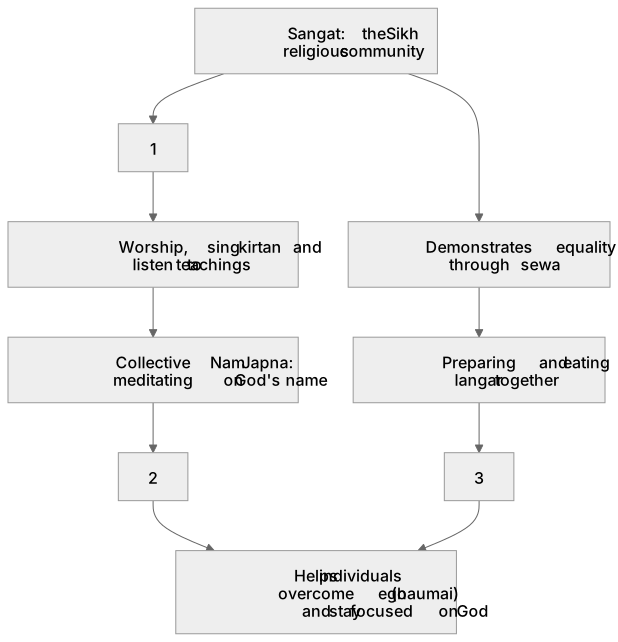
1Box 1
2Box 2
3Box 3
There is more to this lesson
The full lesson goes on to check your understanding and help you earn the marks. Create a free account to carry on, with your progress saved.
A week of Premium from your first lesson · Then the free plan continues · No card, no charge
Test your understanding of Sikhism - 3.1.7.1 Beliefs and teachings: The role and importance of the sangat (religious community).
Active recall beats re-reading. Take an instant quiz now to test what you’ve learned and lock it into long-term memory.
A week of Premium from your first lesson · Then the free plan continues · No card, no charge