AQA · GCSE · Religious Studies
Course version: 8062 · Version from Sept 2018
The stories of the lives of Gurus, including Guru Nanak and Guru Gobind…
Full specification wording
Sikhism - 3.1.7.1 Beliefs and teachings: the stories of the lives of Gurus, including Guru Nanak and Guru Gobind Singh
The ten human Gurus shaped Sikhism through their lived examples.
Checked against the AQA 8062 specification (opens in a new tab) on .
- Point 13 of 16
- 3 key terms
Study notes
From the checked teaching notes for this specification point.
The idea
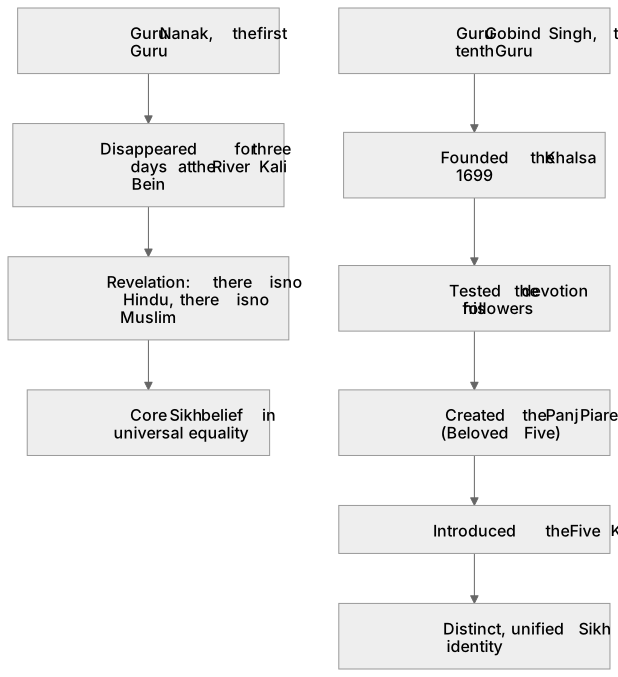
The ten human Gurus shaped Sikhism through their lived examples. Guru Nanak, the first Guru, founded the faith based on equality and devotion to one God. His transformative experience at the River Kali Bein, where he disappeared for three days, led to his revelation that "there is no Hindu, there is no Muslim," establishing the core Sikh belief in universal equality. Guru Gobind Singh, the tenth Guru, fundamentally changed Sikh identity by founding the Khalsa in 1699. He tested the devotion of his followers, creating the Panj Piare (Beloved Five) and introducing the Five Ks to give Sikhs a distinct, unified identity. These stories are not just historical accounts but provide moral and spiritual templates for modern Sikhs, demonstrating how to live with courage, equality, and devotion.
What earns the marks
- Explain Guru Nanak's revelation at the River Kali Bein and its significance for Sikh beliefs about equality.
- Describe the founding of the Khalsa by Guru Gobind Singh in 1699 and the creation of the Panj Piare.
- Explain how the stories of the Gurus demonstrate core Sikh virtues such as courage, equality, and devotion to God.
- Evaluate the impact of Guru Gobind Singh's introduction of the Five Ks on modern Sikh identity and practice.
Common mistakes and how to put them right
Confusing the actions of the Gurus.
Put it right: Ensure Guru Nanak is credited with founding the religion and Guru Gobind Singh with founding the Khalsa.
Stating that Sikhs worship the Gurus.
Put it right: Sikhs respect the Gurus as spiritual teachers and messengers, but worship only the one God, Waheguru.
Believing Guru Gobind Singh was the final Guru.
Put it right: He was the final human Guru, but he passed the eternal Guruship to the Guru Granth Sahib.
Exam tips
- Use the story of Guru Nanak at the River Kali Bein to illustrate the Sikh belief in the equality of all religions.
- When discussing Sikh identity, reference Guru Gobind Singh's creation of the Khalsa and the Panj Piare.
- Link the historical actions of the Gurus to how Sikhs practice their faith today, such as wearing the Five Ks.
Try the lesson
The start of the Sikhism - 3.1.7.1 Beliefs and teachings: the stories of the lives of Gurus, including Guru Nanak and Guru Gobind Singh lesson, made from checked teaching notes for this specification point.
Have a go first
What event in Guru Nanak's life led to his revelation and declaration that 'There is no Hindu, there is no Muslim'?
Listen
The ten human Gurus shaped Sikhism through their lived examples. Guru Nanak, the first Guru, founded the faith based on equality and devotion to one God. His transformative experience at the River Kali Bein, where he disappeared for three days, led to his revelation that "there is no Hindu, there is no Muslim," establishing the core Sikh belief in universal equality. Guru Gobind Singh, the tenth Guru, fundamentally changed Sikh identity by founding the Khalsa in 1699. He tested the devotion of his followers, creating the Panj Piare (Beloved Five) and introducing the Five Ks to give Sikhs a distinct, unified identity. These stories are not just historical accounts but provide moral and spiritual templates for modern Sikhs, demonstrating how to live with courage, equality, and devotion. A strong answer earns marks for these points. Explain Guru Nanak's revelation at the River Kali Bein and its significance for Sikh beliefs about equality. Describe the founding of the Khalsa by Guru Gobind Singh in 1699 and the creation of the Panj Piare. Explain how the stories of the Gurus demonstrate core Sikh virtues such as courage, equality, and devotion to God. Evaluate the impact of Guru Gobind Singh's introduction of the Five Ks on modern Sikh identity and practice. A common slip: Confusing the actions of the Gurus. Instead, ensure Guru Nanak is credited with founding the religion and Guru Gobind Singh with founding the Khalsa. Exam tip: Use the story of Guru Nanak at the River Kali Bein to illustrate the Sikh belief in the equality of all religions.
See it
Key words
Say what each word means before you turn the card.
Equality
Try answering aloud or in your head before turning the card.
Devotion
Try answering aloud or in your head before turning the card.
Identity
Try answering aloud or in your head before turning the card.
See every definition
- Equality
- The core Sikh belief in universal equality, established by Guru Nanak's revelation that there is no Hindu and no Muslim.
- Devotion
- The testing of followers' devotion by Guru Gobind Singh, and a virtue shown in the stories of the Gurus.
- Identity
- A distinct, unified identity given to Sikhs through the Five Ks introduced by Guru Gobind Singh.
Label the diagram
Some boxes have lost their names. Pick the right name for each number.

1Box 1
2Box 2
3Box 3
There is more to this lesson
The full lesson goes on to check your understanding and help you earn the marks. Create a free account to carry on, with your progress saved.
A week of Premium from your first lesson · Then the free plan continues · No card, no charge
Test your understanding of Sikhism - 3.1.7.1 Beliefs and teachings: the stories of the lives of Gurus, including Guru Nanak and Guru Gobind Singh
Active recall beats re-reading. Take an instant quiz now to test what you’ve learned and lock it into long-term memory.
A week of Premium from your first lesson · Then the free plan continues · No card, no charge