AQA · GCSE · Religious Studies
Course version: 8062 · Version from Sept 2018
The expression of the equality of all in:
Full specification wording
Sikhism - 3.1.7.1 Beliefs and teachings: The expression of the equality of all in:
Sikhism translates its theological belief in the equality of all into tangible, everyday practices.
Checked against the AQA 8062 specification (opens in a new tab) on .
- Point 12 of 16
- 4 key terms
Study notes
From the checked teaching notes for this specification point.
The idea
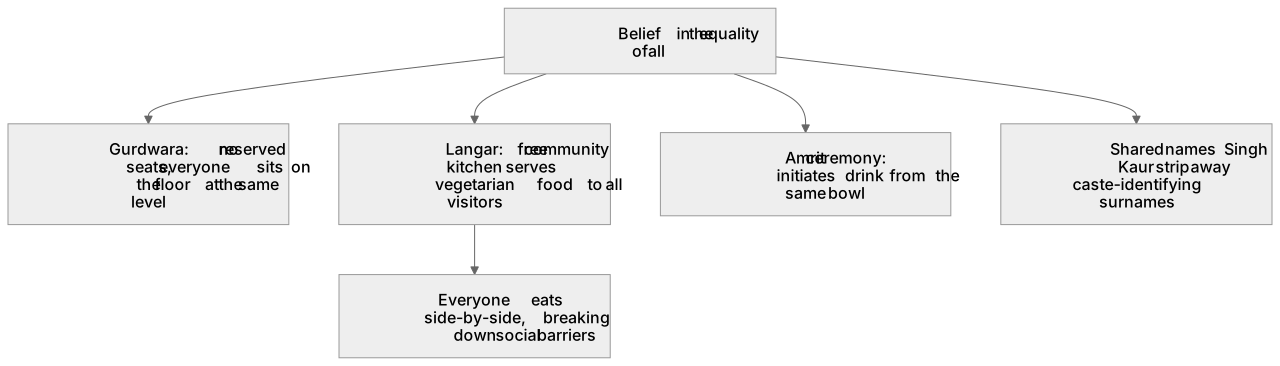
Sikhism translates its theological belief in the equality of all into tangible, everyday practices. The expression of this equality is most visibly demonstrated in the Gurdwara, where there are no reserved seats; everyone sits together on the floor at the same level, symbolising that no individual is superior to another. Furthermore, the langar (free community kitchen) serves vegetarian food to all visitors regardless of their religion, caste, gender, or wealth. Everyone eats side-by-side, actively breaking down social barriers. Equality is also expressed in the Amrit ceremony, where initiates drink from the same bowl, and through the shared names Singh and Kaur, which strip away caste-identifying surnames to unite all Sikhs.
What earns the marks
- Explain how sitting on the floor in the Gurdwara physically demonstrates that all people are equal before God.
- Describe the langar as a practical expression of equality, where people of all backgrounds eat the same vegetarian meal side-by-side.
- Identify the use of the names Singh (Lion) and Kaur (Princess) as a method to eliminate caste distinctions and express universal equality.
- Explain that the Amrit ceremony expresses equality by having all initiates drink Amrit from the exact same bowl, regardless of their social background.
Common mistakes and how to put them right
Stating that the langar only serves Sikhs.
Put it right by emphasising that the langar is open to absolutely everyone, expressing universal equality.
Claiming men and women sit together in the Gurdwara to show equality.
Put it right by noting that while they are equal, men and women typically sit on separate sides of the hall for modesty, but both sit on the floor at the same level.
Forgetting to explain why vegetarian food is served in the langar.
Put it right by explaining it ensures no one is excluded due to dietary religious restrictions, upholding the equality of all.
Exam tips
- Always link the physical action, such as sitting on the floor, directly back to the theological concept of equality to secure higher marks.
- Use the langar as your primary example when asked how Sikhs put their beliefs about equality into practice.
- Mention the shared surnames Singh and Kaur as a specific historical method used by the Gurus to enforce equality.
Try the lesson
The start of the Sikhism - 3.1.7.1 Beliefs and teachings: The expression of the equality of all in: lesson, made from checked teaching notes for this specification point.
Have a go first
How is the principle of equality practically demonstrated in the Langar (free kitchen)?
Listen
Sikhism translates its theological belief in the equality of all into tangible, everyday practices. The expression of this equality is most visibly demonstrated in the Gurdwara, where there are no reserved seats; everyone sits together on the floor at the same level, symbolising that no individual is superior to another. Furthermore, the langar (free community kitchen) serves vegetarian food to all visitors regardless of their religion, caste, gender, or wealth. Everyone eats side-by-side, actively breaking down social barriers. Equality is also expressed in the Amrit ceremony, where initiates drink from the same bowl, and through the shared names Singh and Kaur, which strip away caste-identifying surnames to unite all Sikhs. A strong answer earns marks for these points. Explain how sitting on the floor in the Gurdwara physically demonstrates that all people are equal before God. Describe the langar as a practical expression of equality, where people of all backgrounds eat the same vegetarian meal side-by-side. Identify the use of the names Singh (Lion) and Kaur (Princess) as a method to eliminate caste distinctions and express universal equality. Explain that the Amrit ceremony expresses equality by having all initiates drink Amrit from the exact same bowl, regardless of their social background. A common slip: Stating that the langar only serves Sikhs. Instead, emphasising that the langar is open to absolutely everyone, expressing universal equality. Exam tip: Always link the physical action, such as sitting on the floor, directly back to the theological concept of equality to secure higher marks.
See it
Key words
Say what each word means before you turn the card.
Langar
Try answering aloud or in your head before turning the card.
Gurdwara practices
Try answering aloud or in your head before turning the card.
Khalsa identity
Try answering aloud or in your head before turning the card.
Practical equality
Try answering aloud or in your head before turning the card.
See every definition
- Langar
- A free community kitchen that serves vegetarian food to all visitors regardless of their religion, caste, gender, or wealth.
- Gurdwara practices
- There are no reserved seats and everyone sits together on the floor at the same level, symbolising that no individual is superior to another.
- Khalsa identity
- Shared names Singh and Kaur strip away caste-identifying surnames to unite all Sikhs.
- Practical equality
- Equality is expressed in the Amrit ceremony, where initiates drink from the same bowl.
Label the diagram
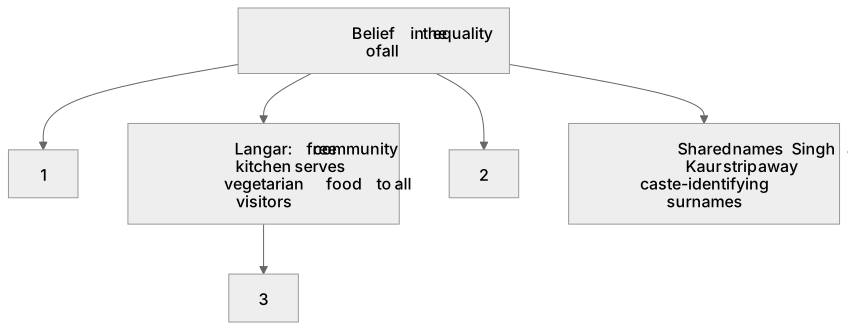
Some boxes have lost their names. Pick the right name for each number.
1Box 1
2Box 2
3Box 3
There is more to this lesson
The full lesson goes on to check your understanding and help you earn the marks. Create a free account to carry on, with your progress saved.
A week of Premium from your first lesson · Then the free plan continues · No card, no charge
Test your understanding of Sikhism - 3.1.7.1 Beliefs and teachings: The expression of the equality of all in:
Active recall beats re-reading. Take an instant quiz now to test what you’ve learned and lock it into long-term memory.
A week of Premium from your first lesson · Then the free plan continues · No card, no charge