AQA · GCSE · Religious Studies
Course version: 8062 · Version from Sept 2018
Common and divergent views within Sikhism in the way beliefs and teachings…
Full specification wording
Sikhism: Common and divergent views within Sikhism in the way beliefs and teachings are understood and expressed should be included throughout. Students may refer to a range of Sikh perspectives in their answers, for example to the perspective of sahajdhari and amritdhari Sikhs and the different emphases in different texts. They must study the specific differences identified below.
While Sikhs share core beliefs, divergent views exist in how these teachings are understood and expressed.
Checked against the AQA 8062 specification (opens in a new tab) on .
- Point 4 of 4
- 4 key terms
Study notes
From the checked teaching notes for this specification point.
The idea
While Sikhs share core beliefs, divergent views exist in how these teachings are understood and expressed. A key distinction is between Amritdhari Sikhs, who are initiated into the Khalsa and strictly wear the Five Ks, and Sahajdhari Sikhs, who follow the Gurus' teachings but have not taken Amrit or may cut their hair. Furthermore, different emphases in texts, such as the Dasam Granth compared to the Guru Granth Sahib, highlight diverse theological expressions. Recognising these specific differences is essential for evaluating the varied nature of modern Sikh practice.
What earns the marks
- Distinguish between the practices and commitments of Amritdhari (initiated) and Sahajdhari (uninitiated) Sikhs.
- Explain common views that unite all Sikhs, such as the belief in one God (Waheguru) and the ultimate authority of the Guru Granth Sahib.
- Analyse how divergent views lead to different expressions of faith, such as varying adherence to the Rahit Maryada (Sikh code of conduct).
- Reference different emphases in Sikh texts, noting how the Dasam Granth is viewed alongside the Guru Granth Sahib by different groups.
Common mistakes and how to put them right
Claiming Sahajdhari Sikhs are not 'real' Sikhs.
Put it right: Acknowledge that Sahajdhari Sikhs are recognised members of the Sikh community who believe in the Gurus, even if uninitiated.
Ignoring the shared, common beliefs when discussing differences.
Put it right: Balance divergent views with the core commonalities, such as the Mool Mantra, that unite the religion.
Confusing the Guru Granth Sahib with the Dasam Granth.
Put it right: Specify that the Guru Granth Sahib is the eternal living Guru for all Sikhs, while the Dasam Granth contains texts attributed to Guru Gobind Singh with varying levels of emphasis.
Exam tips
- When asked about Sikh practices, explicitly contrast the expectations placed on Amritdhari Sikhs with those of Sahajdhari Sikhs.
- Use the terms 'common' and 'divergent' in your answers to show the examiner you understand the diversity within the faith.
- In 12-mark questions, use the differing perspectives of initiated and uninitiated Sikhs to build strong, contrasting arguments.
Try the lesson
The start of the Sikhism: Common and divergent views within Sikhism in the way beliefs and teachings are understood and expressed should be included throughout. Students may refer to a range of Sikh perspectives in their answers, for example to the perspective of sahajdhari and amritdhari Sikhs and the different emphases in different texts. They must study the specific differences identified below. lesson, made from checked teaching notes for this specification point.
Have a go first
What is a key difference between an Amritdhari Sikh and a Sahajdhari Sikh?
Listen
While Sikhs share core beliefs, divergent views exist in how these teachings are understood and expressed. A key distinction is between Amritdhari Sikhs, who are initiated into the Khalsa and strictly wear the Five Ks, and Sahajdhari Sikhs, who follow the Gurus' teachings but have not taken Amrit or may cut their hair. Furthermore, different emphases in texts, such as the Dasam Granth compared to the Guru Granth Sahib, highlight diverse theological expressions. Recognising these specific differences is essential for evaluating the varied nature of modern Sikh practice. A strong answer earns marks for these points. Distinguish between the practices and commitments of Amritdhari (initiated) and Sahajdhari (uninitiated) Sikhs. Explain common views that unite all Sikhs, such as the belief in one God (Waheguru) and the ultimate authority of the Guru Granth Sahib. Analyse how divergent views lead to different expressions of faith, such as varying adherence to the Rahit Maryada (Sikh code of conduct). Reference different emphases in Sikh texts, noting how the Dasam Granth is viewed alongside the Guru Granth Sahib by different groups. A common slip: Claiming Sahajdhari Sikhs are not 'real' Sikhs. Instead, Acknowledge that Sahajdhari Sikhs are recognised members of the Sikh community who believe in the Gurus, even if uninitiated. Exam tip: When asked about Sikh practices, explicitly contrast the expectations placed on Amritdhari Sikhs with those of Sahajdhari Sikhs.
See it

Key words
Say what each word means before you turn the card.
Diversity within Sikhism
Try answering aloud or in your head before turning the card.
Khalsa Initiation
Try answering aloud or in your head before turning the card.
Authority of Texts
Try answering aloud or in your head before turning the card.
Religious Identity
Try answering aloud or in your head before turning the card.
See every definition
- Diversity within Sikhism
- Sikhs share core beliefs, but divergent views exist in how these teachings are understood and expressed, for example between sahajdhari and amritdhari Sikhs and the different emphases in different texts.
- Khalsa Initiation
- Amritdhari Sikhs are initiated into the Khalsa and strictly wear the Five Ks, while Sahajdhari Sikhs have not taken Amrit.
- Authority of Texts
- The Guru Granth Sahib is the eternal living Guru for all Sikhs, while the Dasam Granth contains texts attributed to Guru Gobind Singh with varying levels of emphasis.
- Religious Identity
- Sahajdhari Sikhs are recognised members of the Sikh community who believe in the Gurus, even if uninitiated, and may cut their hair.
Label the diagram
Some boxes have lost their names. Pick the right name for each number.
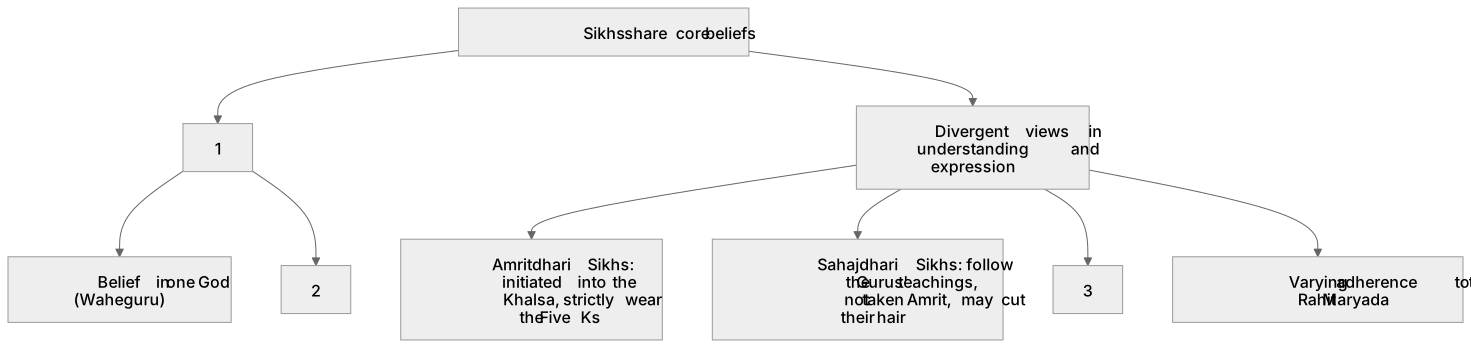
1Box 1
2Box 2
3Box 3
There is more to this lesson
The full lesson goes on to check your understanding and help you earn the marks. Create a free account to carry on, with your progress saved.
A week of Premium from your first lesson · Then the free plan continues · No card, no charge
Test your understanding of Sikhism: Common and divergent views within Sikhism in the way beliefs and teachings are understood and expressed should be included throughout. Students may refer to a range of Sikh perspectives in their answers, for example to the perspective of sahajdhari and amritdhari Sikhs and the different emphases in different texts. They must study the specific differences identified below.
Active recall beats re-reading. Take an instant quiz now to test what you’ve learned and lock it into long-term memory.
A week of Premium from your first lesson · Then the free plan continues · No card, no charge