AQA · GCSE · Religious Studies
Course version: 8062 · Version from Sept 2018
Students should study the influence of the beliefs, teachings and…
Full specification wording
Sikhism: Students should study the influence of the beliefs, teachings and practices studied on individuals, communities and societies.
Sikh beliefs, teachings, and practices profoundly shape the lives of individuals, communities, and wider societies.
Checked against the AQA 8062 specification (opens in a new tab) on .
- Point 3 of 4
- 3 key terms
Study notes
From the checked teaching notes for this specification point.
The idea
Sikh beliefs, teachings, and practices profoundly shape the lives of individuals, communities, and wider societies. For an individual, the belief in karma and mukti influences daily choices, encouraging honest living (kirat karna) and meditation (naam japna). At the community level, practices like the langar (free kitchen) foster equality and unity within the gurdwara, breaking down social barriers. On a societal scale, the teaching of vand chhakna (charitable giving) and the pursuit of justice (dharam) inspire Sikhs to actively challenge discrimination and support humanitarian causes globally. Understanding these distinct levels of influence is crucial for evaluating the practical impact of Sikhism today.
What earns the marks
- Identify specific ways Sikh beliefs influence individual behaviour, such as treating all people with respect due to the belief in the divine spark within everyone.
- Explain how community practices, particularly the langar, demonstrate teachings of sewa (selfless service) and castelessness.
- Evaluate the societal impact of Sikh teachings, such as the Khalsa's duty to protect the oppressed and fight for social justice.
- Link specific teachings, like the Mool Mantra, to the daily spiritual practices and mindset of an individual Sikh.
Common mistakes and how to put them right
Confusing individual influence with societal influence.
Put it right: Clearly distinguish between personal practices (like naam japna) and societal impacts (like funding global disaster relief).
Stating beliefs without explaining their practical influence.
Put it right: Connect a belief (e.g., equality) to a tangible action (e.g., sitting together on the floor during langar).
Assuming all practices only affect Sikhs.
Put it right: Recognise that practices like langar and sewa are explicitly designed to benefit the wider non-Sikh society as well.
Exam tips
- Use the formula 'Belief + Action = Influence' to structure your paragraphs when explaining how teachings affect daily life.
- Provide distinct examples for individuals (e.g., wearing the 5Ks), communities (e.g., gurdwara worship), and societies (e.g., Khalsa Aid).
- In evaluation questions, weigh up whether a teaching has a greater impact on personal spirituality or wider social harmony.
Try the lesson
The start of the Sikhism: Students should study the influence of the beliefs, teachings and practices studied on individuals, communities and societies. lesson, made from checked teaching notes for this specification point.
Have a go first
How is the Sikh belief in sewa (selfless service) most likely to influence an individual's daily life?
Listen
Sikh beliefs, teachings, and practices profoundly shape the lives of individuals, communities, and wider societies. For an individual, the belief in karma and mukti influences daily choices, encouraging honest living (kirat karna) and meditation (naam japna). At the community level, practices like the langar (free kitchen) foster equality and unity within the gurdwara, breaking down social barriers. On a societal scale, the teaching of vand chhakna (charitable giving) and the pursuit of justice (dharam) inspire Sikhs to actively challenge discrimination and support humanitarian causes globally. Understanding these distinct levels of influence is crucial for evaluating the practical impact of Sikhism today. A strong answer earns marks for these points. Identify specific ways Sikh beliefs influence individual behaviour, such as treating all people with respect due to the belief in the divine spark within everyone. Explain how community practices, particularly the langar, demonstrate teachings of sewa (selfless service) and castelessness. Evaluate the societal impact of Sikh teachings, such as the Khalsa's duty to protect the oppressed and fight for social justice. Link specific teachings, like the Mool Mantra, to the daily spiritual practices and mindset of an individual Sikh. A common slip: Confusing individual influence with societal influence. Instead, Clearly distinguish between personal practices (like naam japna) and societal impacts (like funding global disaster relief). Exam tip: Use the formula 'Belief + Action = Influence' to structure your paragraphs when explaining how teachings affect daily life.
See it

Key words
Say what each word means before you turn the card.
Sewa (Selfless Service)
Try answering aloud or in your head before turning the card.
Equality
Try answering aloud or in your head before turning the card.
Social Justice
Try answering aloud or in your head before turning the card.
See every definition
- Sewa (Selfless Service)
- Community practices, particularly the langar, demonstrate this teaching of castelessness and service.
- Equality
- A belief connected to tangible action, such as sitting together on the floor during langar.
- Social Justice
- The Khalsa's duty to protect the oppressed and fight for it is a societal impact of Sikh teachings.
Label the diagram
Some boxes have lost their names. Pick the right name for each number.
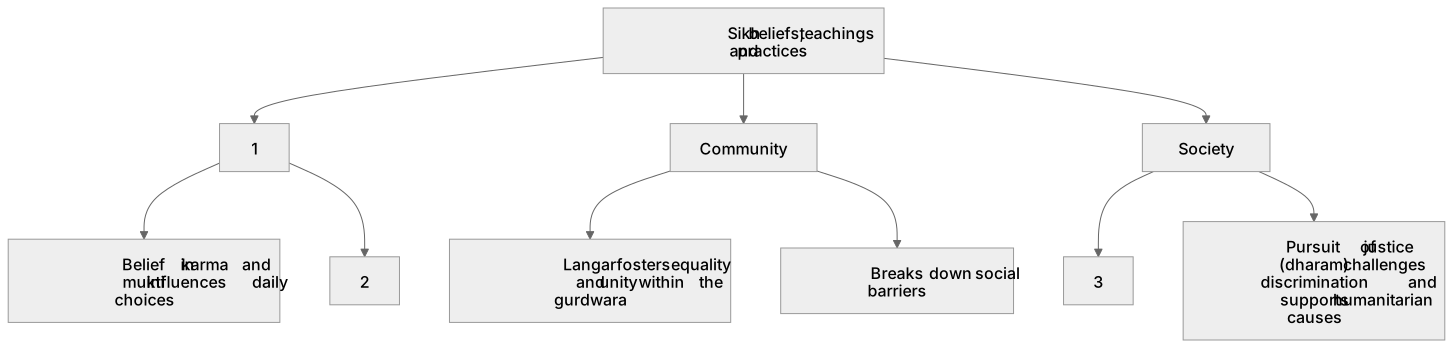
1Box 1
2Box 2
3Box 3
There is more to this lesson
The full lesson goes on to check your understanding and help you earn the marks. Create a free account to carry on, with your progress saved.
A week of Premium from your first lesson · Then the free plan continues · No card, no charge
Test your understanding of Sikhism: Students should study the influence of the beliefs, teachings and practices studied on individuals, communities and societies.
Active recall beats re-reading. Take an instant quiz now to test what you’ve learned and lock it into long-term memory.
A week of Premium from your first lesson · Then the free plan continues · No card, no charge