AQA · GCSE · Religious Studies
Course version: 8062 · Version from Sept 2018
In studying these themes, students should be aware of the significance,…
Full specification wording
Textual studies: In studying these themes, students should be aware of the significance, importance and influence of St Mark’s Gospel for individuals, communities and societies. They should understand how varied interpretations of the meaning of passages from St Mark’s Gospel may give rise to diversity within Christian traditions and consider how far Christian and non-religious communities give authority to
You must analyse how varied interpretations of passages create diversity within Christian traditions.
Checked against the AQA 8062 specification (opens in a new tab) on .
- Point 1 of 2
Study notes
From the checked teaching notes for this specification point.
The idea
You must analyse how varied interpretations of passages create diversity within Christian traditions. For instance, literalist interpretations of miracles differ from liberal, metaphorical views, leading to different denominational practices. Finally, you must assess how far both Christian and non-religious communities give authority to this text, contrasting a fundamentalist who views it as the absolute word of God with a secular humanist who might value its moral teachings without assigning it divine authority.
What earns the marks
- Explain the influence of St Mark's Gospel on individual Christians, such as providing moral guidance or comfort.
- Describe how the Gospel shapes community and societal actions, including church worship and social justice initiatives.
- Analyse how differing interpretations of St Mark's Gospel lead to diverse practices and beliefs within Christian denominations.
- Evaluate the varying degrees of authority given to the Gospel by different Christian traditions and non-religious groups.
Common mistakes and how to put them right
Treating all Christians as having the exact same interpretation of St Mark's Gospel.
Put it right: Acknowledge the diversity within Christian traditions, contrasting literal, conservative, and liberal interpretations.
Ignoring the perspective of non-religious communities when discussing the text's authority.
Put it right: Explicitly address how secular or non-religious groups might view the text, perhaps as a historical document or moral guide rather than divine revelation.
Failing to distinguish between the Gospel's impact on an individual versus its impact on society.
Put it right: Provide distinct examples for individuals (such as personal faith) and society (such as legal or cultural norms).
Exam tips
- Use specific passages from St Mark's Gospel to illustrate how different interpretations lead to diverse Christian practices.
- When evaluating authority, explicitly contrast a fundamentalist Christian view with a non-religious or humanist perspective to show breadth of understanding.
- Structure 12-mark evaluation answers to explicitly cover the impact on individuals, communities, and societies to ensure comprehensive coverage of the specification.
Try the lesson
The start of the Textual studies: In studying these themes, students should be aware of the significance, importance and influence of St Mark’s Gospel for individuals, communities and societies. They should understand how varied interpretations of the meaning of passages from St Mark’s Gospel may give rise to diversity within Christian traditions and consider how far Christian and non-religious communities give authority to lesson, made from checked teaching notes for this specification point.
Have a go first
Which of the following best describes how St Mark's Gospel provides influence for a Christian individual today?
Listen
You must analyse how varied interpretations of passages create diversity within Christian traditions. For instance, literalist interpretations of miracles differ from liberal, metaphorical views, leading to different denominational practices. Finally, you must assess how far both Christian and non-religious communities give authority to this text, contrasting a fundamentalist who views it as the absolute word of God with a secular humanist who might value its moral teachings without assigning it divine authority. A strong answer earns marks for these points. Explain the influence of St Mark's Gospel on individual Christians, such as providing moral guidance or comfort. Describe how the Gospel shapes community and societal actions, including church worship and social justice initiatives. Analyse how differing interpretations of St Mark's Gospel lead to diverse practices and beliefs within Christian denominations. Evaluate the varying degrees of authority given to the Gospel by different Christian traditions and non-religious groups. A common slip: Treating all Christians as having the exact same interpretation of St Mark's Gospel. Instead, Acknowledge the diversity within Christian traditions, contrasting literal, conservative, and liberal interpretations. Exam tip: Use specific passages from St Mark's Gospel to illustrate how different interpretations lead to diverse Christian practices.
See it

Label the diagram
Some boxes have lost their names. Pick the right name for each number.
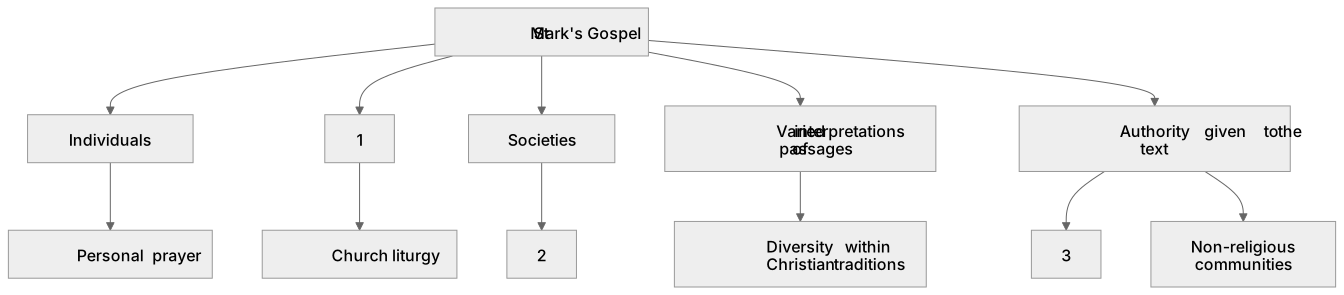
1Box 1
2Box 2
3Box 3
There is more to this lesson
The full lesson goes on to check your understanding and help you earn the marks. Create a free account to carry on, with your progress saved.
A week of Premium from your first lesson · Then the free plan continues · No card, no charge
Test your understanding of Textual studies: In studying these themes, students should be aware of the significance, importance and influence of St Mark’s Gospel for individuals, communities and societies. They should understand how varied interpretations of the meaning of passages from St Mark’s Gospel may give rise to diversity within Christian traditions and consider how far Christian and non-religious communities give authority to
Active recall beats re-reading. Take an instant quiz now to test what you’ve learned and lock it into long-term memory.
A week of Premium from your first lesson · Then the free plan continues · No card, no charge