AQA · GCSE · Religious Studies
Course version: 8062 · Version from Sept 2018
Textual studies
Dive into the fast-paced, action-packed Gospel of Mark, the earliest written account of Jesus' life. Discover how Mark's portrayal of a suffering, active Messiah provided hope to persecuted early Christians, and why its radical themes of discipleship and inclusion remain deeply significant today.
- Point 2 of 2
- 4 min read
- 3 worked examples
- 2 practice questions
- 4 key terms
Study Notes
Overview
 Open full-size image (opens in a new tab)
St Mark's Gospel is widely considered the earliest of the four Gospels, written around 65-70 CE for a Roman Christian community facing intense persecution under Emperor Nero. Because of this context, Mark portrays Jesus not as a distant philosopher, but as a man of urgent action and profound suffering. The Gospel is fast-paced, using the word 'immediately' (euthys) repeatedly to drive the narrative forward. For your GCSE exam (Themes G and H), examiners expect you to go beyond simply retelling the stories. You must be able to analyse the theological significance of Jesus' actions, evaluate contrasting interpretations of key concepts like the Kingdom of God, and explain what these ancient texts mean for twenty-first-century Christians.
Listen to the Podcast
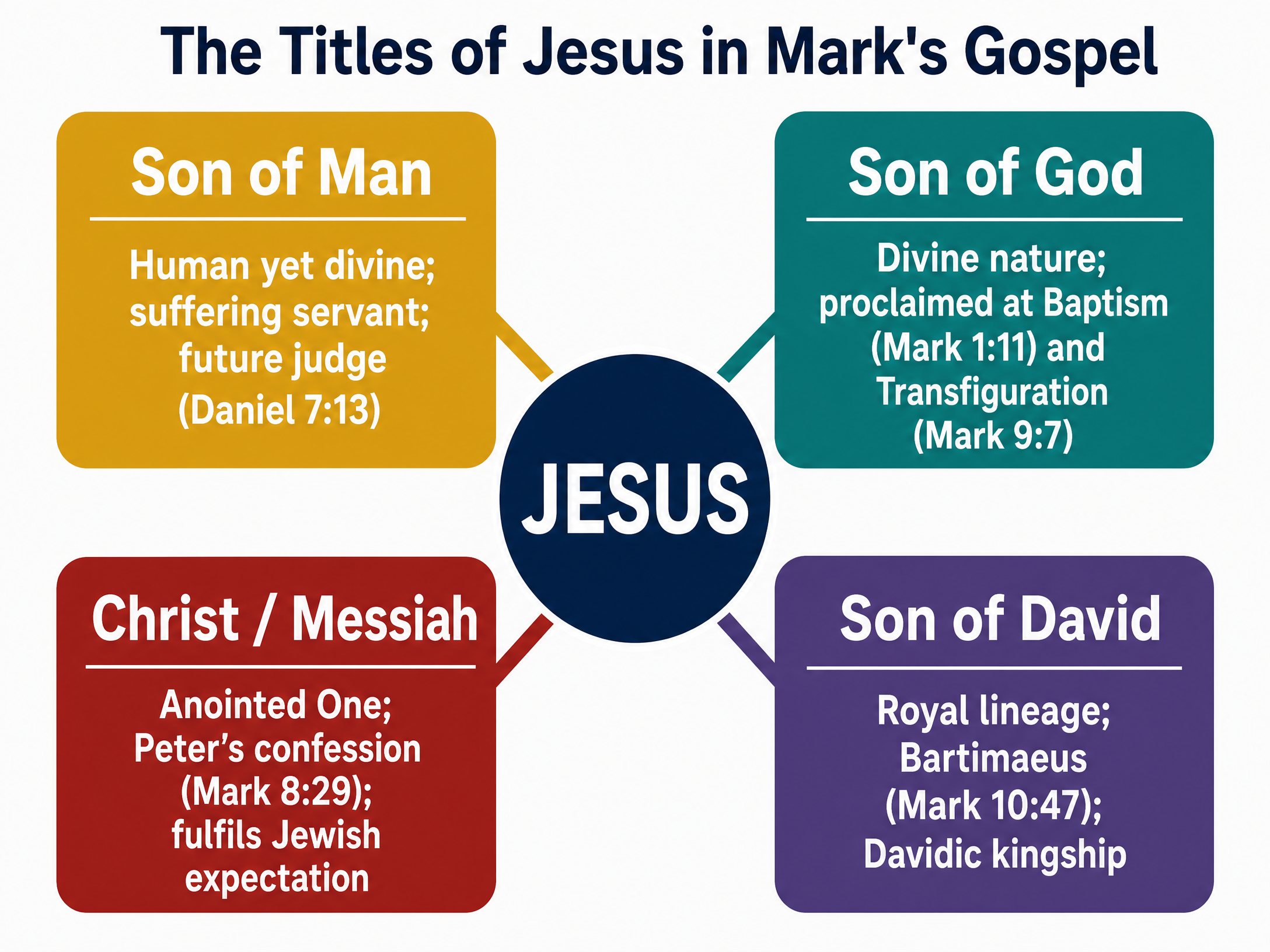
Key Titles of Jesus
 Open full-size image (opens in a new tab)
Son of Man
Significance: The title Jesus uses most frequently for himself. It holds a dual meaning: a heavenly figure of authority (from Daniel 7:13) and a human figure destined to suffer (Mark 8:31).
Exam Relevance: Shows the tension between Jesus' divine authority and his human vulnerability.
Son of God
Significance: Used by Mark in the opening verse (1:1), confirmed by God at the Baptism (1:11) and Transfiguration (9:7), and remarkably recognised by a Roman centurion at the crucifixion (15:39).
Exam Relevance: Central to understanding Jesus' divine nature and authority.
Christ / Messiah
Significance: Means 'Anointed One'. Jews expected a military/political leader to overthrow the Romans. Jesus redefines it as a suffering servant after Peter's confession (Mark 8:29).
Exam Relevance: Crucial for 'explain' questions about Jewish expectations vs Jesus' reality.
Son of David
Significance: Connects Jesus to the royal lineage of Israel's greatest king. Used by the blind beggar Bartimaeus (Mark 10:47).
Exam Relevance: Highlights how the marginalised often recognised Jesus when the religious elite did not.
The Kingdom of God
 Open full-size image (opens in a new tab)
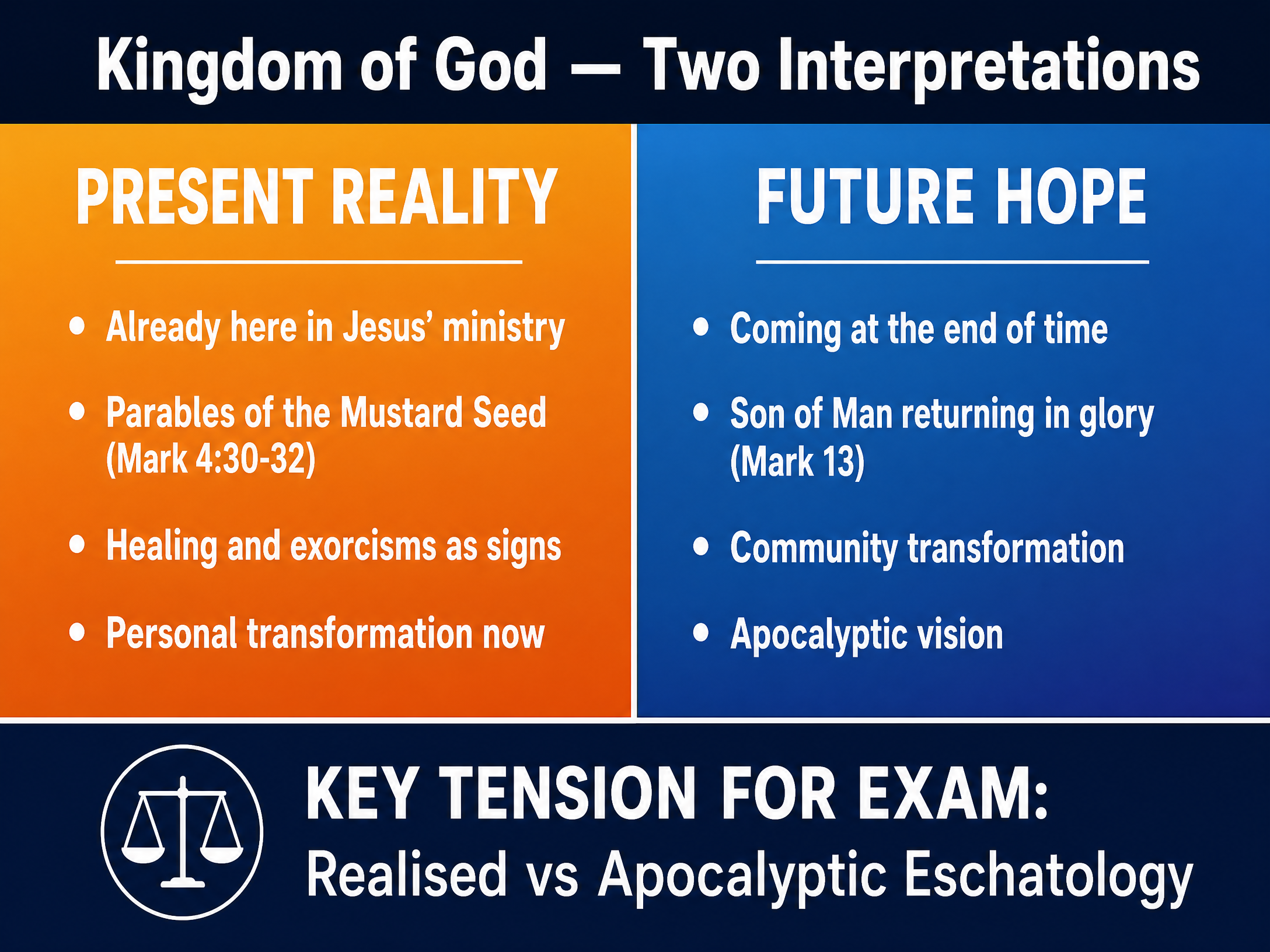
The Kingdom of God (Basileia tou Theou) is not a physical place, but the rule and reign of God. There are two contrasting interpretations you must know:
Present Reality (Realised Eschatology)
The belief that the Kingdom is already here, breaking into the world through Jesus' ministry. Evidence includes his healings, exorcisms, and the Parable of the Mustard Seed (Mark 4:30-32), which shows the Kingdom starting small but growing significantly.
Future Hope (Apocalyptic Eschatology)
The belief that the Kingdom will arrive fully at the end of time. Evidence includes Jesus' apocalyptic teachings in Mark 13, where he describes the Son of Man returning in clouds with great power and glory.
Discipleship and the Marginalised
 Open full-size image (opens in a new tab)
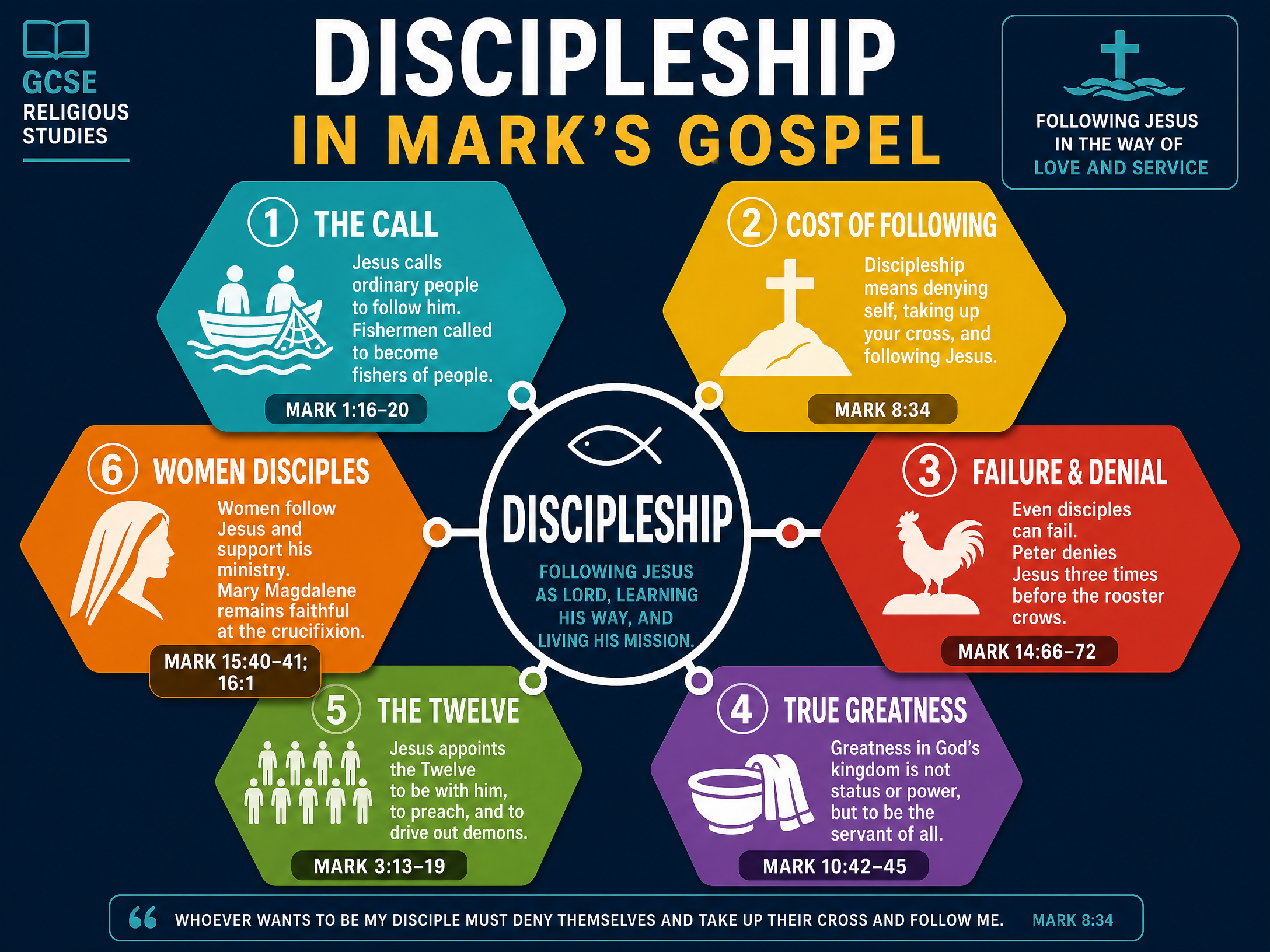
The Nature of Discipleship
Discipleship in Mark is honest. The disciples are called immediately (Mark 1:16-20), but they often fail, misunderstand, and deny Jesus (e.g., Peter in Mark 14:66-72). Jesus defines true discipleship as self-denial and taking up one's cross (Mark 8:34), a radical call to self-sacrifice.
Jesus and the Marginalised
Jesus consistently breaks social and religious taboos to reach out to those excluded by society: lepers, tax collectors, women, and Gentiles. For example, healing the woman with the haemorrhage (Mark 5:25-34) restores her social dignity and challenges purity laws. For 21st-century Christians, this sets a mandate for social justice and inclusion.
Try the lesson
The start of the Textual studies lesson, made from teaching notes for this specification point.
Have a go first
Why was St Mark's Gospel particularly important for the early followers of Jesus?
Listen
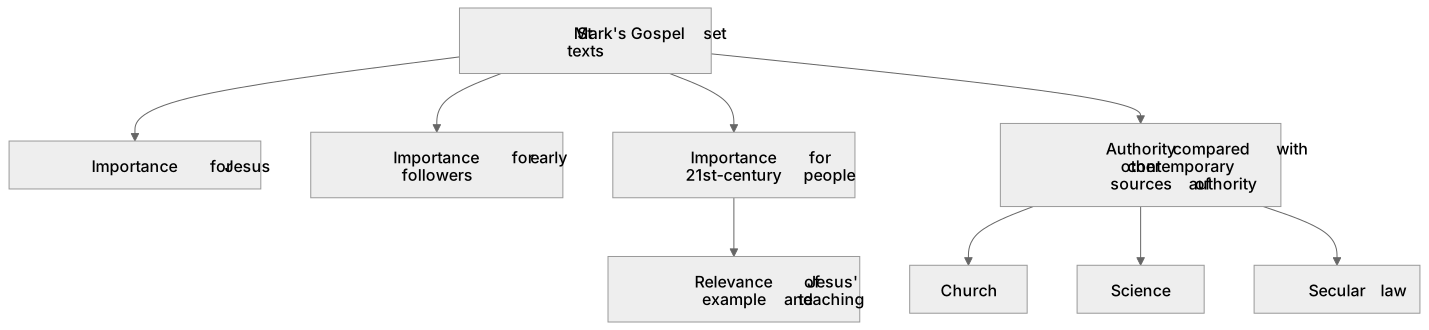
St Mark’s Gospel serves as a foundational text, offering profound insights into Jesus’ identity and mission. You must analyse set texts to understand their significance across three contexts: what they meant for Jesus himself (e.g., his messianic consciousness at his baptism), their impact on his early followers facing persecution, and their enduring relevance for 21st-century Christians seeking moral guidance. Crucially, you must evaluate the Gospel's authority compared to other contemporary sources of authority, such as the Church, science, or secular law. By examining Jesus’ example and teachings, such as his healing miracles or parables, you can assess how his actions continue to shape modern Christian ethics and discipleship today. A strong answer earns marks for these points. Accurately recount specific details from the set texts within St Mark's Gospel. Explain the significance of Gospel events for Jesus, his early disciples, and modern Christians. Compare the authority of St Mark's Gospel with contemporary sources of authority, such as secular law or Church tradition. Evaluate the practical relevance of Jesus' teachings and example for ethical decision-making in the 21st century. A common slip: Treating the Gospel's meaning as identical for early Christians and modern readers. Instead, Distinguish between the historical context of early persecuted followers and the ethical application for 21st-century believers. Exam tip: Always link the events in St Mark's Gospel to their impact on 21st-century Christian daily life and worship.
See it
Key words
Say what each word means before you turn the card.
Authority
Try answering aloud or in your head before turning the card.
Discipleship
Try answering aloud or in your head before turning the card.
Historical Context
Try answering aloud or in your head before turning the card.
Contemporary Relevance
Try answering aloud or in your head before turning the card.
See every definition
- Authority
- The standing of the Gospel, which students should be able to consider and compare with other sources of contemporary authority.
- Discipleship
- The following of Jesus by his early followers, whose impact students should understand, and which his example and teaching continue to shape today.
- Historical Context
- The situation of early persecuted followers, which must be distinguished from the ethical application for 21st-century believers.
- Contemporary Relevance
- The enduring relevance of Jesus' example and teaching for 21st-century Christians seeking moral guidance and ethical decision-making.
Label the diagram
Some boxes have lost their names. Pick the right name for each number.
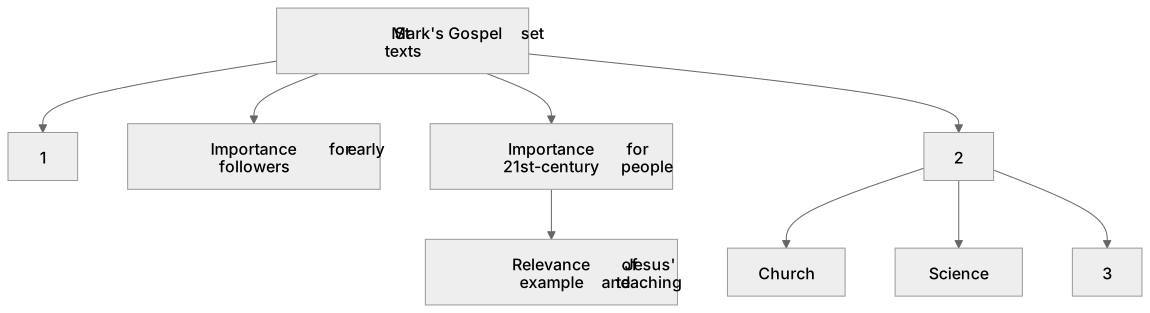
1Box 1
2Box 2
3Box 3
There is more to this lesson
The full lesson goes on to check your understanding and help you earn the marks. Create a free account to carry on, with your progress saved.
A week of Premium from your first lesson · Then the free plan continues · No card, no charge
Worked Examples
3 worked examples — open one to explore the question and available guidance.
Practice Questions
Try the question, then reveal an answer plan or example response
Describe the calling of the first disciples in Mark's Gospel. (5 marks)
Hint: Focus on who was called, what they were doing, what Jesus said, and how they reacted.
‘A 21st-century Christian cannot be expected to take up their cross.’ Evaluate this statement. (12 marks)
Hint: Contrast literal first-century crucifixion with metaphorical 21st-century sacrifice.
Ready to test yourself interactively?
Active recall beats reading alone. Answer questions on Textual studies with instant AI scoring and mark scheme guidance.
A week of Premium from your first lesson · Then the free plan continues · No card, no charge
Exam technique
How to turn what you know into marks
How to approach the question
Always identify the command word and check if the question asks for 1st-century context, 21st-century context, or both.
How to structure your answer
- Essay questions
- Intro (define terms) -> Agree paragraph (with evidence) -> Disagree paragraph (with evidence) -> Conclusion (justified judgement).
- Source questions
- If given a quote, you MUST refer to it in your answer. Do not ignore the stimulus material.
- Explain questions
- Use PEEL: Point, Evidence (Verse/Story), Explanation (Theological meaning), Link (Significance for believers).
Timing
Approximately 1 minute per mark, plus planning time for 12-mark evaluation questions.
Common pitfalls
- Retelling the story (narrative) instead of explaining its meaning (analysis).
- Confusing the different titles of Jesus.
- Failing to mention what the text means for Christians living today.
What the command words want
- Explain
- Give reasons why something happened or why it is important. Use 'because' and 'this means that'.
- Outline
- Briefly state the main points.
- Describe
- Give factual details of a story or teaching. No deep analysis needed.
- Evaluate
- Look at multiple viewpoints, weigh up the evidence, and come to a conclusion.
Test your understanding of Textual studies
Active recall beats re-reading. Take an instant quiz now to test what you’ve learned and lock it into long-term memory.
A week of Premium from your first lesson · Then the free plan continues · No card, no charge