AQA · GCSE · Religious Studies
The later ministry of Jesus
The Later Ministry of Jesus, also known as the Passion Narrative, covers the final, climactic days of Jesus's earthly life from Palm Sunday to the Resurrection. It is historically significant as the foundation of Christian belief and practice, and examiners frequently test candidates on the deep theological themes of atonement, discipleship, and the Kingdom of God embedded within these events.
- 8 min read
- 3 worked examples
- 5 practice questions
- 6 key terms
Study Notes
Overview
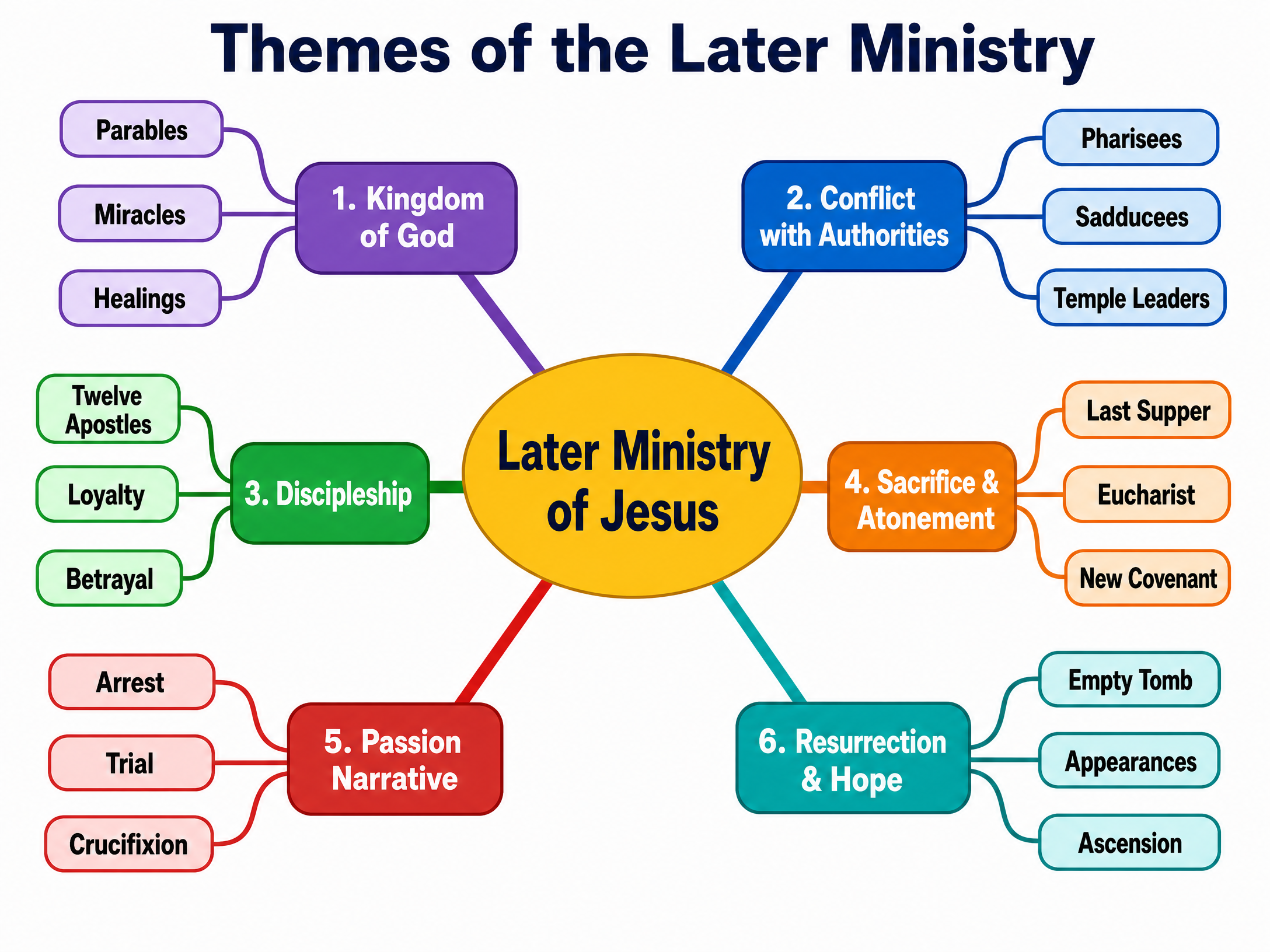
The Later Ministry of Jesus (the Passion Narrative) is the cornerstone of the Christianity unit in GCSE Religious Studies. This topic covers the final week of Jesus's life, beginning with his triumphant entry into Jerusalem and culminating in his crucifixion and resurrection. Examiners expect candidates to not only know the sequence of events but to understand their profound theological significance. Key themes include Jesus's identity as the Messiah, the nature of the Kingdom of God, the concept of atonement (reconciling humanity with God through sacrifice), and the challenges of discipleship. A strong answer will consistently link historical events to these theological concepts and cite specific Gospel references.
Key Events & Developments

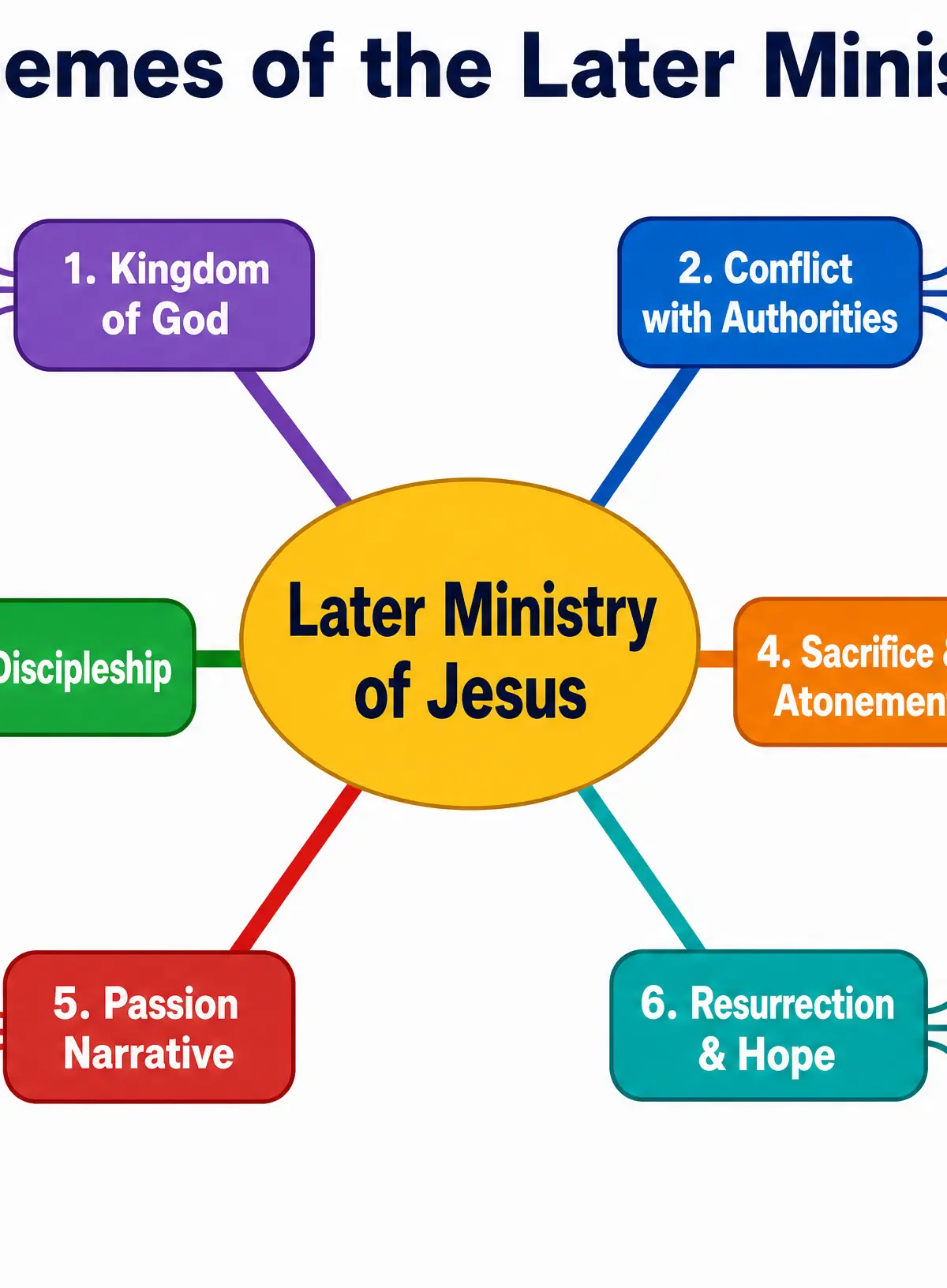
The Entry into Jerusalem (Palm Sunday)
Date(s): The Sunday before the Crucifixion
What happened: Jesus rode into Jerusalem on a donkey. Crowds welcomed him by laying palm branches and cloaks on the road, shouting "Hosanna! Blessed is he who comes in the name of the Lord!" (Mark 11:9).
Why it matters: Theologically, Jesus is fulfilling Old Testament prophecy (Zechariah 9:9), making a public claim to be the promised Messiah. However, by choosing a donkey rather than a warhorse, he presents himself as a humble, peaceful king, redefining messianic expectations.
Specific Knowledge: Zechariah 9:9 prophecy; Mark 11; the contrast between a military conqueror and a servant king.
The Cleansing of the Temple
Date(s): Shortly after entering Jerusalem
What happened: Jesus drove money changers and merchants out of the Temple courts, overturning their tables. He declared, "My house shall be called a house of prayer, but you have made it a den of robbers."
Why it matters: This was a provocative prophetic act. Jesus claimed divine authority over the Temple, condemning the religious establishment for corrupting God's intentions. Historically, this act directly triggered the authorities' plot to arrest him.
Specific Knowledge: Quotes combining Isaiah 56:7 and Jeremiah 7:11; the Temple as the centre of Jewish religious life.
The Last Supper
Date(s): The Thursday evening before the Crucifixion
What happened: Jesus shared a final Passover meal with his disciples. He took bread, saying, "This is my body, given for you," and wine, saying, "This cup is the new covenant in my blood" (Luke 22:19-20). He also predicted Judas's betrayal and Peter's denial.
Why it matters: This event instituted the Eucharist (Holy Communion). Theologically, Jesus reinterpreted the Passover—just as the Passover lamb saved the Israelites in Egypt, Jesus is the new lamb sacrificed to save humanity from sin (Atonement).
Specific Knowledge: Luke 22; the connection to the Jewish Passover; the establishment of the New Covenant.
Gethsemane and the Arrest
Date(s): Late Thursday night
What happened: Jesus prayed in the Garden of Gethsemane, expressing deep anguish: "Father, if you are willing, take this cup from me; yet not my will, but yours be done" (Luke 22:42). The disciples repeatedly fell asleep. Judas then arrived and betrayed Jesus with a kiss, leading to his arrest.
Why it matters: Jesus's prayer demonstrates his full humanity (genuine fear) and perfect obedience to God. The disciples' failure highlights human weakness, while Judas's betrayal raises themes of loyalty and free will.
Specific Knowledge: Luke 22:42; the Mount of Olives; the non-violent response to arrest.
The Trials
Date(s): Thursday night to Friday morning
What happened: Jesus was tried before the Jewish Sanhedrin (led by High Priest Caiaphas) and condemned for blasphemy for claiming to be the Son of God. He was then brought before the Roman governor, Pontius Pilate, who alone had the authority to order crucifixion. Despite finding no fault, Pilate yielded to the crowd and sentenced Jesus to death.
Why it matters: The trials show Jesus's rejection by both religious and political authorities. Christians view this suffering as the fulfilment of Isaiah 53 (the Suffering Servant), demonstrating God's plan for salvation.
Specific Knowledge: The Sanhedrin; Pontius Pilate; the charge of blasphemy vs. treason.
The Crucifixion
Date(s): Good Friday
What happened: Jesus was crucified at Golgotha. He spoke seven times from the cross, including the cry of desolation: "My God, my God, why have you forsaken me?" (Psalm 22:1). At his death, the Temple curtain tore in two.
Why it matters: The crucifixion is the ultimate act of atonement. The tearing of the Temple curtain symbolises that Jesus's death removed the barrier between God and humanity, allowing direct access to God.
Specific Knowledge: Golgotha; Psalm 22; the significance of the torn Temple curtain.
The Resurrection
Date(s): Easter Sunday
What happened: Women found the tomb empty. Angels announced Jesus had risen, and he subsequently appeared to Mary Magdalene and the disciples.
Why it matters: The Resurrection is the foundation of Christianity. It vindicates Jesus's teachings, confirms his divine identity, and guarantees eternal life for believers, as Paul states in 1 Corinthians 15: "If Christ has not been raised, your faith is futile."
Specific Knowledge: The empty tomb; 1 Corinthians 15; appearances to disciples.
Key Individuals
Jesus Christ
Role: The central figure, believed by Christians to be the Son of God and the Messiah.
Key Actions: Taught, performed miracles, confronted authorities, instituted the Eucharist, was crucified, and resurrected.
Impact: His life, death, and resurrection form the basis of the Christian faith and the doctrine of salvation.
Judas Iscariot
Role: One of the Twelve Apostles.
Key Actions: Betrayed Jesus to the chief priests for thirty pieces of silver, identifying him with a kiss in Gethsemane.
Impact: His actions fulfilled prophecy but also serve as a profound theological warning about the failures of discipleship and the reality of free will.
Simon Peter
Role: A leading Apostle.
Key Actions: Pledged absolute loyalty but denied knowing Jesus three times; later restored by the risen Christ.
Impact: Represents the flawed but redeemable nature of human discipleship; highlights themes of repentance and grace.
Pontius Pilate
Role: The Roman Governor of Judaea.
Key Actions: Presided over Jesus's Roman trial, found him innocent, but ultimately ordered his crucifixion to appease the crowd.
Impact: Demonstrates the political context of Jesus's death and the collision between worldly power and the Kingdom of God.
Caiaphas
Role: The Jewish High Priest.
Key Actions: Led the Sanhedrin trial that condemned Jesus for blasphemy.
Impact: Represents the religious establishment's rejection of Jesus's messianic claims.
Second-Order Concepts
Causation
Why was Jesus crucified? The short-term trigger was the Cleansing of the Temple, which directly threatened the religious authorities' power and income. Long-term causes included Jesus's growing popularity, his reinterpretation of Jewish law, and his implicit claims to divine authority (e.g., forgiving sins), which the Sanhedrin viewed as blasphemy.
Consequence
The immediate consequence of the crucifixion was the scattering of the disciples in fear. However, the long-term consequence—following the Resurrection—was the birth of the Christian Church, the spread of the Gospel, and a fundamental shift in world history. Theologically, the consequence is the atonement of human sin.
Change & Continuity
Jesus represented both continuity (fulfilling Old Testament prophecies like Zechariah 9:9 and Isaiah 53) and radical change (instituting a New Covenant that replaced the old sacrificial system of the Temple with his own ultimate sacrifice).
Significance
The Later Ministry is significant because it contains the core doctrines of Christianity: the Incarnation, Atonement, and Resurrection. Without these events, Christianity as a faith system would not exist.
Source Skills
When examining Gospel extracts or theological texts, consider the provenance: which Gospel is it from? Mark is often seen as the earliest and most urgent; Luke emphasises Jesus's compassion for outcasts; Matthew focuses on fulfilling Jewish prophecy; John is highly theological. In exam answers, explicitly state how a source supports a particular Christian belief (e.g., "Source A from Luke 22 supports the belief in the Eucharist because...").
Interactive Diagrams
1 interactive diagram to visualise key concepts
Conceptual Flow Outline
Theological developments from the Last Supper
Worked Examples
3 worked examples — open one to explore the question and available guidance.
Practice Questions
Test your understanding — click to reveal model answers
Explain two ways in which the events of Gethsemane show Jesus's human nature. (4 marks)
Hint: Think about his emotions during prayer and his physical reactions.
Explain the Christian teaching about the Atonement. (5 marks)
Hint: Link the concept to the Crucifixion, the Passover lamb, and the restoration of the relationship between God and humanity.
"The betrayal by Judas was a necessary part of God's plan." Evaluate this statement. (12 marks)
Hint: Consider the tension between divine predestination (prophecy) and human free will.
Describe what happened at the Cleansing of the Temple. (5 marks)
Hint: Give a chronological account of Jesus's actions and words in the Temple courts.
Explain the significance of the tearing of the Temple curtain. (4 marks)
Hint: What did the curtain separate, and what does its tearing represent?