AQA · GCSE · Religious Studies
Course version: 8062 · Version from Sept 2018
Religion, human rights and social justice: Prejudice and discrimination in…
Full specification wording
Theme F: Religion, human rights and social justice: Prejudice and discrimination in religion and belief, including the status and treatment within religion of women and those in same sex relationships.
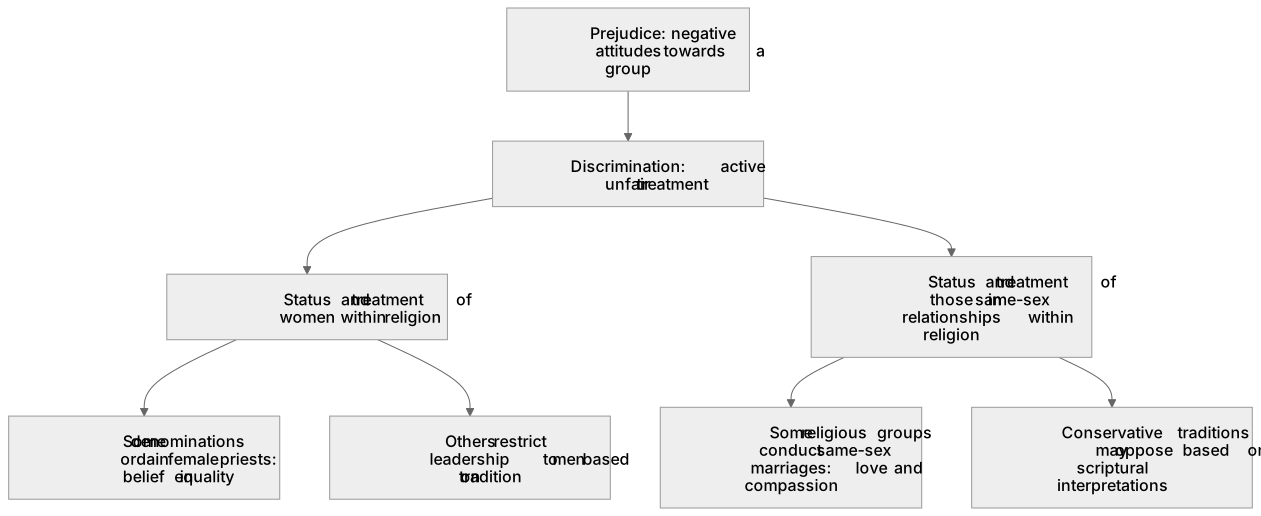
Prejudice is holding negative attitudes towards someone based on their group, while discrimination is the active unfair treatment of them.
- Point 8 of 23
- 3 key terms
Study notes
From the teaching notes for this specification point.
The idea
Prejudice is holding negative attitudes towards someone based on their group, while discrimination is the active unfair treatment of them. For example, some Christian denominations ordain female priests, reflecting a belief in equality (Galatians 3:28), while others restrict leadership to men based on tradition. Similarly, views on same-sex relationships vary; some religious groups conduct same-sex marriages, emphasising love and compassion, whereas conservative traditions may oppose such relationships based on specific scriptural interpretations. Both areas require contrasting religious views.
What earns the marks
- Distinguish between prejudice (an attitude or thought) and discrimination (an action or behaviour).
- Explain differing religious views on the status of women, including debates over female ordination or leadership roles.
- Explain differing religious views on same-sex relationships, contrasting liberal acceptance with conservative opposition.
- Use specific scriptural references (e.g., 'There is neither male nor female' or the story of Adam and Eve) to justify different treatments of women.
- Use specific religious teachings to explain varying attitudes towards same-sex relationships.
Common mistakes and how to put them right
Using prejudice and discrimination interchangeably.
Put it right: Clearly define prejudice as an internal attitude and discrimination as an external action.
Claiming that a whole religion holds one view on women or same-sex relationships.
Put it right: Acknowledge the diversity of belief within religions, such as differences between liberal and conservative denominations.
Failing to address both women and same-sex relationships in broad questions.
Put it right: Ensure both groups are discussed if the question asks generally about discrimination in religion.
Exam tips
- Always provide contrasting views from within the same religion (e.g., Church of England vs. Catholic Church) when discussing the treatment of women.
- Learn specific quotes that can be used to argue both for and against equality in religious leadership.
- Ensure you explicitly link the concepts of prejudice and discrimination to the specific examples of women and same-sex relationships.
Try the lesson
The start of the Theme F: Religion, human rights and social justice: Prejudice and discrimination in religion and belief, including the status and treatment within religion of women and those in same sex relationships. lesson, made from teaching notes for this specification point.
Have a go first
Which of the following is an example of discrimination, rather than prejudice, regarding the treatment of women in a religious context?
Listen
Prejudice is holding negative attitudes towards someone based on their group, while discrimination is the active unfair treatment of them. For example, some Christian denominations ordain female priests, reflecting a belief in equality (Galatians 3:28), while others restrict leadership to men based on tradition. Similarly, views on same-sex relationships vary; some religious groups conduct same-sex marriages, emphasising love and compassion, whereas conservative traditions may oppose such relationships based on specific scriptural interpretations. Both areas require contrasting religious views. A strong answer earns marks for these points. Distinguish between prejudice (an attitude or thought) and discrimination (an action or behaviour). Explain differing religious views on the status of women, including debates over female ordination or leadership roles. Explain differing religious views on same-sex relationships, contrasting liberal acceptance with conservative opposition. Use specific scriptural references (e.g., 'There is neither male nor female' or the story of Adam and Eve) to justify different treatments of women. A common slip: Using prejudice and discrimination interchangeably. Instead, clearly define prejudice as an internal attitude and discrimination as an external action. Exam tip: Always provide contrasting views from within the same religion (e.g., Church of England vs. Catholic Church) when discussing the treatment of women.
See it
Key words
Say what each word means before you turn the card.
Prejudice
Try answering aloud or in your head before turning the card.
Discrimination
Try answering aloud or in your head before turning the card.
Equality
Try answering aloud or in your head before turning the card.
See every definition
- Prejudice
- Holding negative attitudes towards someone based on their group.
- Discrimination
- The active unfair treatment of someone based on their group.
- Equality
- A belief reflected in some Christian denominations ordaining female priests.
Label the diagram
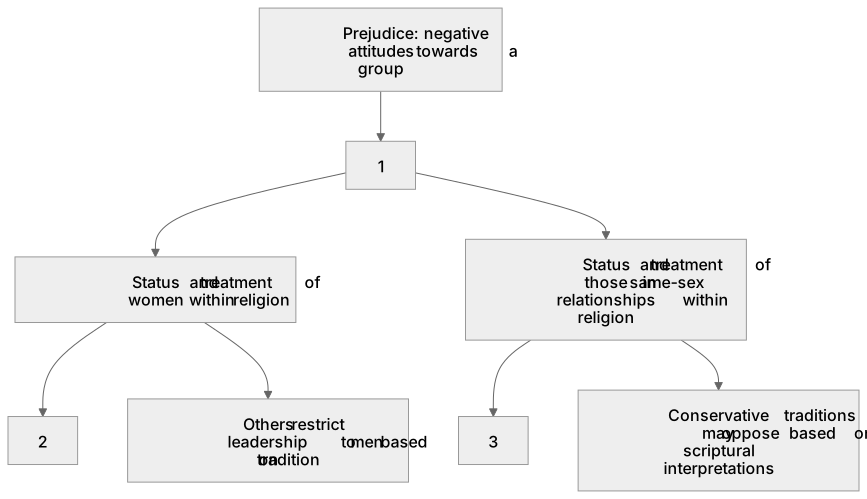
Some boxes have lost their names. Pick the right name for each number.
1Box 1
2Box 2
3Box 3
There is more to this lesson
The full lesson goes on to check your understanding and help you earn the marks. Create a free account to carry on, with your progress saved.
A week of Premium from your first lesson · Then the free plan continues · No card, no charge
Test your understanding of Theme F: Religion, human rights and social justice: Prejudice and discrimination in religion and belief, including the status and treatment within religion of women and those in same sex relationships.
Active recall beats re-reading. Take an instant quiz now to test what you’ve learned and lock it into long-term memory.
A week of Premium from your first lesson · Then the free plan continues · No card, no charge