AQA · GCSE · Religious Studies
Course version: 8062 · Version from Sept 2018
Theme F: Religion, human rights and social justice: Human rights
Human rights are the basic entitlements and freedoms that belong to every person in the world, from birth until death, regardless of their race, sex, or religion.
- Point 7 of 23
Study notes
From the teaching notes for this specification point.
The idea
Human rights are the basic entitlements and freedoms that belong to every person in the world, from birth until death, regardless of their race, sex, or religion. They are formally outlined in documents like the Universal Declaration of Human Rights (UDHR). In religious traditions, these rights are often seen as God-given. For example, Christians believe in 'Imago Dei' (that humans are made in the image of God), which means every life has inherent dignity and value. Similarly, Islamic teachings emphasise equality and justice, supporting rights such as the right to life and freedom of belief.
What earns the marks
- Define human rights as universal entitlements, such as the right to life or freedom of speech.
- Reference the Universal Declaration of Human Rights (UDHR) as a key secular framework.
- Explain Christian support for human rights using concepts like Agape or Imago Dei.
- Explain Islamic (or other chosen religion) support for human rights using teachings on equality and justice.
- Provide examples of religious individuals or organisations campaigning for human rights.
Common mistakes and how to put them right
Confusing human rights with civil rights.
Put it right: Human rights are universal and inherent, whereas civil rights are granted by specific nations.
Assuming religions always agree with secular human rights.
Put it right: Acknowledge that some religious practices may conflict with secular interpretations of rights.
Failing to link human rights to specific religious teachings.
Put it right: Back up general statements with specific concepts like 'sanctity of life' or 'Imago Dei'.
Exam tips
- Use the Universal Declaration of Human Rights (UDHR) as a concrete example of secular human rights.
- Memorise at least two religious quotes or teachings that support the concept of human rights, such as 'Love your neighbour'.
- When evaluating, contrast secular views on human rights with religious perspectives to build a balanced argument.
Try the lesson
The start of the Theme F: Religion, human rights and social justice: Human rights lesson, made from teaching notes for this specification point.
Have a go first
What is the fundamental principle behind the concept of universal human rights?
Listen
Human rights are the basic entitlements and freedoms that belong to every person in the world, from birth until death, regardless of their race, sex, or religion. They are formally outlined in documents like the Universal Declaration of Human Rights (UDHR). In religious traditions, these rights are often seen as God-given. For example, Christians believe in 'Imago Dei' (that humans are made in the image of God), which means every life has inherent dignity and value. Similarly, Islamic teachings emphasise equality and justice, supporting rights such as the right to life and freedom of belief. A strong answer earns marks for these points. Define human rights as universal entitlements, such as the right to life or freedom of speech. Reference the Universal Declaration of Human Rights (UDHR) as a key secular framework. Explain Christian support for human rights using concepts like Agape or Imago Dei. Explain Islamic (or other chosen religion) support for human rights using teachings on equality and justice. A common slip: Confusing human rights with civil rights. Instead, human rights are universal and inherent, whereas civil rights are granted by specific nations. Exam tip: Use the Universal Declaration of Human Rights (UDHR) as a concrete example of secular human rights.
See it
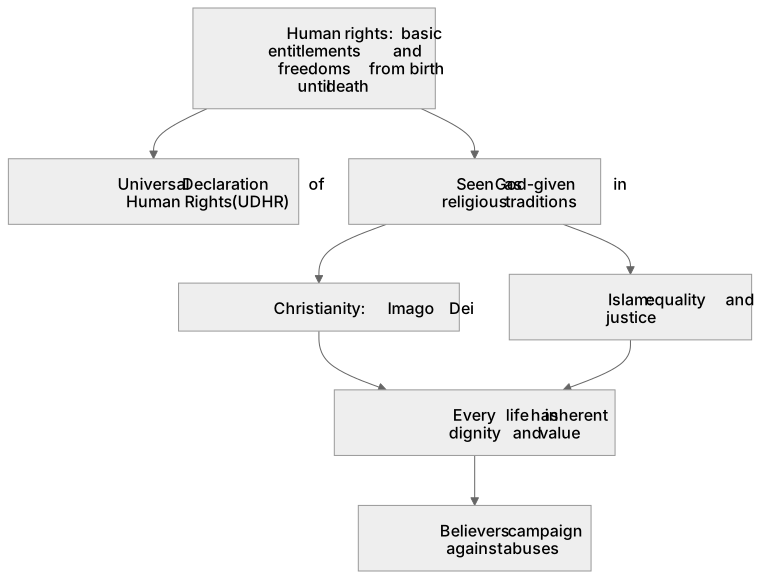
Label the diagram
Some boxes have lost their names. Pick the right name for each number.
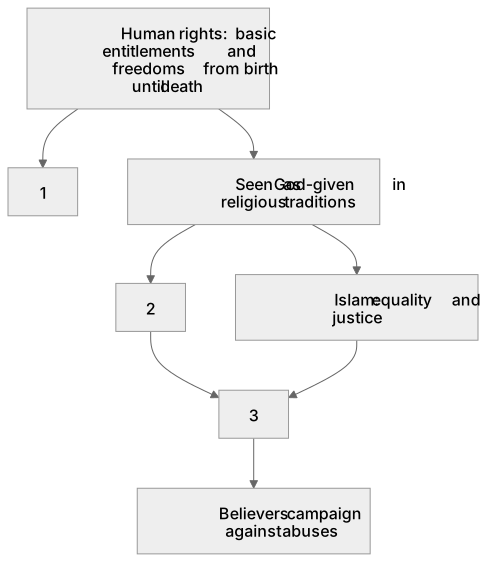
1Box 1
2Box 2
3Box 3
There is more to this lesson
The full lesson goes on to check your understanding and help you earn the marks. Create a free account to carry on, with your progress saved.
A week of Premium from your first lesson · Then the free plan continues · No card, no charge
Test your understanding of Theme F: Religion, human rights and social justice: Human rights
Active recall beats re-reading. Take an instant quiz now to test what you’ve learned and lock it into long-term memory.
A week of Premium from your first lesson · Then the free plan continues · No card, no charge