AQA · GCSE · Religious Studies
Course version: 8062 · Version from Sept 2018
Theme F: Religion, human rights and social justice: Social justice.
Social justice refers to the concept of a fair and equal society where all individuals have access to basic human rights, wealth, opportunities, and privileges.
- Point 11 of 23
Study notes
From the teaching notes for this specification point.
The idea
Social justice refers to the concept of a fair and equal society where all individuals have access to basic human rights, wealth, opportunities, and privileges. In Religious Studies, this involves examining how religious teachings motivate believers to actively challenge inequality and oppression. For example, Christians might campaign for fair trade or support food banks, driven by the biblical teaching to 'love your neighbour' and the belief that all humans are created in the image of God (imago Dei). Similarly, Muslims are motivated by the principle of Zakah (charitable giving) and the belief in the Ummah (brotherhood) to ensure wealth is distributed fairly and the vulnerable are protected from exploitation.
What earns the marks
- Define social justice as promoting a fair society by challenging injustice and valuing diversity.
- Explain Christian motivations for social justice, such as the concept of Agape and Jesus' teachings on wealth and poverty.
- Explain Islamic motivations for social justice, including the duty of Zakah and the importance of the Ummah.
- Provide examples of how religious believers put social justice into practice, such as supporting charities like Christian Aid or Islamic Relief.
Common mistakes and how to put them right
Confusing social justice with charity.
Put it right: Charity is giving to those in need, whereas social justice also involves changing the systems that cause poverty and inequality.
Stating that only religious people care about social justice.
Put it right: Acknowledge that secular organisations and humanists also campaign for social justice based on human rights and empathy.
Providing vague religious teachings.
Put it right: Use specific teachings like 'imago Dei' or 'Zakah' rather than just saying 'God wants people to be nice'.
Exam tips
- Always link the concept of social justice to specific religious teachings or sacred texts to access higher marks.
- Use concrete examples of religious charities, such as Tearfund or Islamic Relief, to illustrate how believers work for social justice today.
- When evaluating whether religious people do enough for social justice, contrast practical action with the view that prayer and spiritual duties are equally important.
Try the lesson
The start of the Theme F: Religion, human rights and social justice: Social justice. lesson, made from teaching notes for this specification point.
Have a go first
What is the most accurate definition of social justice in a religious context?
Listen
Social justice refers to the concept of a fair and equal society where all individuals have access to basic human rights, wealth, opportunities, and privileges. In Religious Studies, this involves examining how religious teachings motivate believers to actively challenge inequality and oppression. For example, Christians might campaign for fair trade or support food banks, driven by the biblical teaching to 'love your neighbour' and the belief that all humans are created in the image of God (imago Dei). Similarly, Muslims are motivated by the principle of Zakah (charitable giving) and the belief in the Ummah (brotherhood) to ensure wealth is distributed fairly and the vulnerable are protected from exploitation. A strong answer earns marks for these points. Define social justice as promoting a fair society by challenging injustice and valuing diversity. Explain Christian motivations for social justice, such as the concept of Agape and Jesus' teachings on wealth and poverty. Explain Islamic motivations for social justice, including the duty of Zakah and the importance of the Ummah. Provide examples of how religious believers put social justice into practice, such as supporting charities like Christian Aid or Islamic Relief. A common slip: Confusing social justice with charity. Instead, charity is giving to those in need, whereas social justice also involves changing the systems that cause poverty and inequality. Exam tip: Always link the concept of social justice to specific religious teachings or sacred texts to access higher marks.
See it
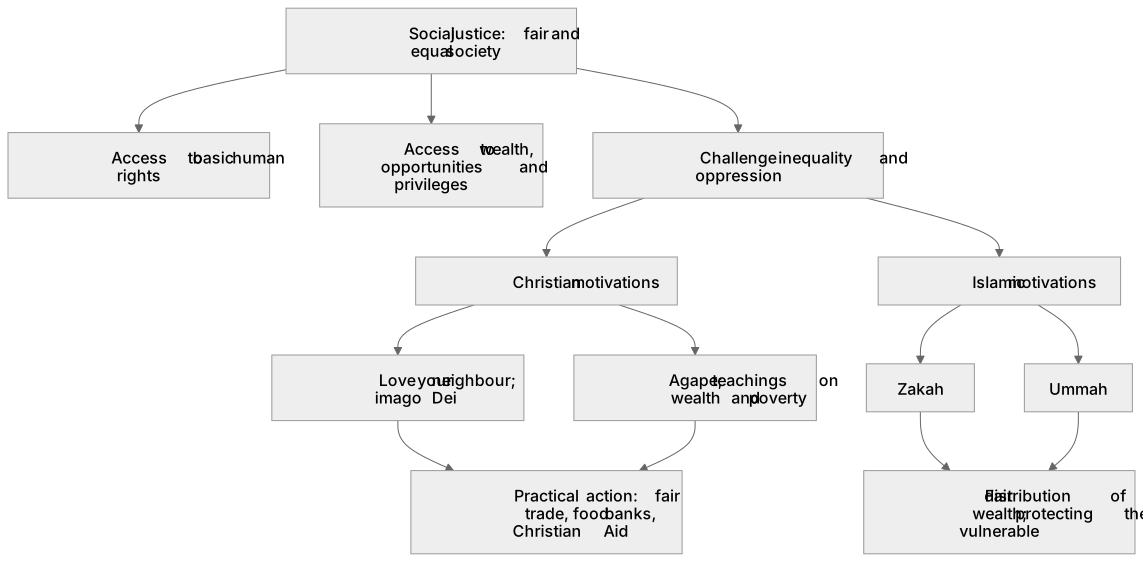
Label the diagram
Some boxes have lost their names. Pick the right name for each number.
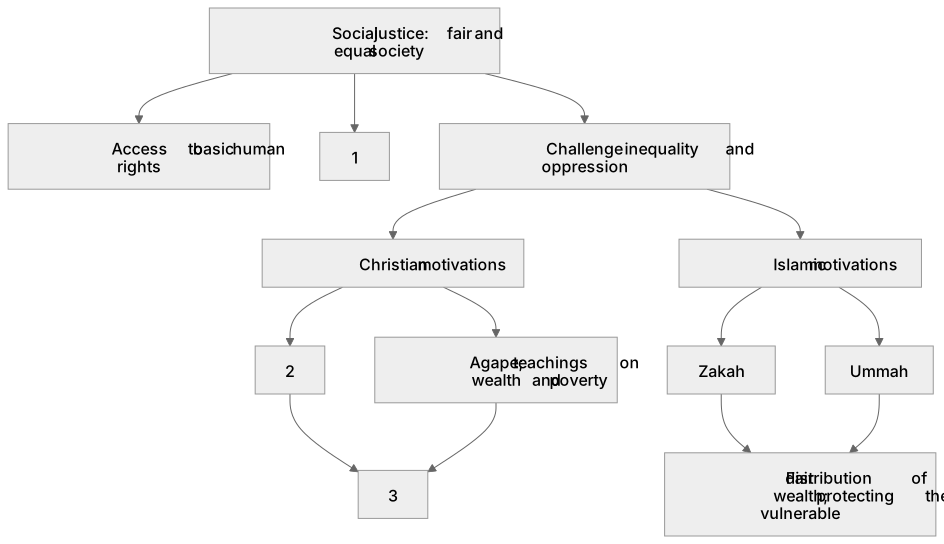
1Box 1
2Box 2
3Box 3
There is more to this lesson
The full lesson goes on to check your understanding and help you earn the marks. Create a free account to carry on, with your progress saved.
A week of Premium from your first lesson · Then the free plan continues · No card, no charge
Test your understanding of Theme F: Religion, human rights and social justice: Social justice.
Active recall beats re-reading. Take an instant quiz now to test what you’ve learned and lock it into long-term memory.
A week of Premium from your first lesson · Then the free plan continues · No card, no charge