AQA · GCSE · Religious Studies
Course version: 8062 · Version from Sept 2018
Religion, human rights and social justice: Racial prejudice and…
Full specification wording
Theme F: Religion, human rights and social justice: Racial prejudice and discrimination.
Racial prejudice involves holding negative thoughts, feelings, or stereotypes about a person based on their race, while racial discrimination is the act of treating someone unfairly because of…
- Point 12 of 23
- 3 key terms
Study notes
From the teaching notes for this specification point.
The idea
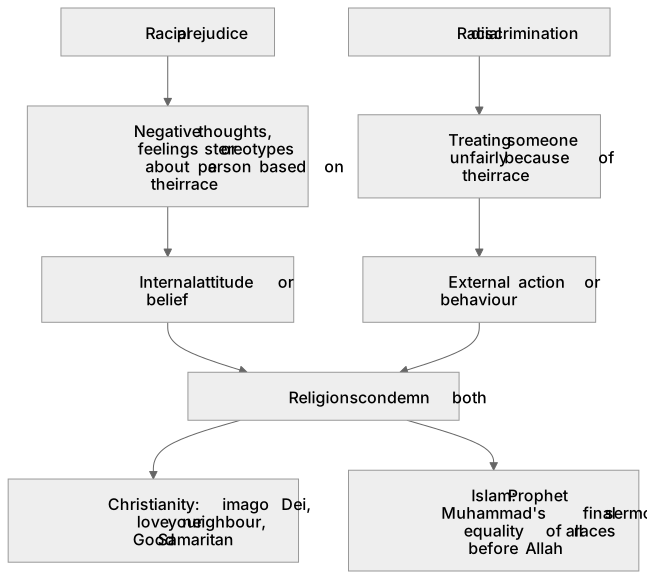
Racial prejudice involves holding negative thoughts, feelings, or stereotypes about a person based on their race, while racial discrimination is the act of treating someone unfairly because of their race. Most major religions strongly condemn both racial prejudice and discrimination. For instance, Christians argue that racism defies the belief that all humans are created equally in the image of God (imago Dei) and contradicts the parable of the Good Samaritan. In Islam, the Prophet Muhammad's final sermon explicitly stated that an Arab has no superiority over a non-Arab, emphasising the absolute equality of all races before Allah.
What earns the marks
- Distinguish clearly between prejudice (an internal attitude or belief) and discrimination (an external action or behaviour).
- Explain the Christian rejection of racism using the concept of 'imago Dei' and the teaching to 'love your neighbour'.
- Explain the Islamic rejection of racism by referencing the Prophet Muhammad's Last Sermon and the equality of the Ummah.
- Discuss historical or contemporary examples of religious figures who fought against racial discrimination, such as Martin Luther King Jr.
Common mistakes and how to put them right
Using prejudice and discrimination interchangeably.
Put it right: Explicitly define prejudice as an attitude and discrimination as an action.
Claiming that religion has never been associated with racism.
Put it right: Acknowledge that while core teachings promote equality, historical misinterpretations of religious texts have sometimes been used to justify racial discrimination.
Providing generic answers without religious evidence.
Put it right: Support arguments against racism with specific scriptural references like Galatians 3:28 or the Last Sermon.
Exam tips
- Memorise a specific quote from your chosen religions that condemns racial inequality to use as evidence in 4-mark and 5-mark questions.
- Use the example of Martin Luther King Jr. to demonstrate how Christian beliefs can inspire non-violent action against racial discrimination.
- In 12-mark evaluation questions, consider whether religious teachings are the most effective way to combat racism compared to secular laws.
Try the lesson
The start of the Theme F: Religion, human rights and social justice: Racial prejudice and discrimination. lesson, made from teaching notes for this specification point.
Have a go first
Which of the following best describes the difference between racial prejudice and racial discrimination?
Listen
Racial prejudice involves holding negative thoughts, feelings, or stereotypes about a person based on their race, while racial discrimination is the act of treating someone unfairly because of their race. Most major religions strongly condemn both racial prejudice and discrimination. For instance, Christians argue that racism defies the belief that all humans are created equally in the image of God (imago Dei) and contradicts the parable of the Good Samaritan. In Islam, the Prophet Muhammad's final sermon explicitly stated that an Arab has no superiority over a non-Arab, emphasising the absolute equality of all races before Allah. A strong answer earns marks for these points. Distinguish clearly between prejudice (an internal attitude or belief) and discrimination (an external action or behaviour). Explain the Christian rejection of racism using the concept of 'imago Dei' and the teaching to 'love your neighbour'. Explain the Islamic rejection of racism by referencing the Prophet Muhammad's Last Sermon and the equality of the Ummah. Discuss historical or contemporary examples of religious figures who fought against racial discrimination, such as Martin Luther King Jr. A common slip: Using prejudice and discrimination interchangeably. Instead, explicitly define prejudice as an attitude and discrimination as an action. Exam tip: Memorise a specific quote from your chosen religions that condemns racial inequality to use as evidence in 4-mark and 5-mark questions.
See it
Key words
Say what each word means before you turn the card.
Prejudice
Try answering aloud or in your head before turning the card.
Discrimination
Try answering aloud or in your head before turning the card.
Equality
Try answering aloud or in your head before turning the card.
See every definition
- Prejudice
- Holding negative thoughts, feelings, or stereotypes about a person based on their race.
- Discrimination
- The act of treating someone unfairly because of their race.
- Equality
- The belief that all humans are created equally, and that all races are equal before Allah.
Label the diagram
Some boxes have lost their names. Pick the right name for each number.
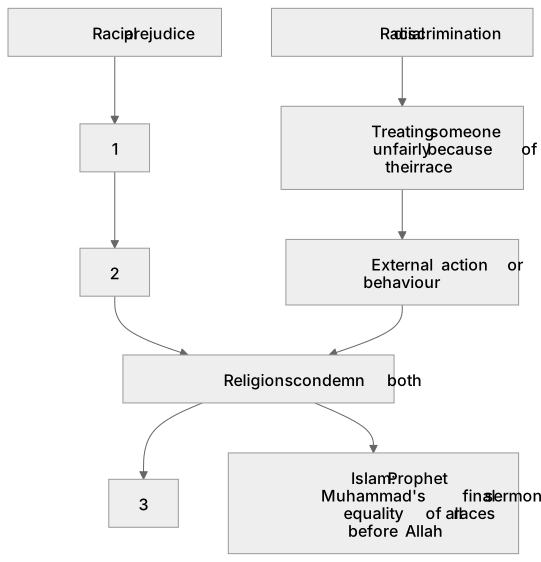
1Box 1
2Box 2
3Box 3
There is more to this lesson
The full lesson goes on to check your understanding and help you earn the marks. Create a free account to carry on, with your progress saved.
A week of Premium from your first lesson · Then the free plan continues · No card, no charge
Test your understanding of Theme F: Religion, human rights and social justice: Racial prejudice and discrimination.
Active recall beats re-reading. Take an instant quiz now to test what you’ve learned and lock it into long-term memory.
A week of Premium from your first lesson · Then the free plan continues · No card, no charge