AQA · A-Level · Sociology
Course version: 7192 · Version from Sept 2015
The social distribution of crime and deviance by ethnicity, gender and…
Full specification wording
Crime and Deviance: the social distribution of crime and deviance by ethnicity, gender and social class, including recent patterns and trends in crime
This topic examines how crime and deviance are distributed across ethnicity, gender, and social class, alongside recent trends.
Checked against the AQA 7192 specification (opens in a new tab) on .
- Point 2 of 4
- 4 key terms
Study notes
From the checked teaching notes for this specification point.
The idea
This topic examines how crime and deviance are distributed across ethnicity, gender, and social class, alongside recent trends. Official statistics suggest crime is disproportionately committed by working-class males, with Black and Asian groups over-represented in the justice system. Sociologists debate whether these figures reflect actual offending or systemic biases like institutional racism and selective law enforcement. Gender differences highlight the chivalry thesis versus double deviance, while class analysis contrasts visible street crime with hidden white-collar and corporate offences. Recent trends include a rise in cybercrime and fraud, alongside a decline in traditional property offences, reflecting technological shifts.
What earns the marks
- Identify the over-representation of specific ethnic minority groups in stop and search, arrest, and prison statistics.
- Recognise the gender gap in offending, where males commit the vast majority of recorded crimes, and evaluate explanations like the chivalry thesis.
- Explain the social class distribution of crime, contrasting working-class street crime with middle-class white-collar and corporate crime.
- Identify recent trends in crime, such as the increase in cybercrime and fraud, and the impact of changes in reporting and recording practices.
Common mistakes and how to put them right
Assuming official statistics provide a completely accurate picture of crime, rather than recognising them as a social construction influenced by police discretion.
Confusing white-collar crime with corporate crime.
Put it right: White-collar crime is committed for personal gain, whereas corporate crime is committed for the organisation's benefit.
Ignoring female offending entirely or assuming the gender gap is solely biological, rather than exploring sociological explanations like patriarchal control or the chivalry thesis.
Exam tips
- Always evaluate official statistics using self-report studies and victim surveys to provide a more balanced view of the social distribution of crime.
- When discussing ethnicity, use concepts like institutional racism and marginalisation to explain both the statistics and the lived experiences of minority groups.
- Link recent trends, such as the rise in cybercrime, to globalisation and technological advancements to show contemporary sociological understanding.
Try the lesson
The start of the Crime and Deviance: the social distribution of crime and deviance by ethnicity, gender and social class, including recent patterns and trends in crime lesson, made from checked teaching notes for this specification point.
Have a go first
Which pattern regarding the use of police stop and search powers by ethnicity has been consistently demonstrated by official statistics in England and Wales over recent decades?
Listen
This topic examines how crime and deviance are distributed across ethnicity, gender, and social class, alongside recent trends. Official statistics suggest crime is disproportionately committed by working-class males, with Black and Asian groups over-represented in the justice system. Sociologists debate whether these figures reflect actual offending or systemic biases like institutional racism and selective law enforcement. Gender differences highlight the chivalry thesis versus double deviance, while class analysis contrasts visible street crime with hidden white-collar and corporate offences. Recent trends include a rise in cybercrime and fraud, alongside a decline in traditional property offences, reflecting technological shifts. A strong answer earns marks for these points. Identify the over-representation of specific ethnic minority groups in stop and search, arrest, and prison statistics. Recognise the gender gap in offending, where males commit the vast majority of recorded crimes, and evaluate explanations like the chivalry thesis. Explain the social class distribution of crime, contrasting working-class street crime with middle-class white-collar and corporate crime. Identify recent trends in crime, such as the increase in cybercrime and fraud, and the impact of changes in reporting and recording practices. Exam tip: Always evaluate official statistics using self-report studies and victim surveys to provide a more balanced view of the social distribution of crime.
See it

Key words
Say what each word means before you turn the card.
The social construction of official statistics
Try answering aloud or in your head before turning the card.
Institutional bias and selective law enforcement
Try answering aloud or in your head before turning the card.
Contemporary changes in criminal activity
Try answering aloud or in your head before turning the card.
Social inequality and stratification
Try answering aloud or in your head before turning the card.
See every definition
- The social construction of official statistics
- Official statistics are shaped by police discretion and reporting and recording practices rather than providing a completely accurate picture of crime.
- Institutional bias and selective law enforcement
- Systemic biases such as institutional racism and selective law enforcement may explain the over-representation of Black and Asian groups in the justice system.
- Contemporary changes in criminal activity
- Recent trends include a rise in cybercrime and fraud alongside a decline in traditional property offences, reflecting technological shifts.
- Social inequality and stratification
- Crime and deviance are distributed across ethnicity, gender and social class, with official statistics suggesting crime is disproportionately committed by working-class males.
Label the diagram
Some boxes have lost their names. Pick the right name for each number.
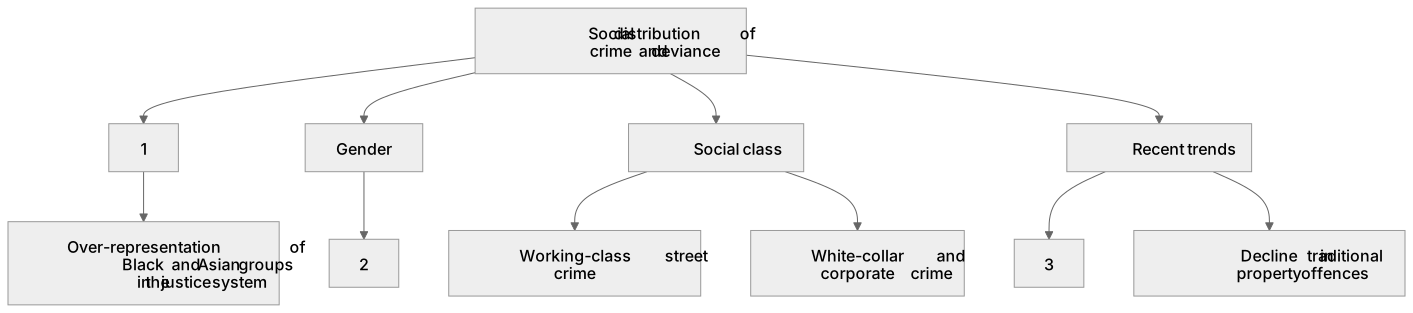
1Box 1
2Box 2
3Box 3
There is more to this lesson
The full lesson goes on to check your understanding and help you earn the marks. Create a free account to carry on, with your progress saved.
A week of Premium from your first lesson · Then the free plan continues · No card, no charge
Test your understanding of Crime and Deviance: the social distribution of crime and deviance by ethnicity, gender and social class, including recent patterns and trends in crime
Active recall beats re-reading. Take an instant quiz now to test what you’ve learned and lock it into long-term memory.
A week of Premium from your first lesson · Then the free plan continues · No card, no charge