AQA · A-Level · Sociology
Course version: 7192 · Version from Sept 2015
The self, identity and difference as both socially caused and socially…
Full specification wording
Culture and Identity: the self, identity and difference as both socially caused and socially constructed
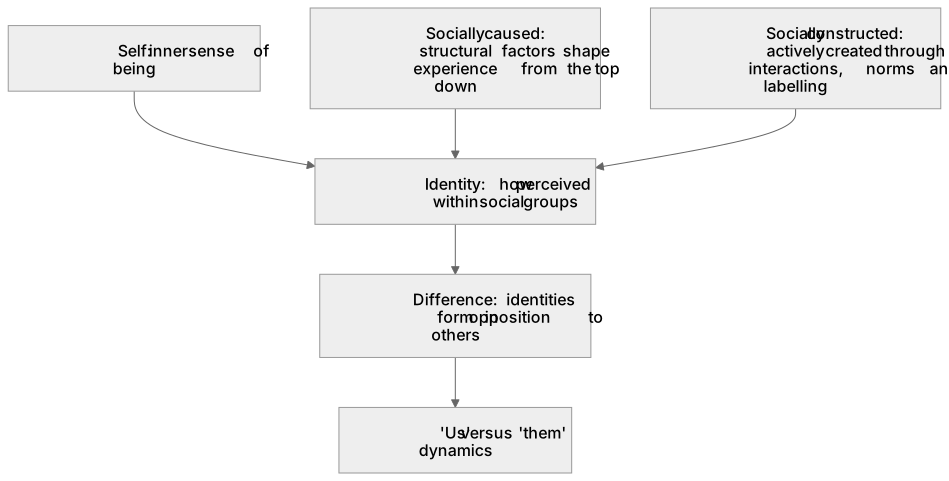
The 'self' is an individual's inner sense of being, while 'identity' is how they are perceived within social groups.
Checked against the AQA 7192 specification (opens in a new tab) on .
- Point 3 of 3
- 4 key terms
Study notes
From the checked teaching notes for this specification point.
The idea
The 'self' is an individual's inner sense of being, while 'identity' is how they are perceived within social groups. 'Difference' highlights how identities form in opposition to others, creating 'us' versus 'them' dynamics. These concepts are 'socially caused', meaning structural factors like class and ethnicity shape our experiences from the top down. Simultaneously, they are 'socially constructed', meaning they are actively created through social interactions, cultural norms, and labelling.
For example: Gender identity is socially caused by patriarchal structures that dictate roles, but socially constructed through everyday interactions and media representations that reinforce what it means to be masculine or feminine.
What earns the marks
- Define the 'self' as the internal, subjective understanding of one's own being, distinct from external categorisation.
- Define 'identity' as the social positioning of the self, encompassing both how individuals see themselves and how others see them.
- Explain 'difference' as the relational aspect of identity, where defining who we are depends on defining who we are not (the 'other').
- Distinguish 'socially caused' (a structuralist view where macro-level societal forces shape the individual) from 'socially constructed' (an interactionist view where individuals actively create meaning).
Common mistakes and how to put them right
Confusing 'socially caused' with 'socially constructed'.
Put it right: 'Socially caused' refers to structural forces determining outcomes, whereas 'socially constructed' refers to the active creation of meaning through interaction.
Treating the 'self' and 'identity' as identical concepts.
Put it right: The 'self' is the internal, private experience of being, while 'identity' is the public, socially recognised categorisation.
Ignoring the concept of 'difference' when discussing identity.
Put it right: Explain that identity formation relies on establishing boundaries between 'us' and 'them', making difference a core component.
Exam tips
- Use structuralist theories, such as Marxism or feminism, to illustrate how identity is socially caused by macro-level inequalities.
- Use interactionist theories, such as labelling theory, to illustrate how identity is socially constructed through micro-level interactions.
- Apply concrete examples, such as how disability can be viewed as socially caused by environmental barriers and socially constructed through stigmatising labels.
Try the lesson
The start of the Culture and Identity: the self, identity and difference as both socially caused and socially constructed lesson, made from checked teaching notes for this specification point.
Have a go first
A sociologist observes that a person's gender identity is heavily influenced by the patriarchal structure of society, yet this individual also actively negotiates and redefines their gender roles during everyday interactions. Which theoretical understanding of identity does this best illustrate?
Listen
The 'self' is an individual's inner sense of being, while 'identity' is how they are perceived within social groups. Difference' highlights how identities form in opposition to others, creating 'us' versus 'them' dynamics. These concepts are 'socially caused', meaning structural factors like class and ethnicity shape our experiences from the top down. Simultaneously, they are 'socially constructed', meaning they are actively created through social interactions, cultural norms, and labelling. For example, gender identity is socially caused by patriarchal structures that dictate roles, but socially constructed through everyday interactions and media representations that reinforce what it means to be masculine or feminine. A strong answer earns marks for these points. Define the 'self' as the internal, subjective understanding of one's own being, distinct from external categorisation. Define 'identity' as the social positioning of the self, encompassing both how individuals see themselves and how others see them. Explain 'difference' as the relational aspect of identity, where defining who we are depends on defining who we are not (the 'other'). Distinguish 'socially caused' (a structuralist view where macro-level societal forces shape the individual) from 'socially constructed' (an interactionist view where individuals actively create meaning). A common slip: Confusing 'socially caused' with 'socially constructed'. Instead, 'Socially caused' refers to structural forces determining outcomes, whereas 'socially constructed' refers to the active creation of meaning through interaction. Exam tip: Use structuralist theories, such as Marxism or feminism, to illustrate how identity is socially caused by macro-level inequalities.
See it
Key words
Say what each word means before you turn the card.
Structuralism versus Interactionism
Try answering aloud or in your head before turning the card.
The Social Construction of Reality
Try answering aloud or in your head before turning the card.
Socialisation and Identity Formation
Try answering aloud or in your head before turning the card.
Power and Inequality
Try answering aloud or in your head before turning the card.
See every definition
- Structuralism versus Interactionism
- A distinction between a structuralist view where macro-level societal forces shape the individual and an interactionist view where individuals actively create meaning.
- The Social Construction of Reality
- The idea that the self and identity are actively created through social interactions, cultural norms, and labelling.
- Socialisation and Identity Formation
- The process through which the self and identity are socially caused by structural factors and socially constructed through interaction.
- Power and Inequality
- Macro-level inequalities through which structuralist theories illustrate how identity is socially caused.
Label the diagram
Some boxes have lost their names. Pick the right name for each number.
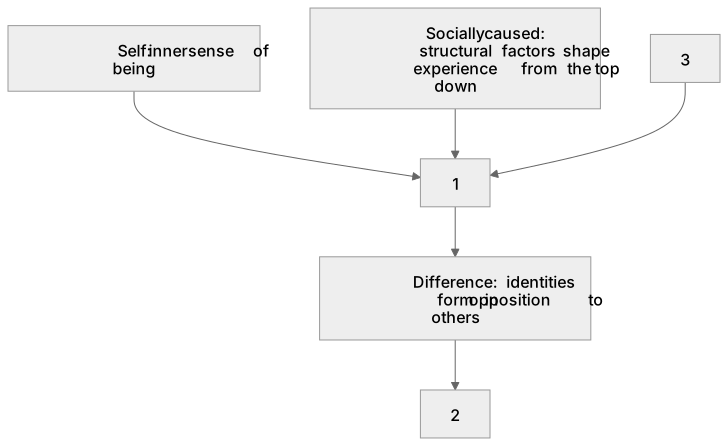
1Box 1
2Box 2
3Box 3
There is more to this lesson
The full lesson goes on to check your understanding and help you earn the marks. Create a free account to carry on, with your progress saved.
A week of Premium from your first lesson · Then the free plan continues · No card, no charge
Test your understanding of Culture and Identity: the self, identity and difference as both socially caused and socially constructed
Active recall beats re-reading. Take an instant quiz now to test what you’ve learned and lock it into long-term memory.
A week of Premium from your first lesson · Then the free plan continues · No card, no charge