AQA · A-Level · Sociology
Course version: 7192 · Version from Sept 2015
The socialisation process and the role of the agencies of socialisation
Full specification wording
Culture and Identity: the socialisation process and the role of the agencies of socialisation
Socialisation is the lifelong process through which individuals learn and internalise the culture, norms, and values of their society.
Checked against the AQA 7192 specification (opens in a new tab) on .
- Point 2 of 3
Study notes
From the checked teaching notes for this specification point.
The idea
Socialisation is the lifelong process through which individuals learn and internalise the culture, norms, and values of their society. It is divided into primary and secondary stages. Primary socialisation occurs in early childhood, predominantly within the family, where foundational behaviours like language and basic manners are acquired. Secondary socialisation continues throughout life, facilitated by agencies such as education, peer groups, media, and religion. For example, schools act as an agency of secondary socialisation by teaching the formal curriculum and the 'hidden curriculum', which instils values like punctuality and obedience to authority. These agencies collectively ensure social cohesion and cultural transmission.
What earns the marks
- Define socialisation as the process of learning the culture, norms, and values of a society.
- Distinguish between primary socialisation (early childhood, mainly family) and secondary socialisation (later life, wider society).
- Identify key agencies of socialisation, including the family, education system, peer groups, mass media, religion, and the workplace.
- Explain the mechanisms used by agencies, such as positive and negative sanctions, role modelling, and the hidden curriculum in schools.
Common mistakes and how to put them right
Confusing primary and secondary socialisation.
Put it right: Primary socialisation happens first, usually in the family, while secondary socialisation involves wider societal institutions like schools and media.
Assuming socialisation only happens in childhood.
Put it right: Recognise that socialisation is a lifelong process, continuing into adulthood through agencies like the workplace.
Treating all agencies as having the same impact.
Put it right: Acknowledge that the influence of different agencies varies depending on the individual's life stage and social context.
Exam tips
- Use specific sociological concepts like 'hidden curriculum' or 'sanctions' when describing how agencies of socialisation operate.
- Be prepared to evaluate the effectiveness of different agencies, perhaps contrasting functionalist and Marxist views on their roles.
- Link the process of socialisation to the formation of individual and social identities.
Try the lesson
The start of the Culture and Identity: the socialisation process and the role of the agencies of socialisation lesson, made from checked teaching notes for this specification point.
Have a go first
Which of the following is the primary agency of socialisation in early childhood?
Listen
Socialisation is the lifelong process through which individuals learn and internalise the culture, norms, and values of their society. It is divided into primary and secondary stages. Primary socialisation occurs in early childhood, predominantly within the family, where foundational behaviours like language and basic manners are acquired. Secondary socialisation continues throughout life, facilitated by agencies such as education, peer groups, media, and religion. For example, schools act as an agency of secondary socialisation by teaching the formal curriculum and the 'hidden curriculum', which instils values like punctuality and obedience to authority. These agencies collectively ensure social cohesion and cultural transmission. A strong answer earns marks for these points. Define socialisation as the process of learning the culture, norms, and values of a society. Distinguish between primary socialisation (early childhood, mainly family) and secondary socialisation (later life, wider society). Identify key agencies of socialisation, including the family, education system, peer groups, mass media, religion, and the workplace. Explain the mechanisms used by agencies, such as positive and negative sanctions, role modelling, and the hidden curriculum in schools. A common slip: Confusing primary and secondary socialisation. Instead, primary socialisation happens first, usually in the family, while secondary socialisation involves wider societal institutions like schools and media. Exam tip: Use specific sociological concepts like 'hidden curriculum' or 'sanctions' when describing how agencies of socialisation operate.
See it
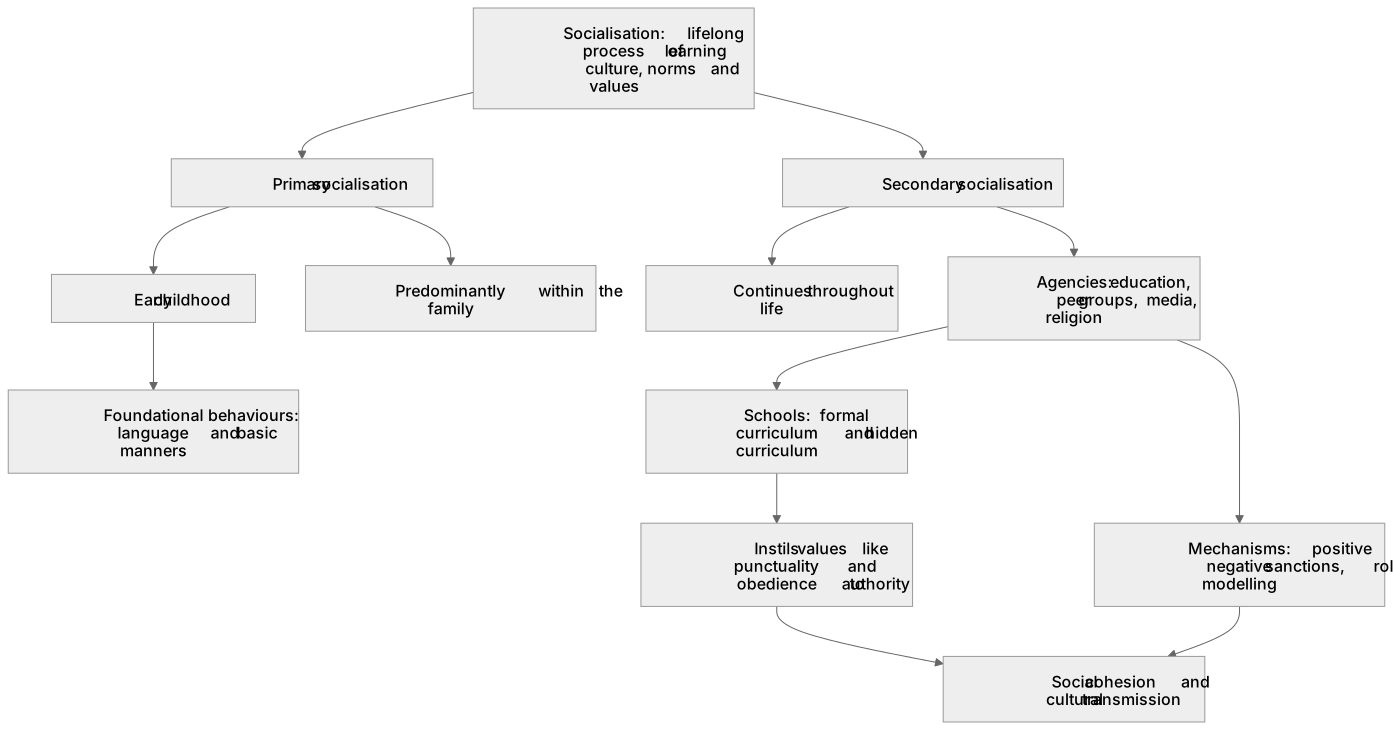
Label the diagram
Some boxes have lost their names. Pick the right name for each number.
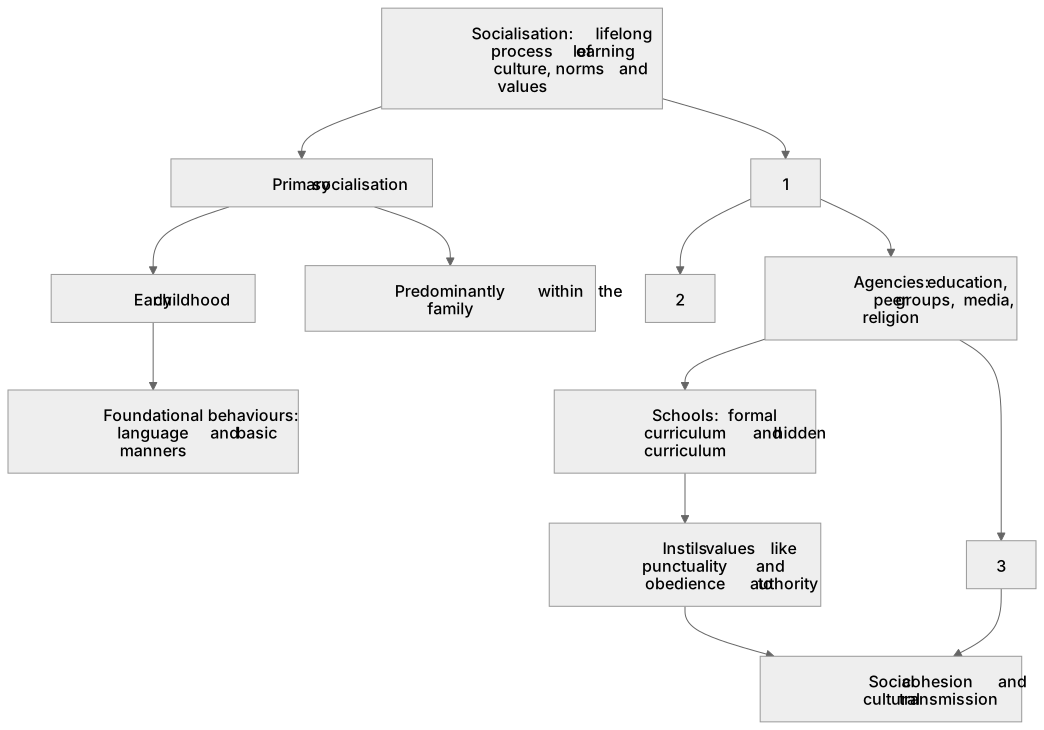
1Box 1
2Box 2
3Box 3
There is more to this lesson
The full lesson goes on to check your understanding and help you earn the marks. Create a free account to carry on, with your progress saved.
A week of Premium from your first lesson · Then the free plan continues · No card, no charge
Test your understanding of Culture and Identity: the socialisation process and the role of the agencies of socialisation
Active recall beats re-reading. Take an instant quiz now to test what you’ve learned and lock it into long-term memory.
A week of Premium from your first lesson · Then the free plan continues · No card, no charge