AQA · A-Level · Sociology
Course version: 7192 · Version from Sept 2015
The role of medicine, the health professions and the globalised health…
Full specification wording
Health: the role of medicine, the health professions and the globalised health industry.
Sociological perspectives examine the role of medicine beyond biological treatment, viewing it as an institution of social control.
Checked against the AQA 7192 specification (opens in a new tab) on .
- Point 5 of 5
- 4 key terms
Study notes
From the checked teaching notes for this specification point.
The idea
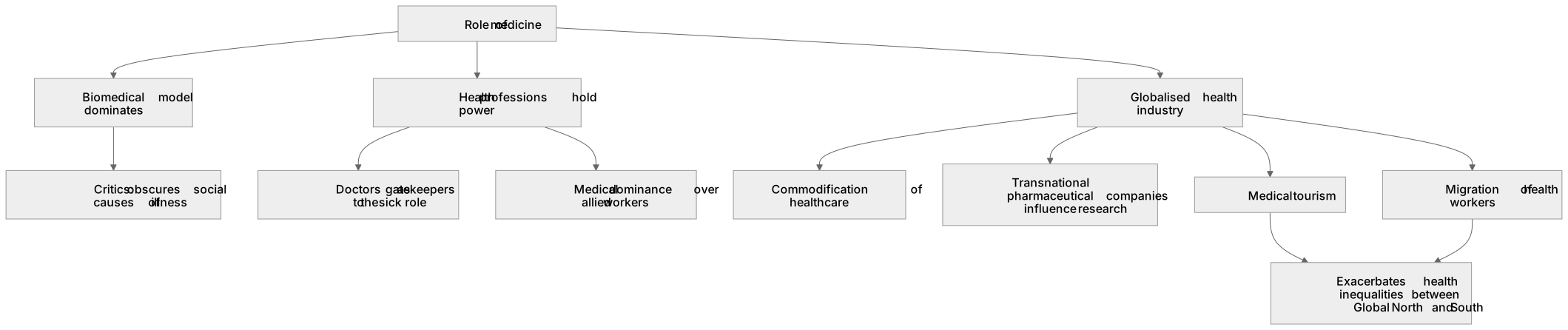
Sociological perspectives examine the role of medicine beyond biological treatment, viewing it as an institution of social control. The biomedical model dominates, but critics argue it obscures the social causes of illness. Health professions, particularly doctors, hold significant power, acting as gatekeepers to the sick role (Parsons) and exercising medical dominance over allied workers. Furthermore, the globalised health industry highlights the commodification of healthcare. Transnational pharmaceutical companies influence medical research globally, often prioritising profit over patient care. This globalisation also encompasses medical tourism and the migration of health workers, exacerbating health inequalities between the Global North and South.
What earns the marks
- Identify the biomedical model's focus on individual pathology rather than the social determinants of health.
- Explain the concept of medical dominance and the gatekeeping role of health professions in legitimising illness.
- Evaluate the impact of transnational pharmaceutical companies on global health priorities and the commodification of medicine.
- Analyse how the globalised health industry, including medical tourism and the migration of medical professionals, affects healthcare provision internationally.
Common mistakes and how to put them right
Confusing the biomedical model with the social model of health.
Put it right: Ensure you define the biomedical model as focusing on biological malfunction and individual treatment, whereas the social model examines structural and environmental causes.
Treating the health professions as a unified group with equal power.
Put it right: Recognise the hierarchy within health professions, specifically the concept of medical dominance where doctors hold authority over nurses and allied staff.
Ignoring the globalised aspect of the health industry.
Put it right: Explicitly discuss transnational factors such as pharmaceutical corporations, medical tourism, or the international migration of healthcare professionals, rather than just domestic healthcare systems.
Exam tips
- Use Parsons' concept of the sick role to illustrate how doctors act as gatekeepers who legitimise illness and excuse individuals from normal social duties.
- Apply Marxist concepts to the globalised health industry by discussing how transnational pharmaceutical companies profit from the commodification of health.
- Contrast the functionalist view of medicine as a beneficial institution with the feminist critique of medicalisation, particularly regarding childbirth and women's bodies.
Try the lesson
The start of the Health: the role of medicine, the health professions and the globalised health industry. lesson, made from checked teaching notes for this specification point.
Have a go first
Which of the following best describes the biomedical model of health often used by the health professions?
Listen
Sociological perspectives examine the role of medicine beyond biological treatment, viewing it as an institution of social control. The biomedical model dominates, but critics argue it obscures the social causes of illness. Health professions, particularly doctors, hold significant power, acting as gatekeepers to the sick role (Parsons) and exercising medical dominance over allied workers. Furthermore, the globalised health industry highlights the commodification of healthcare. Transnational pharmaceutical companies influence medical research globally, often prioritising profit over patient care. This globalisation also encompasses medical tourism and the migration of health workers, exacerbating health inequalities between the Global North and South. A strong answer earns marks for these points. Identify the biomedical model's focus on individual pathology rather than the social determinants of health. Explain the concept of medical dominance and the gatekeeping role of health professions in legitimising illness. Evaluate the impact of transnational pharmaceutical companies on global health priorities and the commodification of medicine. Analyse how the globalised health industry, including medical tourism and the migration of medical professionals, affects healthcare provision internationally. Exam tip: Use Parsons' concept of the sick role to illustrate how doctors act as gatekeepers who legitimise illness and excuse individuals from normal social duties.
See it
Key words
Say what each word means before you turn the card.
Social control and medicalisation
Try answering aloud or in your head before turning the card.
Power and medical dominance
Try answering aloud or in your head before turning the card.
Globalisation and commodification
Try answering aloud or in your head before turning the card.
Health inequalities
Try answering aloud or in your head before turning the card.
See every definition
- Social control and medicalisation
- Medicine is viewed as an institution of social control, with a feminist critique of medicalisation particularly regarding childbirth and women's bodies.
- Power and medical dominance
- Doctors hold significant power and exercise medical dominance over allied workers, acting as gatekeepers to the sick role.
- Globalisation and commodification
- The globalised health industry highlights the commodification of healthcare, with transnational pharmaceutical companies often prioritising profit over patient care.
- Health inequalities
- Globalisation encompasses medical tourism and the migration of health workers, exacerbating health inequalities between the Global North and South.
Label the diagram
Some boxes have lost their names. Pick the right name for each number.
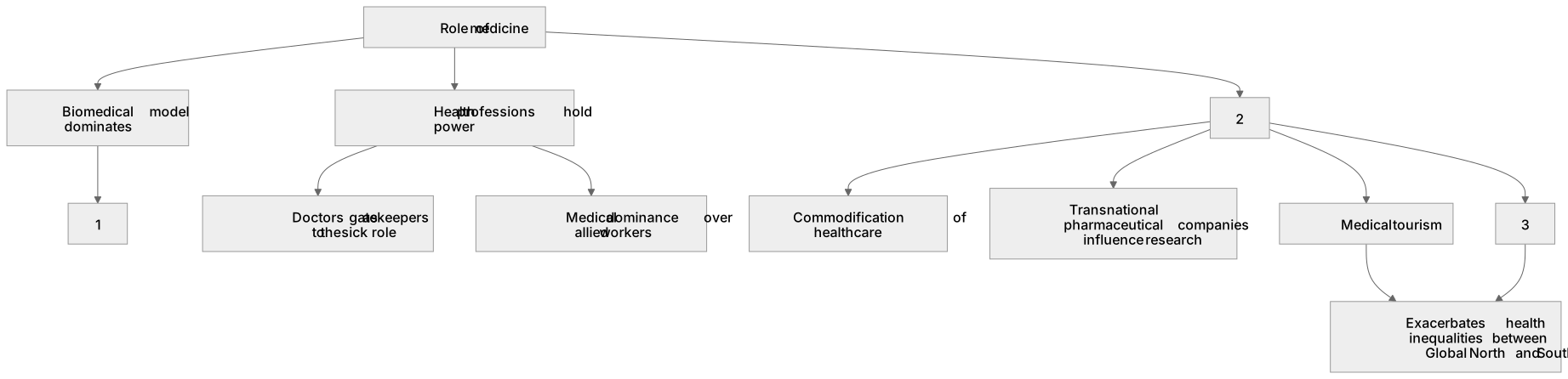
1Box 1
2Box 2
3Box 3
There is more to this lesson
The full lesson goes on to check your understanding and help you earn the marks. Create a free account to carry on, with your progress saved.
A week of Premium from your first lesson · Then the free plan continues · No card, no charge
Test your understanding of Health: the role of medicine, the health professions and the globalised health industry.
Active recall beats re-reading. Take an instant quiz now to test what you’ve learned and lock it into long-term memory.
A week of Premium from your first lesson · Then the free plan continues · No card, no charge