AQA · A-Level · Sociology
Course version: 7192 · Version from Sept 2015
Health: the nature and social distribution of mental illness
Sociologists examine both the nature and the social distribution of mental illness.
Checked against the AQA 7192 specification (opens in a new tab) on .
- Point 4 of 5
- 4 key terms
Study notes
From the checked teaching notes for this specification point.
The idea
Sociologists examine both the nature and the social distribution of mental illness. Its nature is heavily debated: the biomedical model views it as an objective pathology, whereas interactionists argue it is socially constructed through labelling. For example, Goffman explored how psychiatric hospitals enforce a 'mentally ill' master status. The social distribution of mental illness reveals stark inequalities across class, gender, and ethnicity. Lower social classes experience higher rates of mental illness, explained by social causation (poverty causes stress) or social drift (illness causes downward mobility). Women are more frequently diagnosed with depression, linked by feminists to patriarchal burdens. Meanwhile, Black men are disproportionately diagnosed with schizophrenia, raising questions about institutional racism and cultural bias in psychiatric diagnosis.
What earns the marks
- Identify the biomedical model's view of mental illness as a physical disease with biological causes.
- Recognise interactionist perspectives, such as labelling theory, which argue mental illness is a social construct.
- Identify the 'social drift' hypothesis as the idea that mental illness causes downward social mobility.
- Recognise that women are statistically more likely to be diagnosed with depression and anxiety than men.
- Identify institutional racism or cultural misunderstandings as sociological explanations for the over-representation of Black men in schizophrenia diagnoses.
Common mistakes and how to put them right
Confusing social causation with social drift.
Put it right: Social causation argues that lower-class status and poverty cause mental illness, whereas social drift argues that having a mental illness causes individuals to fall into a lower social class.
Assuming the biomedical model and social constructionism are the same.
Put it right: The biomedical model sees mental illness as an objective biological fact, while social constructionism sees it as a label applied by society to deviant behaviour.
Believing that official statistics on mental illness perfectly reflect reality.
Put it right: Sociologists argue that official statistics are socially constructed and may reflect diagnostic biases, such as gender or racial stereotyping by medical professionals.
Exam tips
- When evaluating the nature of mental illness, contrast the biomedical model with interactionist approaches like labelling theory.
- Use specific concepts like 'master status' and 'institutionalisation' when discussing Goffman's work on asylums.
- Always link the social distribution of mental illness to structural factors such as patriarchy, poverty, or institutional racism to demonstrate higher-level sociological understanding.
Try the lesson
The start of the Health: the nature and social distribution of mental illness lesson, made from checked teaching notes for this specification point.
Have a go first
Which of the following statements best describes a recognised pattern in the social distribution of mental illness in the UK?
Listen
Sociologists examine both the nature and the social distribution of mental illness. Its nature is heavily debated: the biomedical model views it as an objective pathology, whereas interactionists argue it is socially constructed through labelling. For example, Goffman explored how psychiatric hospitals enforce a 'mentally ill' master status. The social distribution of mental illness reveals stark inequalities across class, gender, and ethnicity. Lower social classes experience higher rates of mental illness, explained by social causation (poverty causes stress) or social drift (illness causes downward mobility). Women are more frequently diagnosed with depression, linked by feminists to patriarchal burdens. Meanwhile, Black men are disproportionately diagnosed with schizophrenia, raising questions about institutional racism and cultural bias in psychiatric diagnosis. A strong answer earns marks for these points. Identify the biomedical model's view of mental illness as a physical disease with biological causes. Recognise interactionist perspectives, such as labelling theory, which argue mental illness is a social construct. Identify the 'social drift' hypothesis as the idea that mental illness causes downward social mobility. Recognise that women are statistically more likely to be diagnosed with depression and anxiety than men. A common slip: Confusing social causation with social drift. Instead, Social causation argues that lower-class status and poverty cause mental illness, whereas social drift argues that having a mental illness causes individuals to fall into a lower social class. Exam tip: When evaluating the nature of mental illness, contrast the biomedical model with interactionist approaches like labelling theory.
See it

Key words
Say what each word means before you turn the card.
Social construction of health and illness
Try answering aloud or in your head before turning the card.
Social inequality
Try answering aloud or in your head before turning the card.
Labelling and stigma
Try answering aloud or in your head before turning the card.
The role of the medical profession
Try answering aloud or in your head before turning the card.
See every definition
- Social construction of health and illness
- The interactionist view that mental illness is socially constructed through labelling rather than an objective pathology.
- Social inequality
- Stark inequalities across class, gender, and ethnicity revealed in the social distribution of mental illness.
- Labelling and stigma
- The interactionist argument that mental illness is socially constructed through labelling, with psychiatric hospitals enforcing a 'mentally ill' master status.
- The role of the medical profession
- Psychiatric diagnosis by medical professionals, which raises questions about cultural bias and institutional racism.
Label the diagram
Some boxes have lost their names. Pick the right name for each number.
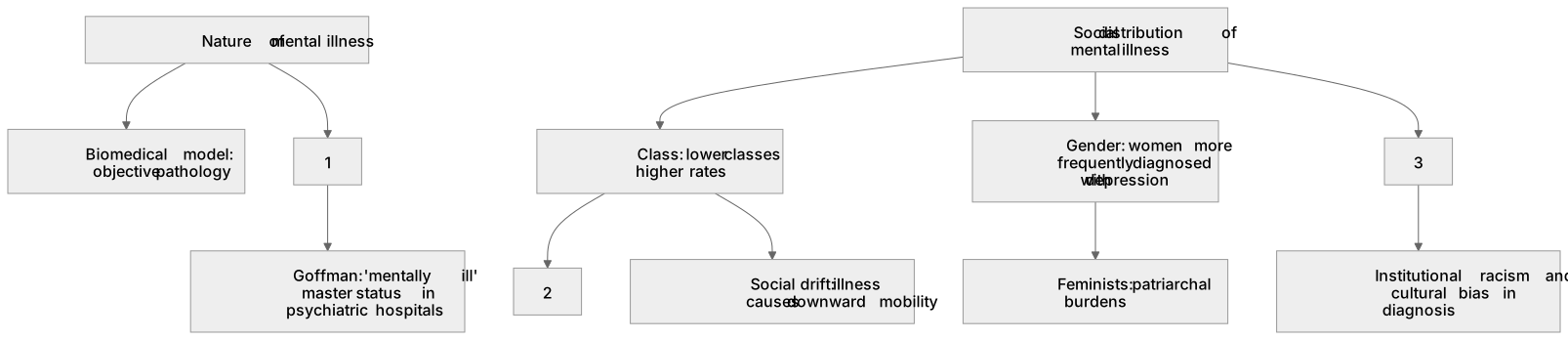
1Box 1
2Box 2
3Box 3
There is more to this lesson
The full lesson goes on to check your understanding and help you earn the marks. Create a free account to carry on, with your progress saved.
A week of Premium from your first lesson · Then the free plan continues · No card, no charge
Test your understanding of Health: the nature and social distribution of mental illness
Active recall beats re-reading. Take an instant quiz now to test what you’ve learned and lock it into long-term memory.
A week of Premium from your first lesson · Then the free plan continues · No card, no charge