AQA · A-Level · Sociology
Course version: 7192 · Version from Sept 2015
The social construction of health, illness, disability and the body, and…
Full specification wording
Health: the social construction of health, illness, disability and the body, and models of health and illness
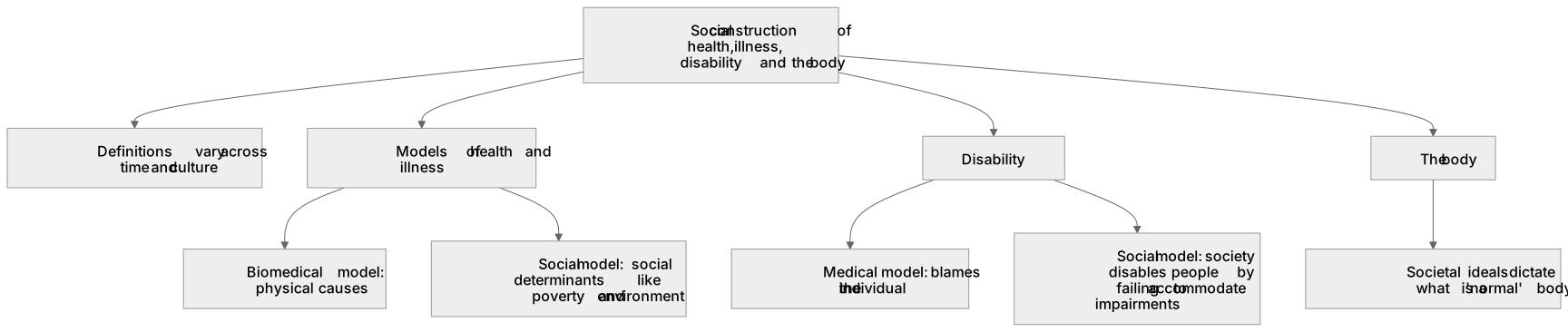
Health, illness, disability, and the body are socially constructed; their definitions vary across time and culture rather than being purely biological facts.
Checked against the AQA 7192 specification (opens in a new tab) on .
- Point 1 of 5
- 4 key terms
Study notes
From the checked teaching notes for this specification point.
The idea
Health, illness, disability, and the body are socially constructed; their definitions vary across time and culture rather than being purely biological facts. For instance, homosexuality was once classified as an illness but is now recognised as normal. Disability is analysed using the social model, arguing society disables people by failing to accommodate impairments, unlike the medical model which blames the individual. The body is also socially constructed, with societal ideals dictating what is considered a 'normal' body.
What earns the marks
- Identify that the social construction of health means definitions of health and illness are shaped by societal norms and values, not just biology.
- Distinguish between the biomedical model (focusing on biological causes and medical interventions) and the social model of health (focusing on structural factors like class, gender, and ethnicity).
- Explain the social model of disability, which argues that societal barriers (physical and attitudinal) disable individuals, rather than their impairments.
- Recognise that the body is socially constructed through cultural expectations, such as beauty standards, gender norms, and the stigmatisation of certain body types.
- Provide examples of how definitions of illness change over time, such as the medicalisation of deviance or the de-medicalisation of homosexuality.
Common mistakes and how to put them right
Confusing the medical model of disability with the social model of disability.
Put it right: The medical model locates the problem within the individual's impairment, whereas the social model locates the problem in society's failure to accommodate them.
Assuming that 'socially constructed' means an illness is not real or does not have physical symptoms.
Put it right: Understand that social constructionism acknowledges physical symptoms but focuses on how society interprets, labels, and responds to those symptoms.
Treating the biomedical model as the only valid way to understand health.
Put it right: Recognise that sociologists critique the biomedical model for ignoring the social determinants of health, such as poverty and poor housing.
Exam tips
- Use specific historical or cross-cultural examples, such as changes in the classification of mental illnesses, to illustrate how health and illness are socially constructed.
- When evaluating the biomedical model, contrast it with the social model by discussing how structural inequalities impact health outcomes.
- Apply the concept of 'medicalisation' to explain how non-medical problems, such as childbirth or sadness, have become defined and treated as medical issues.
Try the lesson
The start of the Health: the social construction of health, illness, disability and the body, and models of health and illness lesson, made from checked teaching notes for this specification point.
Have a go first
Which of the following best describes the social model of disability?
Listen
Health, illness, disability, and the body are socially constructed; their definitions vary across time and culture rather than being purely biological facts. For instance, homosexuality was once classified as an illness but is now recognised as normal. Disability is analysed using the social model, arguing society disables people by failing to accommodate impairments, unlike the medical model which blames the individual. The body is also socially constructed, with societal ideals dictating what is considered a 'normal' body. A strong answer earns marks for these points. Identify that the social construction of health means definitions of health and illness are shaped by societal norms and values, not just biology. Distinguish between the biomedical model (focusing on biological causes and medical interventions) and the social model of health (focusing on structural factors like class, gender, and ethnicity). Explain the social model of disability, which argues that societal barriers (physical and attitudinal) disable individuals, rather than their impairments. Recognise that the body is socially constructed through cultural expectations, such as beauty standards, gender norms, and the stigmatisation of certain body types. A common slip: Confusing the medical model of disability with the social model of disability. Instead, the medical model locates the problem within the individual's impairment, whereas the social model locates the problem in society's failure to accommodate them. Exam tip: Use specific historical or cross-cultural examples, such as changes in the classification of mental illnesses, to illustrate how health and illness are socially constructed.
See it
Key words
Say what each word means before you turn the card.
Social constructionism
Try answering aloud or in your head before turning the card.
Medicalisation
Try answering aloud or in your head before turning the card.
Social inequality and health
Try answering aloud or in your head before turning the card.
The biomedical vs social models
Try answering aloud or in your head before turning the card.
See every definition
- Social constructionism
- The view that health, illness, disability and the body are shaped by societal norms and values rather than being purely biological facts.
- Medicalisation
- The process by which non-medical problems have become defined and treated as medical issues.
- Social inequality and health
- The emphasis of the social model on structural factors like class, gender and ethnicity, and social determinants such as poverty and environment.
- The biomedical vs social models
- A contrast between a model focusing on physical and biological causes and medical interventions and one focusing on social determinants of health.
Label the diagram
Some boxes have lost their names. Pick the right name for each number.
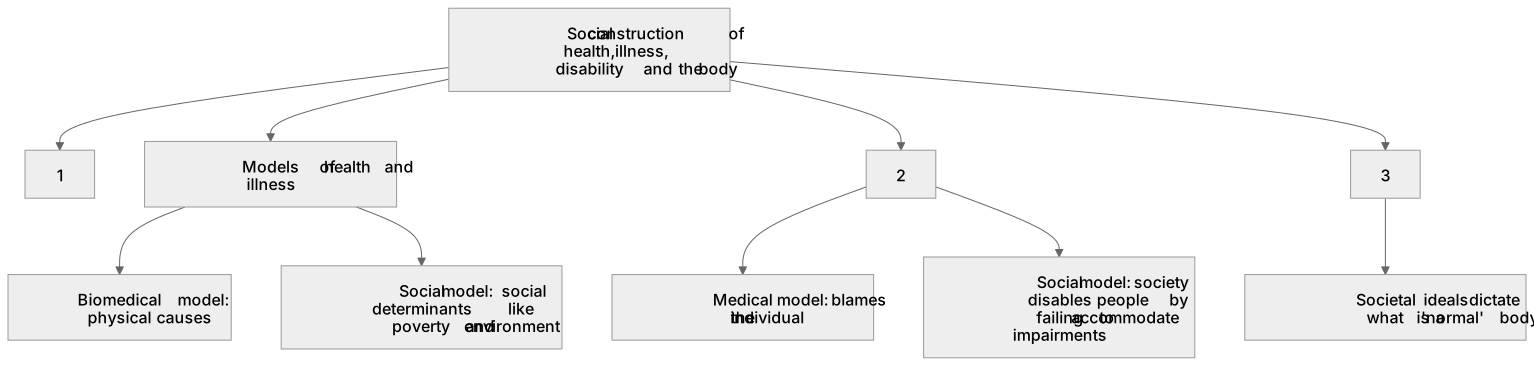
1Box 1
2Box 2
3Box 3
There is more to this lesson
The full lesson goes on to check your understanding and help you earn the marks. Create a free account to carry on, with your progress saved.
A week of Premium from your first lesson · Then the free plan continues · No card, no charge
Test your understanding of Health: the social construction of health, illness, disability and the body, and models of health and illness
Active recall beats re-reading. Take an instant quiz now to test what you’ve learned and lock it into long-term memory.
A week of Premium from your first lesson · Then the free plan continues · No card, no charge