AQA · A-Level · Sociology
Course version: 7192 · Version from Sept 2015
The unequal social distribution of health chances in the United Kingdom by…
Full specification wording
Health: the unequal social distribution of health chances in the United Kingdom by social class, gender, ethnicity and region
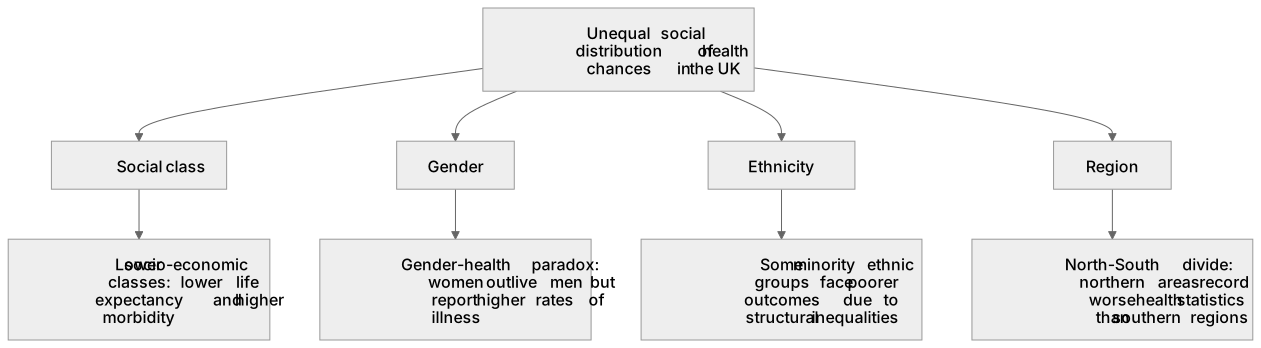
Health chances in the United Kingdom are unequally distributed across social class, gender, ethnicity, and region, showing health is heavily influenced by social determinants.
Checked against the AQA 7192 specification (opens in a new tab) on .
- Point 2 of 5
- 2 key terms
Study notes
From the checked teaching notes for this specification point.
The idea
Health chances in the United Kingdom are unequally distributed across social class, gender, ethnicity, and region, showing health is heavily influenced by social determinants. Lower socio-economic classes typically experience lower life expectancy and higher morbidity than affluent groups. Gender patterns reveal a paradox: women generally outlive men but report higher rates of illness. Ethnicity significantly impacts health, with some minority ethnic groups facing poorer outcomes due to structural inequalities. Finally, regional disparities, such as the UK's 'North-South divide', show that geographical location affects health, with northern areas often recording worse health statistics than southern regions.
What earns the marks
- Identify the relationship between lower social class and increased rates of morbidity and mortality in the UK.
- Recognise the gender-health paradox where women have a higher life expectancy but experience more years in poor health compared to men.
- Explain how some ethnic minority groups in the UK experience worse health outcomes, linking this to socio-economic status and systemic factors.
- Describe the 'North-South divide' in UK health statistics, noting lower life expectancies in northern regions compared to the south.
Common mistakes and how to put them right
Assuming health inequalities are purely biological or genetic.
Put it right: Recognise that sociological analysis focuses on social determinants like income, housing, and structural inequality.
Believing men have worse health outcomes in every metric.
Put it right: Understand the gender-health paradox; men have lower life expectancy, but women report higher rates of morbidity.
Treating all minority ethnic groups as having identical health outcomes.
Put it right: Acknowledge that health chances vary significantly between different ethnic groups in the UK.
Exam tips
- Use specific sociological concepts like 'morbidity', 'mortality', and 'life expectancy' when discussing health chances.
- When evaluating health inequalities, consider how social class, gender, ethnicity, and region intersect rather than treating them in isolation.
- Reference the 'North-South divide' as a concrete example of regional health inequality in the UK.
Try the lesson
The start of the Health: the unequal social distribution of health chances in the United Kingdom by social class, gender, ethnicity and region lesson, made from checked teaching notes for this specification point.
Have a go first
Which of the following best describes the general relationship between social class and health chances in the United Kingdom?
Listen
Health chances in the United Kingdom are unequally distributed across social class, gender, ethnicity, and region, showing health is heavily influenced by social determinants. Lower socio-economic classes typically experience lower life expectancy and higher morbidity than affluent groups. Gender patterns reveal a paradox: women generally outlive men but report higher rates of illness. Ethnicity significantly impacts health, with some minority ethnic groups facing poorer outcomes due to structural inequalities. Finally, regional disparities, such as the UK's 'North-South divide', show that geographical location affects health, with northern areas often recording worse health statistics than southern regions. A strong answer earns marks for these points. Identify the relationship between lower social class and increased rates of morbidity and mortality in the UK. Recognise the gender-health paradox where women have a higher life expectancy but experience more years in poor health compared to men. Explain how some ethnic minority groups in the UK experience worse health outcomes, linking this to socio-economic status and systemic factors. Describe the 'North-South divide' in UK health statistics, noting lower life expectancies in northern regions compared to the south. A common slip: Assuming health inequalities are purely biological or genetic. Instead, Recognise that sociological analysis focuses on social determinants like income, housing, and structural inequality. Exam tip: Use specific sociological concepts like 'morbidity', 'mortality', and 'life expectancy' when discussing health chances.
See it
Key words
Say what each word means before you turn the card.
Structural determinants of health
Try answering aloud or in your head before turning the card.
Intersectionality
Try answering aloud or in your head before turning the card.
See every definition
- Structural determinants of health
- Social determinants such as income, housing and structural inequality that influence health, rather than purely biological or genetic factors.
- Intersectionality
- Considering how social class, gender, ethnicity and region intersect rather than treating them in isolation when evaluating health inequalities.
Label the diagram
Some boxes have lost their names. Pick the right name for each number.
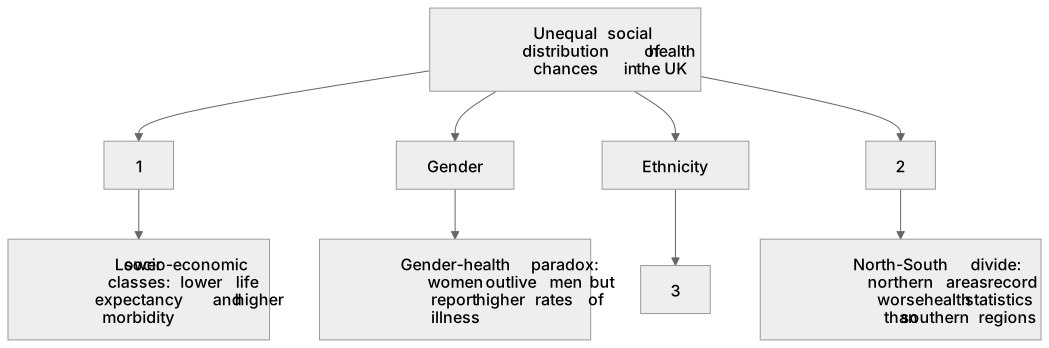
1Box 1
2Box 2
3Box 3
There is more to this lesson
The full lesson goes on to check your understanding and help you earn the marks. Create a free account to carry on, with your progress saved.
A week of Premium from your first lesson · Then the free plan continues · No card, no charge
Test your understanding of Health: the unequal social distribution of health chances in the United Kingdom by social class, gender, ethnicity and region
Active recall beats re-reading. Take an instant quiz now to test what you’ve learned and lock it into long-term memory.
A week of Premium from your first lesson · Then the free plan continues · No card, no charge