AQA · A-Level · Sociology
Course version: 7192 · Version from Sept 2015
The nature, extent and significance of patterns of social mobility.
Full specification wording
Stratification and Differentiation: the nature, extent and significance of patterns of social mobility.
Social mobility is the movement of individuals or groups between positions in a stratification system.
Checked against the AQA 7192 specification (opens in a new tab) on .
- Point 3 of 3
- 2 key terms
Study notes
From the checked teaching notes for this specification point.
The idea
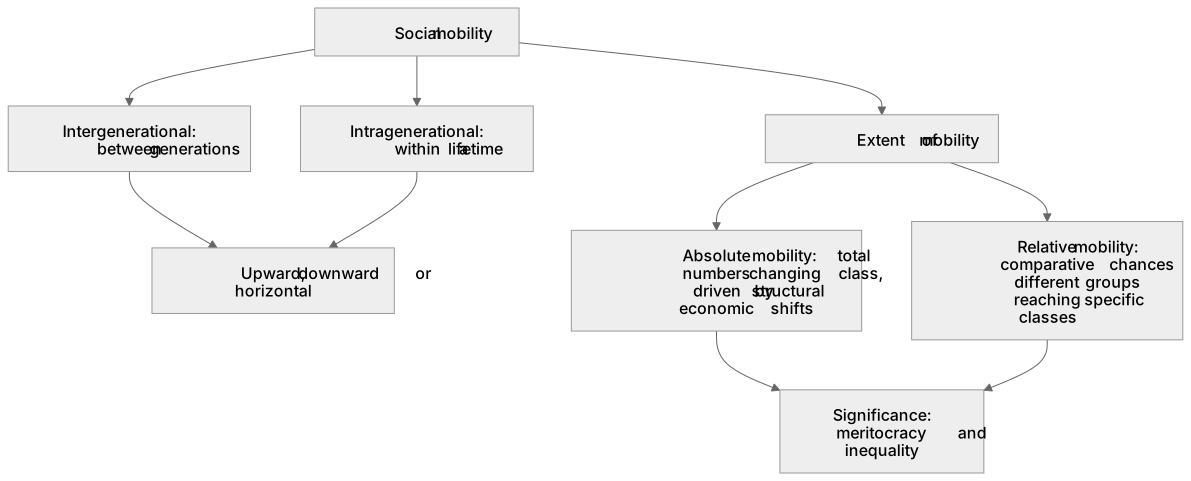
Social mobility is the movement of individuals or groups between positions in a stratification system. Its nature includes intergenerational (between generations) and intragenerational (within a lifetime) movement, which can be upward, downward, or horizontal. The extent of mobility is measured to assess how open a society is. Absolute mobility tracks total numbers changing class, often driven by structural economic shifts like the expansion of white-collar jobs. Relative mobility examines the comparative chances of different groups reaching specific classes. The significance of these patterns lies in what they reveal about meritocracy and inequality.
For example: Persistent barriers for working-class individuals accessing elite professions challenge functionalist claims of a purely meritocratic society, highlighting entrenched structural inequalities.
What earns the marks
- Define intergenerational mobility as movement between generations and intragenerational mobility as movement within an individual's working life.
- Distinguish between absolute mobility, which is driven by structural changes in the economy, and relative mobility, which measures comparative life chances.
- Identify key sociological research measuring the extent of mobility, such as the Oxford Mobility Study.
- Explain the significance of mobility patterns in evaluating whether a society is meritocratic or reproduces existing class inequalities.
- Recognise the difference between upward, downward, and horizontal social mobility in given scenarios.
Common mistakes and how to put them right
Confusing absolute and relative mobility.
Put it right: Absolute mobility refers to the total amount of movement due to changes in the occupational structure, whereas relative mobility refers to the comparative chances of individuals from different backgrounds reaching a particular class.
Assuming high absolute mobility means society is fully meritocratic.
Put it right: High absolute mobility can occur due to economic restructuring, such as the creation of more middle-class jobs, without improving the relative chances of working-class individuals compared to their middle-class peers.
Using intergenerational and intragenerational mobility interchangeably.
Put it right: Intergenerational compares a person's class to their parents' class, while intragenerational tracks a person's class changes over their own working life.
Exam tips
- When evaluating the significance of mobility, use relative mobility data to critique functionalist views of meritocracy.
- Be prepared to interpret data or scenarios describing changes in occupational structures to identify examples of absolute mobility.
- Link patterns of social mobility to broader themes of stratification, such as educational achievement and the reproduction of class inequality.
Try the lesson
The start of the Stratification and Differentiation: the nature, extent and significance of patterns of social mobility. lesson, made from checked teaching notes for this specification point.
Have a go first
Which of the following best describes the nature of intergenerational social mobility?
Listen
Social mobility is the movement of individuals or groups between positions in a stratification system. Its nature includes intergenerational (between generations) and intragenerational (within a lifetime) movement, which can be upward, downward, or horizontal. The extent of mobility is measured to assess how open a society is. Absolute mobility tracks total numbers changing class, often driven by structural economic shifts like the expansion of white-collar jobs. Relative mobility examines the comparative chances of different groups reaching specific classes. The significance of these patterns lies in what they reveal about meritocracy and inequality. For example, persistent barriers for working-class individuals accessing elite professions challenge functionalist claims of a purely meritocratic society, highlighting entrenched structural inequalities. A strong answer earns marks for these points. Define intergenerational mobility as movement between generations and intragenerational mobility as movement within an individual's working life. Distinguish between absolute mobility, which is driven by structural changes in the economy, and relative mobility, which measures comparative life chances. Identify key sociological research measuring the extent of mobility, such as the Oxford Mobility Study. Explain the significance of mobility patterns in evaluating whether a society is meritocratic or reproduces existing class inequalities. A common slip: Confusing absolute and relative mobility. Instead, Absolute mobility refers to the total amount of movement due to changes in the occupational structure, whereas relative mobility refers to the comparative chances of individuals from different backgrounds reaching a particular class. Exam tip: When evaluating the significance of mobility, use relative mobility data to critique functionalist views of meritocracy.
See it
Key words
Say what each word means before you turn the card.
Social mobility
Try answering aloud or in your head before turning the card.
Absolute mobility
Try answering aloud or in your head before turning the card.
See every definition
- Social mobility
- The movement of individuals or groups between positions in a stratification system.
- Absolute mobility
- Total numbers changing class, often driven by structural economic shifts like the expansion of white-collar jobs.
Label the diagram
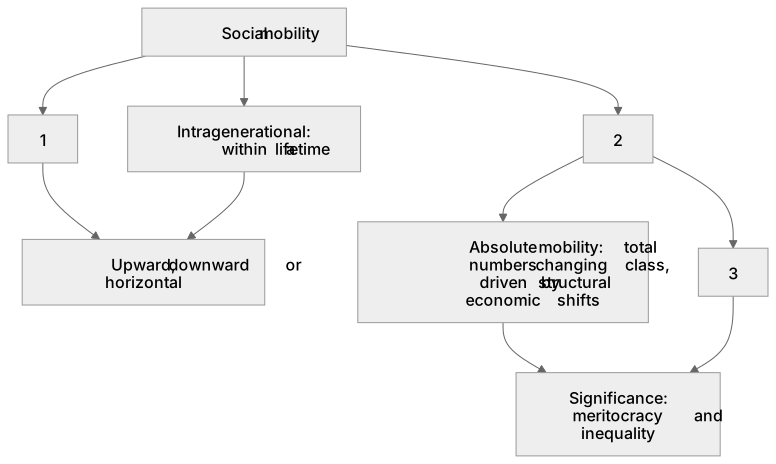
Some boxes have lost their names. Pick the right name for each number.
1Box 1
2Box 2
3Box 3
There is more to this lesson
The full lesson goes on to check your understanding and help you earn the marks. Create a free account to carry on, with your progress saved.
A week of Premium from your first lesson · Then the free plan continues · No card, no charge
Test your understanding of Stratification and Differentiation: the nature, extent and significance of patterns of social mobility.
Active recall beats re-reading. Take an instant quiz now to test what you’ve learned and lock it into long-term memory.
A week of Premium from your first lesson · Then the free plan continues · No card, no charge